Ch2 Syntax Definition
文法的定义:Definition of Grammars
定义
-
Grammar: a Set of Rules to Describe a Language.
-
Language: a Sorted Set of Strings over some fixed Alphabet.
-
关系:Grammar Abstracts the Language to Cover All Its Strings. (文法是对语言的抽象,覆盖了语言的所有字符串)
-
∅: Empty Language (Set of Strings)
-
𝜺: Empty String (Set of Symbols)
组成
-
Grammar G[S] = (VN, VT, P, S)
-
VT: A set of Terminal Symbols (终结符)
- Atomic: 基本符号,不可再分
-
VN : A set of Non-terminals (非终结符)
- A Non-terminal: a set of strings of Terminals
-
P: A set of Productions (生成式、规则)
- A Non-terminal, an Arrow, a sequence of Terminals and/or Non-terminals
-
S: A Start Symbol (开始符)
- A Non-terminal
-
推导:Derivations
定义
-
A Grammar derives strings by beginning with the Start Symbol and repeatedly replacing a Non-terminal with Terminals via its Productions. (文法通过从开始符开始,反复用生成式将非终结符替换为终结符来派生字符串)
-
推导(Derivation):反复根据生成规则用终结符替换非终结符
-
归约(Reduction):推导的反过程
-
语法分析(Syntax Analysis, Parsing)
-
given a sequence of Terminals, figure out Whether it can be Derived from the Grammar and How if possible. (给定一个终结符序列,判断它是否可以由文法推导而来,如果可以,推导过程是什么)
-
一个语言可能有多个文法描述,而一个文法只会派生一个唯一语言
文法的二义性:Ambiguity
定义
-
语法树(Parse Tree): A Graphical Representation of a Derivation without the Order of Applying Productions. (语法树是一个图形表示,表示了一个推导过程,但不考虑生成式应用的顺序)
-
二义性(Ambiguity): When Parsing, given a sequence of Terminals, a Grammar is Ambiguous if there are more than one Parse Tree for the Derivation.(二义性是指一个文法可以产生多棵语法树)
Fix the Grammar
-
Example:
-
stmt -> if expr then stmt | if expr then stmt else stmt | other
-
if E1 then if E2 then S1 else S2
-
-
Match each else with the closest unmatched then
-
the statement appearing between a then and an else must be “matched”
-
the interior statement must not end with an unmatched (open) then
-
-
Listing All Cases then Tidying Them Up
-
if expr then matched_stmt
-
if expr then open_stmt
-
if expr then matched_stmt else matched_stmt
-
if expr then matched_stmt else open_stmt
-
so that:
-
matched_stmt -> if expr then matched_stmt else matched_stmt | other
-
open_stmt -> if expr then matched_stmt | if expr then open_stmt | if expr then matched_stmt else open_stm
-
-
finally:
-
stmt -> matched_stmt | open_stmt
-
matched_stmt -> if expr then matched_stmt else matched_stmt | other
-
open_stmt -> if expr then stmt | if expr then matched_stmt else open_stmt
-
-
文法和语言的分类:Classes of Languages
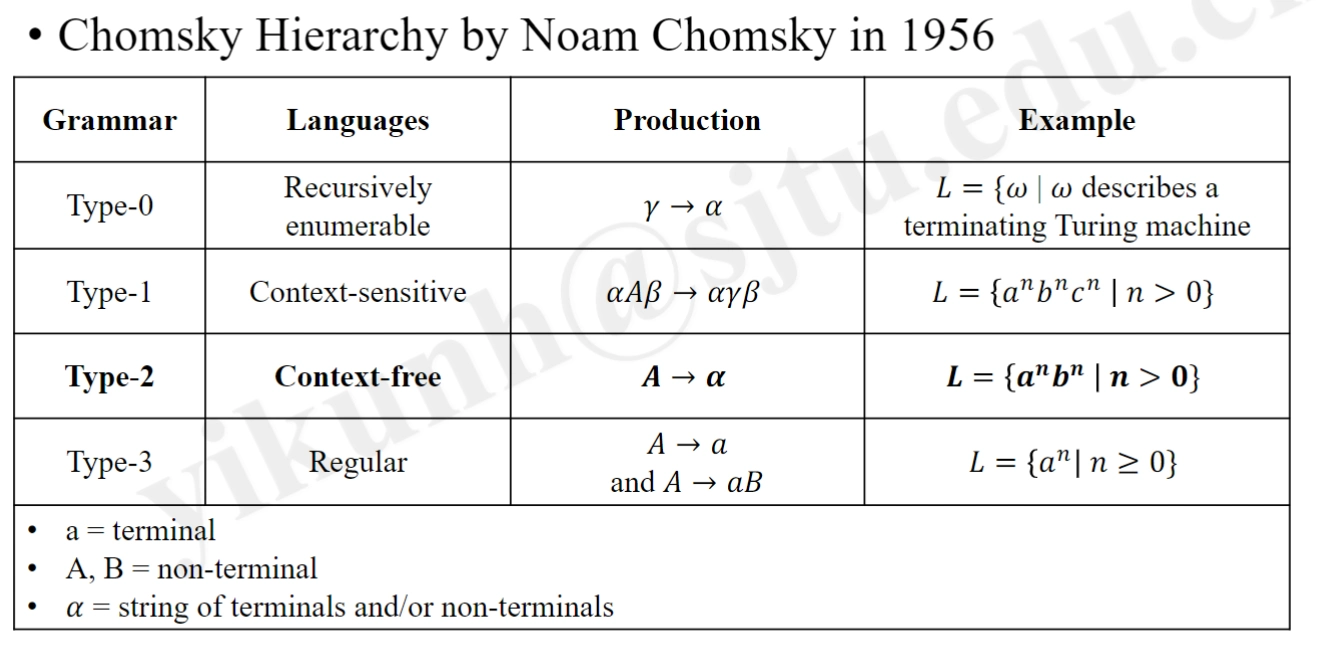
- 范围由 Type 0 到 Type 3 逐渐缩小