顺序算法──图算法
最小生成树 (Minimum Spanning Trees)
最小生成树概述
-
应用
-
Telecommunications networks(电信网络)
-
Computer networks(计算机网络)
-
Electronic circuit designs(电子电路设计)
-
Others
-
基本定义
-
A connected, undirected graph \(G(V,E)\), where \(V\) is the set of nodes and \(E\) is the set of possible interconnections between pairs of nodes(一个连通的无向图 \(G(V,E)\),\(V\) 是节点集合,\(E\) 是节点对之间可能的连接集合)
- \(E\) can be an adjacency list or an adjacency matrix( \(E\) 可以是邻接表或邻接矩阵)
-
For each edge \((u, v) \in E\), a weight \(w(u, v)\) specifies the cost to connect \(u\) and \(v\) (distance, amount of wires, etc.)(对于每条边 \((u, v) \in E\), 权重 \(w(u, v)\) 指定连接 \(u\) 和 \(v\) 的成本)
-
Goal: Find an acyclic subset \(T \subseteq E\) that connects all of the vertices and whose total weight \(w(T)\) is minimized(寻找一个无环子集 \(T \subseteq E\) ,连接所有顶点且总权重最小)
\[ w (T) = \sum_ {(u, v) \in T} w (u, v) \] -
\(T\) is acyclic and connects all of the vertices(\(T\) 无环且连接所有顶点)
-
\(T\) must form a tree (a spanning tree)(\(T\) 必须形成一棵树(生成树))
-
\(T\) has \(|V|-1\) edges(\(T\) 有 \(|V|-1\) 条边)
-
-
示例:
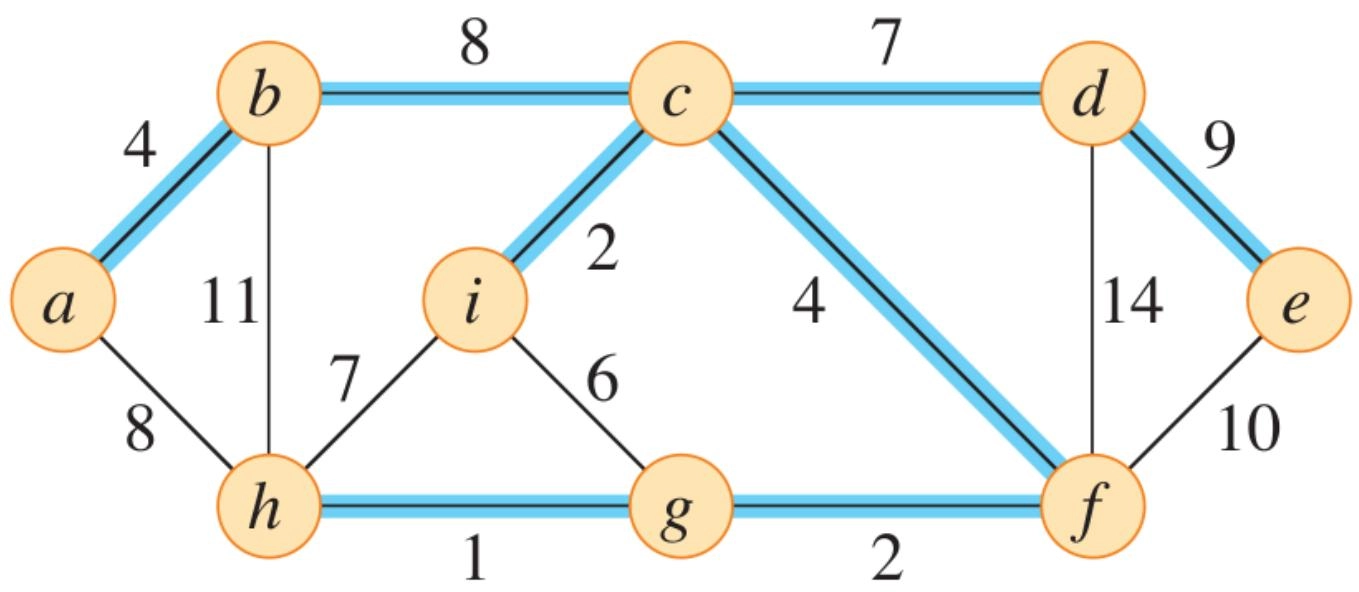
最小生成树通用算法 (MST Generic Method)
-
Greedy
-
Intuition: grows the minimum spanning tree one edge at a time(直觉:每次增长最小生成树的一条边)
-
select edges based on their weights and handle cycles(根据权重选择边并处理环)
-
-
通用算法:
GENERIC-MST(G, w) A = ∅ # 初始化边集A为空 while A does not form a spanning tree find an edge (u, v) that is safe for A A = A ∪ {(u, v)} return A -
How do you find a safe edge?
-
An edge \((u, v)\) is safe for a set \(A\) of edges if \(A \cup \{(u, v)\}\) is also a subset of some minimum spanning tree(如果 \(A \cup \{(u, v)\}\) 也是某个最小生成树的子集,则边 \((u, v)\) 对于边集 \(A\) 是安全的)
-
To find a safe edge, we use the cut property of minimum spanning trees(为了找到一条安全边,我们使用最小生成树的割属性)
-
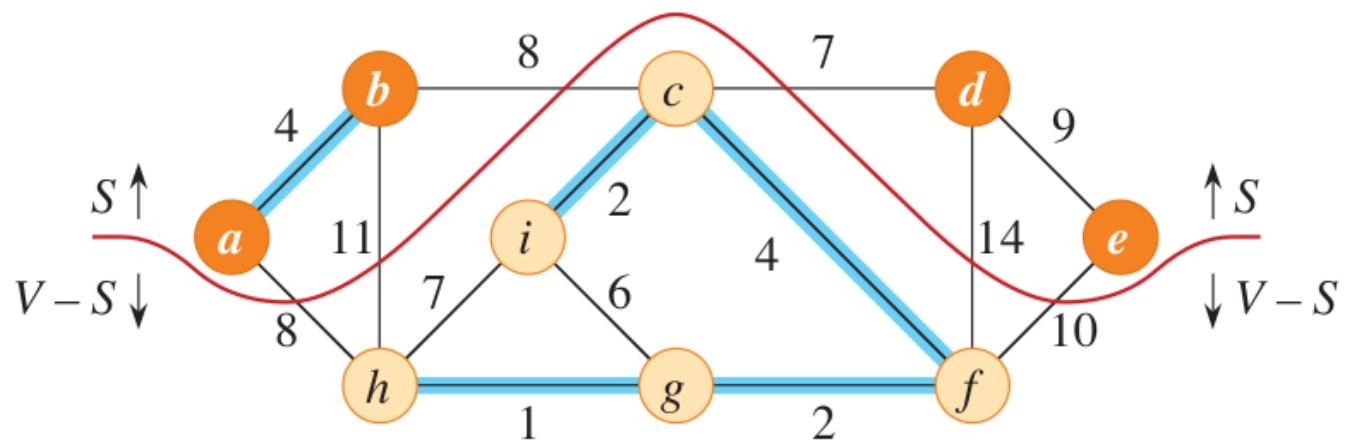
安全边定理
-
基本定义
-
A cut \((S, V - S)\) of an undirected graph \(G(V, E)\) is a partition of \(V\)(无向图 \(G(V, E)\) 的割 \((S, V - S)\) 是 \(V\) 的一个划分)
-
An edge \((u, v) \in E\) crosses the cut \((S, V - S)\) if one of its endpoints belongs to \(S\) and the other belongs to \(V - S\)(如果边 \((u, v) \in E\) 的两个端点分别属于 \(S\) 和 \(V - S\) ,则该边跨越割 \((S, V - S)\))
-
A cut respects a set \(A\) of edges if no edge in \(A\) crosses the cut(如果 \(A\) 中没有边跨越该割,则称该割尊重边集 \(A\) )
-
An edge is a light edge crossing a cut if its weight is the minimum of any edge crossing the cut(如果一条边的权重是跨越该割的任何边的最小值,则该边是跨越该割的轻边)
-
-
安全边定理:Edge \((u,v)\) is safe for \(A\) if,
-
Let \(G(V, E)\) be a connected, undirected graph with a real-valued weight function \(w\) defined on \(E\) ;(设 \(G(V, E)\) 是一个连通的无向图,实值权重函数 \(w\) 定义在 \(E\) 上)
-
let \(A\) be a subset of \(E\) that is included in some minimum spanning tree for \(G\) ;(设 \(A\) 是 \(E\) 的一个子集,包含在 \(G\) 的某个最小生成树中)
-
let \((S,V - S)\) be any cut of \(G\) that respects \(A\) ;(设 \((S,V - S)\) 是 \(G\) 的任意尊重 \(A\) 的割)
-
let \((u, v)\) be a light edge crossing \((S, V - S)\),(令 \((u, v)\) 是跨越 \((S, V - S)\) 的轻边)
-
-
证明:
-
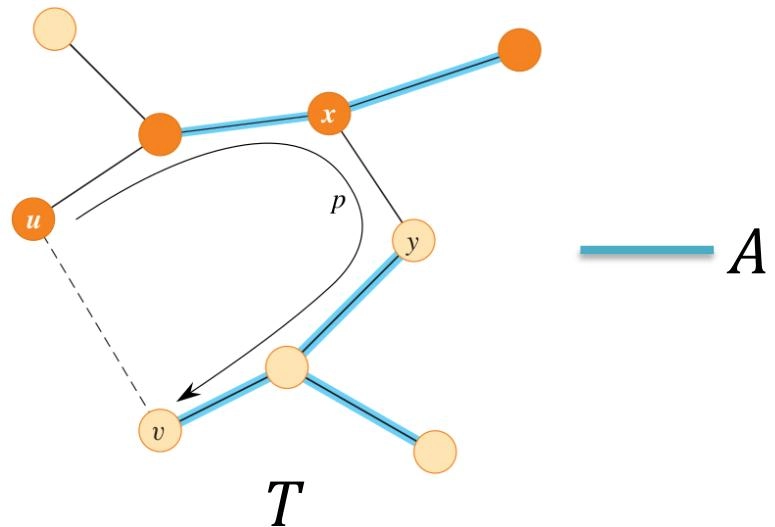
Assume \(T\) is a minimum spanning tree (MST) that includes \(A\) and \((u, v) \notin T\),(假设 \(T\) 是包含 \(A\) 的最小生成树,且 \((u, v) \notin T\)。)
-
We now construct another MST \(T^\prime\) that includes \(A \cup \{(u, v)\}\)(我们现在构造另一个包含 \(A \cup \{(u, v)\}\) 的最小生成树 \(T^\prime\)。)
-
At least one edge \((x, y)\) in \(T\) in the path \(p\) crosses the cut \((S, V - S)\)(在路径 \(p\) 中,\(T\) 中至少有一条边 \((x, y)\) 跨越割 \((S, V - S)\))
-
\(T^{\prime} = (T - \{(x,y)\})\cup \{(u,v)\}\)
-
Since \(w(u,v)\leq w(x,y)\), we have \(w(T^{\prime}) \leq w(T)\)(由于 \(w(u,v)\leq w(x,y)\) ,我们有 \(w(T^{\prime}) \leq w(T)\) )
-
Since \(T\) is a minimum spanning tree, we have \(w(T^{\prime}) = w(T)\)(由于 \(T\) 是最小生成树,我们有 \(w(T^{\prime}) = w(T)\) )
-
Thus, \(T^{\prime}\) is also a minimum spanning tree that contains \(A \cup \{(u, v)\}\)(因此,\(T^{\prime}\) 也是最小生成树,且包含 \(A \cup \{(u, v)\}\))
-
-
Prim 算法
概述
-
概述:
-
The edges in the set \(A\) always form a single tree(边集 \(A\) 总是形成一棵单一的树)
-
The tree starts from an arbitrary root vertex \(r\) and grows until it spans all the vertices in \(V\)(树从任意根节点 \(r\) 开始生长,直到覆盖 \(V\) 中的所有顶点)
-
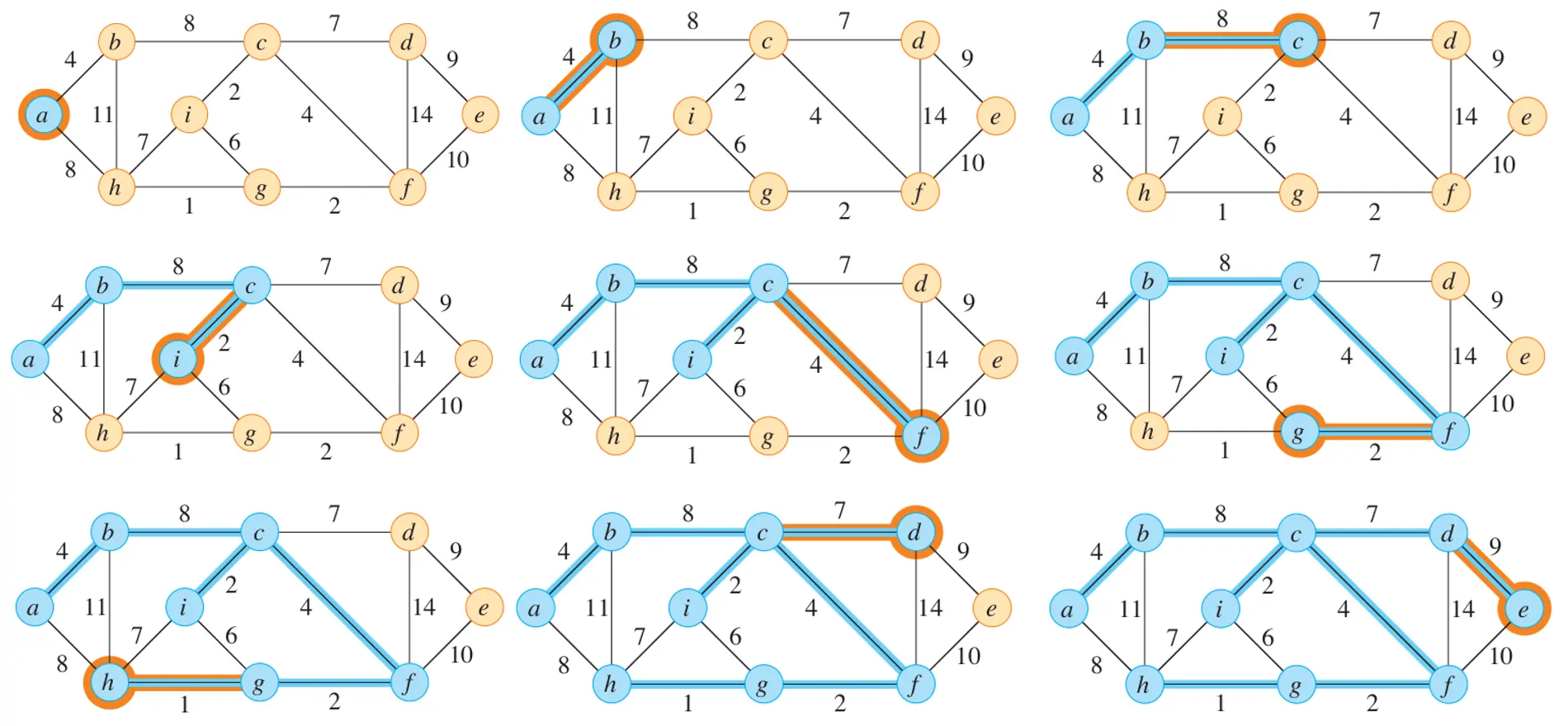
Each step adds to the tree \(A\) an edge that connects \(A\) to an isolated vertex with the minimum weight(每一步向树 \(A\) 添加一条具有最小权重的边,将 \(A\) 连接到孤立顶点)
- This rule adds only edges that are safe for \(A\) (该规则仅添加对 \(A\) 安全的边)
-
-
A greedy algorithm
-
示例:
-
Maintain a min-priority queue \(Q\) of all vertices that are not in the tree(维护一个包含所有不在树中的顶点的最小优先队列 \(Q\) )
- The minimum weight of any edge connecting \(v\) to a vertex in the tree(连接 \(v\) 到树中顶点的任何边的最小权重)
算法伪代码
MST_PRIM(G, w, r)                          // Prim 最小生成树算法
    for each u in G.V                      // 初始化所有顶点
        u.key = ∞
        u.parent = NIL
    r.key = 0
    Q = ∅
    for each u in G.V
        INSERT(Q, u)
    while Q is not empty
        u = EXTRACT-MIN(Q)                // 从优先队列中提取最小 key 的顶点 u
        for each v in G.Adj[u]            // 遍历 u 的所有邻接顶点 v
            if v in Q and w(u, v) < v.key   // 如果 v 在队列中且边 (u, v) 的权重小于 v 的当前 key
                v.parent = u                // 更新 v 的父节点为 u
                v.key = w(u, v)          // 更新 v 的 key 为边 (u, v) 的权重
                DECREASE-KEY(Q, v, v.key)   // 按 key 下降更新优先队列 Q 中顶点 v 的位置
最小/最大优先队列 (Min/Max-Priority Queue)
定义
-
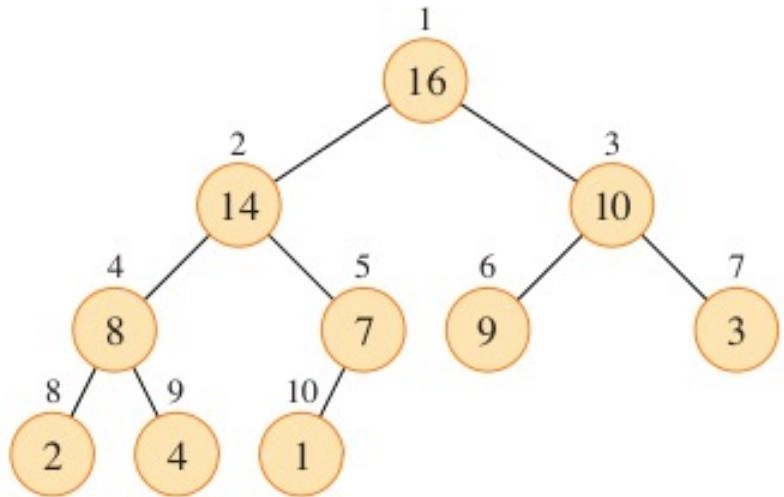
(Binary) heap: a nearly complete binary tree(二叉堆:一个近似完全二叉树)
-
The value of a node is at most (at least) the value of its parent(节点的值小于等于(大于等于)其父节点的值)
算法伪代码
Basic Heap Operations
PARENT(i)
    return floor(i / 2)              // 返回节点 i 的父节点索引
LEFT(i)
    return 2 * i                        // 返回节点 i 的左子节点索引
RIGHT(i)
    return 2 * i + 1                    // 返回节点 i 的右子节点索引
Max-Heap Operations
MAX-HEAP-MAXIMUM(A)                  // 返回堆中的最大元素
    if A.heap_size < 1
        error "heap underflow"
    return A[1]                      // 堆顶元素即为最大值
MAX-HEAPIFY(A, i)                      // 维护最大堆性质
    l = LEFT(i)                      // 获取左子节点索引
    r = RIGHT(i)                        // 获取右子节点索引
    if l <= A.heap_size and A[l] > A[i]
        largest = l                  // 左子节点较大
    else
        largest = i                  // 当前节点较大
    if r <= A.heap_size and A[r] > A[largest]
        largest = r                  // 右子节点较大
    if largest != i
        exchange A[i] with A[largest]   // 交换当前节点与较大子节点
        MAX-HEAPIFY(A, largest)      // 递归调整子树
MAX-HEAP-EXTRACT-MAX(A)              // 从堆中提取并返回最大元素
    max = MAX-HEAP-MAXIMUM(A)          // 获取堆中的最大元素
    A[1] = A[A.heap_size]              // 用堆的最后一个元素替换堆顶
    A.heap_size = A.heap_size - 1      // 减小堆的大小
    MAX-HEAPIFY(A, 1)                  // 从堆顶开始调整堆
    return max                        // 返回最大值
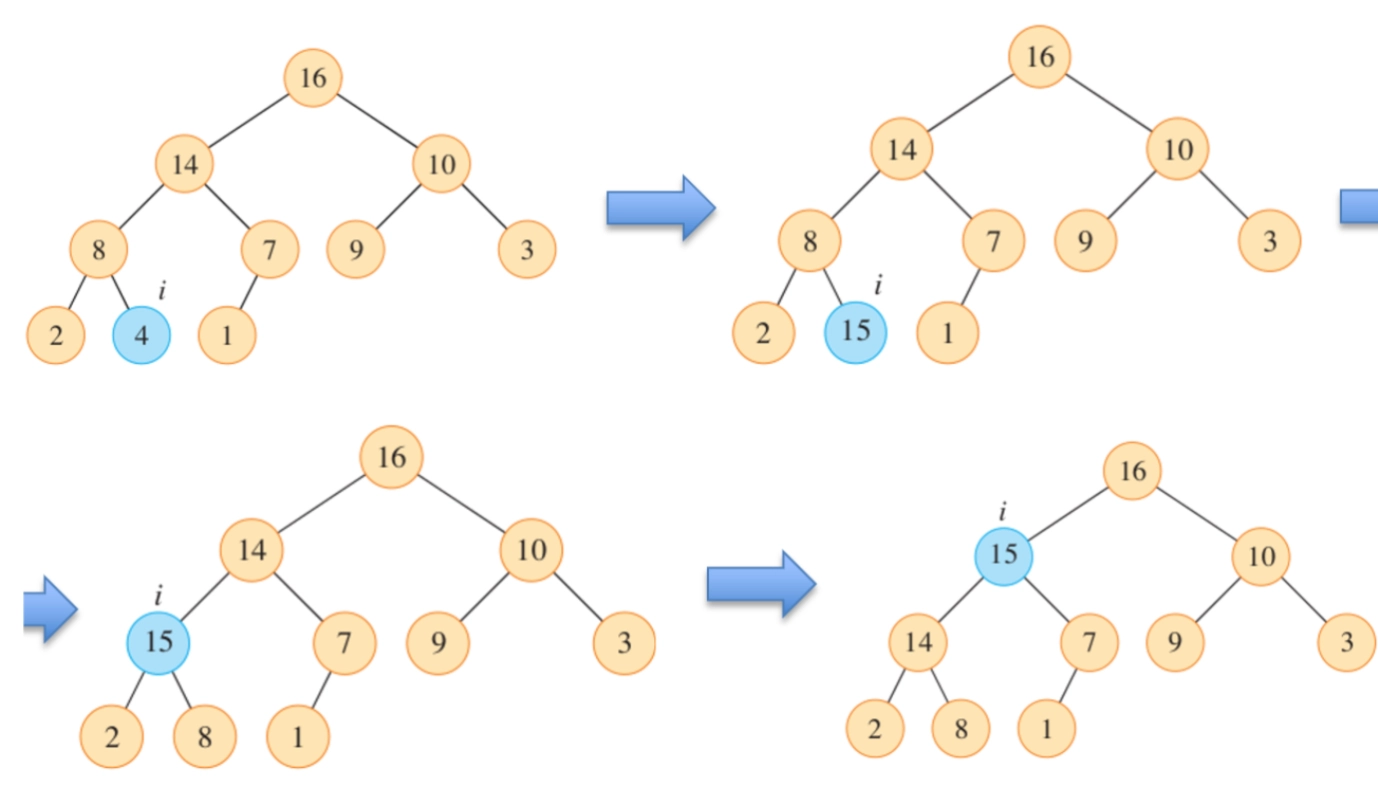
MAX-HEAP-INCREASE-KEY(A, x, k)        // 把堆中元素 x 的值增加到 k
    if k < A[x].key
        error "new key is smaller than current key"
    A[x].key = k                        // 更新元素 x 的值为 k
    while x > 1 and A[PARENT(x)].key < A[x].key // 向上调整堆
        exchange A[x] with A[PARENT(x)] // 交换当前节点与其父节点
        x = PARENT(x)                  // 移动到父节点位置
MAX-HEAP-INSERT(A, key)             // 向堆中插入新元素 key
    A.heap_size = A.heap_size + 1      // 增加堆的大小
    A[A.heap_size] = -∞              // 在堆的末尾插入一个极小值
    MAX-HEAP-INCREASE-KEY(A, A.heap_size, key) // 将新元素的值增加到 key
时间复杂度
-
The total time for Prim's algorithm is \(O(E \log V)\)
-
Initialization for all vertices: \(O(V)\)
-
EXTRACT-MINoperations: \(|V|\) times, \(O(V \log V)\) -
Update keys: \(O(E)\) times, \(O(E \log V)\)
-
Kruskal 算法
概述
-
概述
-
Initially, \(|V|\) trees in the forest(最初,森林中有 \(|V|\) 棵树)
-
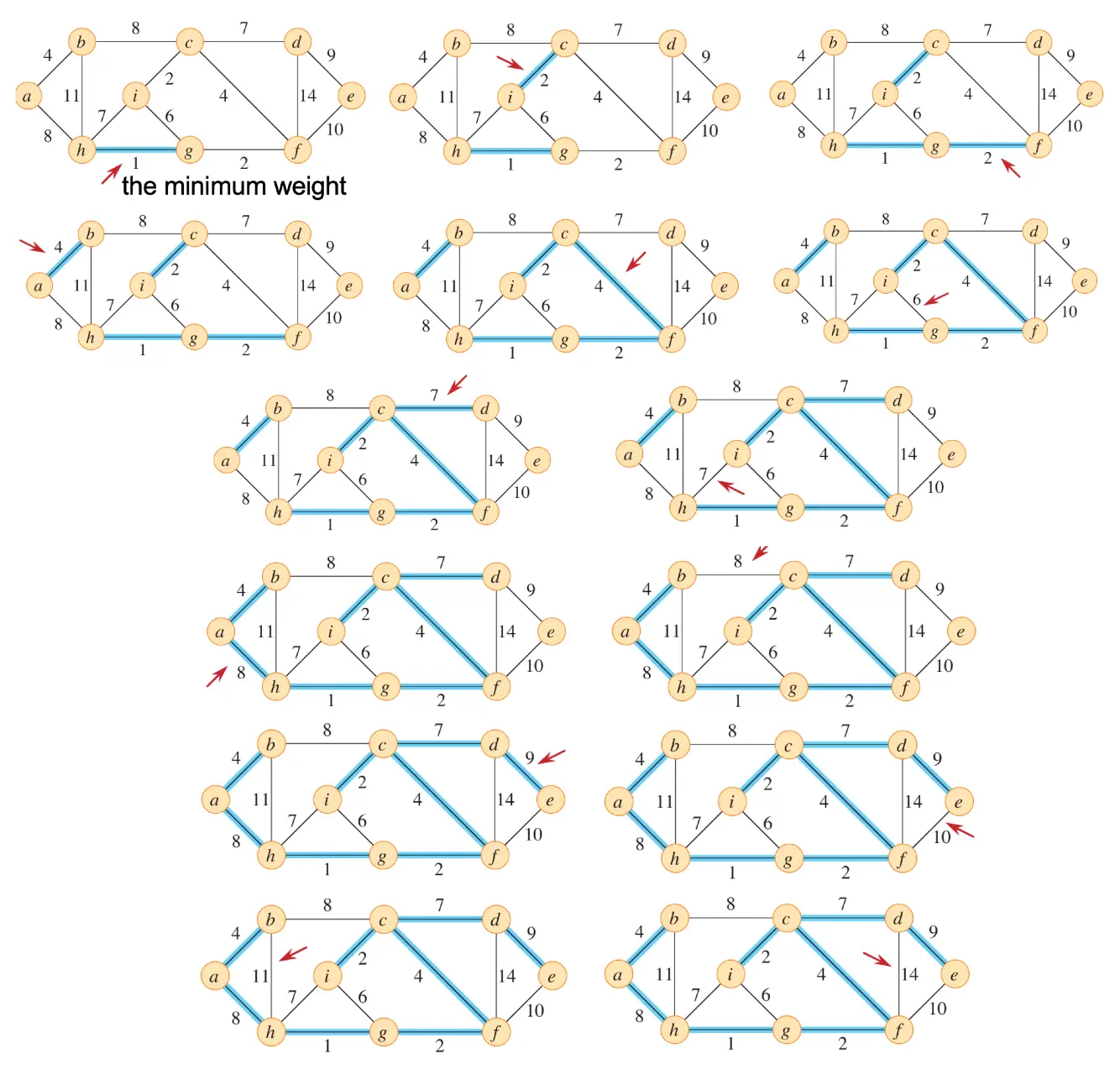
Find a safe edge to add by finding, of all the edges that connect any two trees in the forest, an edge \((u, v)\) with the minimum weight(通过在森林中连接任意两棵树的所有边中找到权重最小的边 \((u, v)\) 来找到一条安全边进行添加)
-
Repeat until there is only one tree(重复直到只有一棵树)
-
-
A greedy algorithm
-
示例
算法伪代码
MST_KRUSKAL(G, w)                              // Kruskal 最小生成树算法
    A = ∅                                     // 初始化边集 A 为空
    for each vertex v in G.V                    // 初始化每个顶点为单独的集合
        MAKE-SET(v)
    edges = all edges in G.E sorted by weight   // 按权重排序所有边
    for each edge (u, v) in edges              // 遍历排序后的边
        if FIND-SET(u) ≠ FIND-SET(v)            // 如果边 (u, v) 的两个端点属于不同集合
            A = A ∪ {(u, v)}                   // 将边 (u, v) 添加到边集 A 中
            UNION(u, v)                      // 合并两个集合
    return A                                    // 返回最小生成树的边集 A
不相交集数据结构 (Disjoint-set data structure)
-
Group \(n\) distinct elements into a collection of disjoint sets(将 \(n\) 个不同的元素分组为不相交的集合)
- with no elements in common(没有共同元素)
-
A collection of \(S = \{S_1, S_2, \ldots, S_n\}\) of disjoint dynamic sets(不相交动态集合的集合 \(S = \{S_1, S_2, \ldots, S_n\}\) )
-
To identify each set, choose a representative, which is some member of the set(为了识别每个集合,选择一个代表,它是集合中的某个成员)
- E.g., choosing the smallest member in the set(例如,选择集合中最小的成员)
-
Three operations:
-
MAKE-SET(x): creates a new set whose only member is \(x\)(创建一个新集合,其唯一成员是 \(x\) )- Also the representative(也是集合的代表)
-
UNION(x, y): unites two disjoint, dynamic sets that contain \(x\) and \(y\) into a new set that is the union of these two sets(联合包含 \(x\) 和 \(y\) 的两个不相交的动态集合,形成一个新的集合,该集合是这两个集合的并集) -
FIND-SET(x): returns a pointer to the representative of the unique set containing \(x\) (返回指向包含 \(x\) 的唯一集合的代表的指针)
-
-
There are \(n\)
MAKE-SEToperations and at most \(n - 1\)UNIONoperations(有 \(n\) 个 MAKE-SET 操作和最多 \(n - 1\) 个 UNION 操作)
不相交集森林 (Disjoint-set forests)
-
A fast implementation of disjoint sets represents sets by trees(不相交集的快速实现:通过树来表示集合)
-
Each tree represents one set(每棵树代表一个集合)
-
Each member points only to its parent(每个成员只指向其父节点)
-
The root contains the representative(根节点包含代表)
-
-
Heuristic #1: union by rank(启发式方法#1:按秩联合)
-
Rank: an upper bound on the height of the node(秩:节点高度的上限)
-
The root with smaller rank points to the root with larger rank(较小秩的根指向较大秩的根)
-
-
Heuristic #2: path compression(启发式方法#2:路径压缩)
- The
FIND-SETprocedure updates each node to point directly to the root(FIND-SET 过程更新每个节点以直接指向根节点)
- The
算法伪代码
Union by Rank
UNION(x, y)                      // 合并包含 x 和 y 的两个集合
    LINK(FIND-SET(x), FIND-SET(y))

LINK(x, y)                        // 按秩联合两个集合的根节点 x 和 y
    if x.rank > y.rank            // 如果 x 的秩大于 y 的秩
        y.p = x                  // y 指向 x
    else:
        x.p = y                  // 反之 x 指向 y,并更新秩
        if x.rank == y.rank
            y.rank = y.rank + 1
UNION(c, f)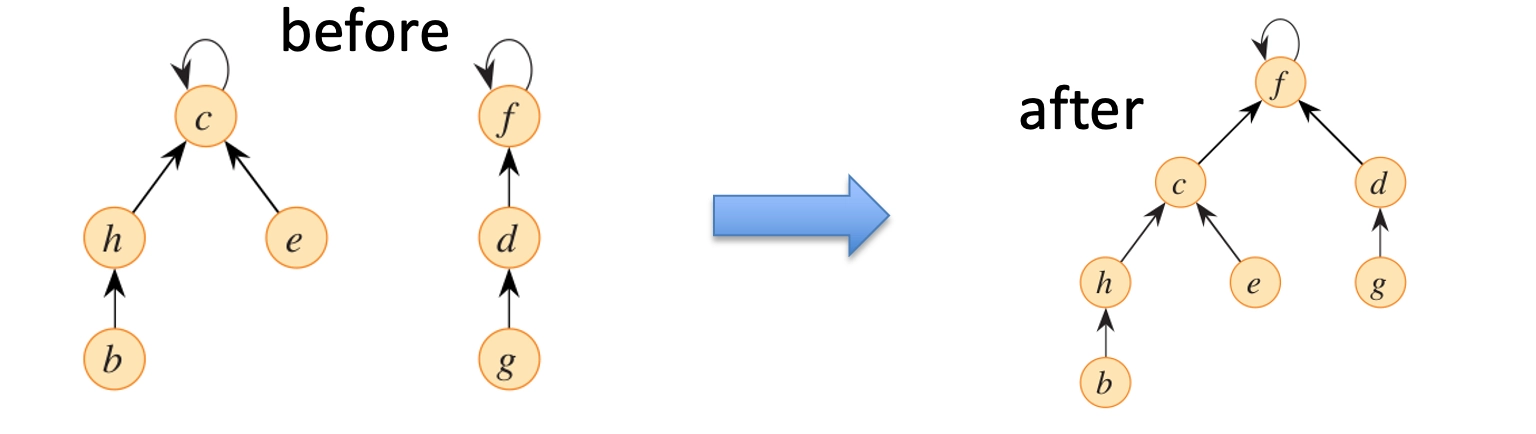
Path Compression
MAKE-SET(x)                  // 创建一个新集合,包含唯一成员 x
    x.p = x
    x.rank = 0                // 初始化秩为 0

FIND-SET(x)
    if x != x.p              // 如果 x 不是根节点
        x.p = FIND-SET(x.p)  // 更新父节点为树的根节点
    return x.p                // 返回集合的代表:根节点
FIND-SET(a)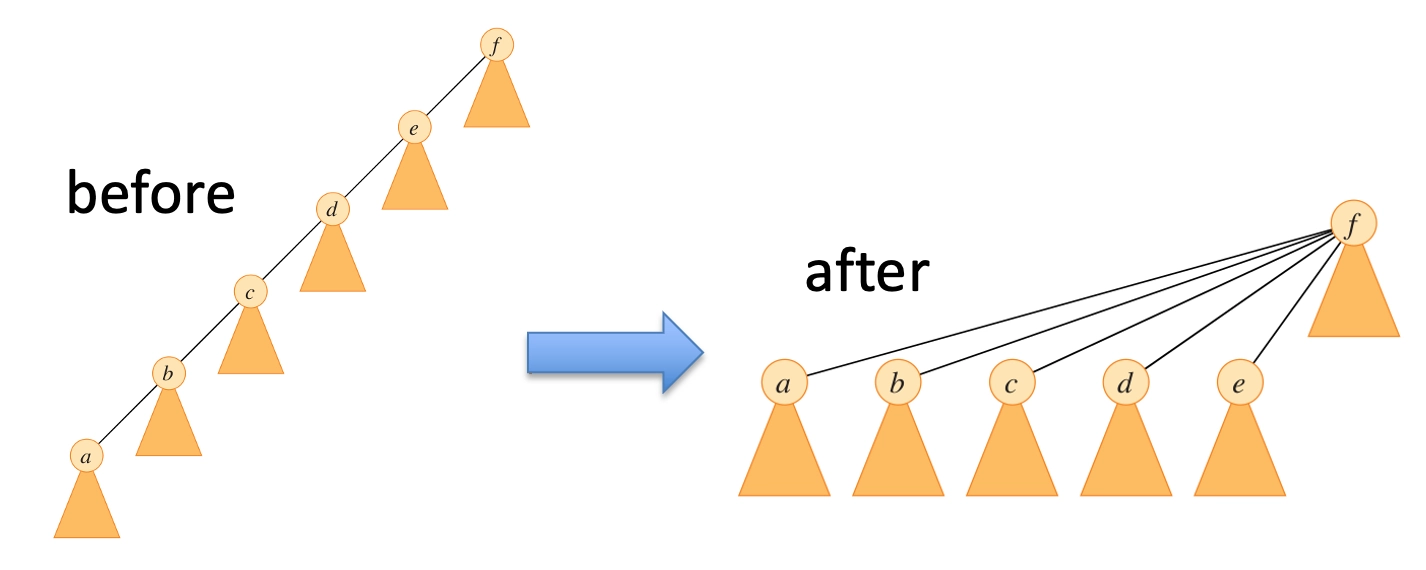
时间复杂度
-
The worst-case running time of the disjoint-set-forest: \(O(m\alpha(n))\)
-
\(n\) is the number of elements(元素数量)
-
\(m\) is the total number of operations(操作总数)
-
\(\alpha (n)\) is a very slowly growing function(增长极慢的反阿克曼函数)
-
\(\alpha (n)\leq 4\) for all practical purposes(在所有实际应用中,\(\alpha (n)\) 不超过 4)
-
时间复杂度
-
The running time of Kruskal's algorithm: \(O(E \log V)\)
-
MAKE-SEToperations: \(O(V)\) -
Sorting: \(O(E \log E) = O(E \log V)\)
-
FIND-SEToperations: \(O(E)\) -
UNIONoperations: \(O(V)\) -
The worst-case running time of the disjoint-set-forest: \(O\big ((E + V) \alpha (V) \big)\)
-
最短路径 (Shortest Paths)
最短路径概述
-
应用
-
Road networks(道路网络)
-
Logistics(物流)
-
Communications(通信)
-
Others
-
-
分类
-
Single-source shortest-paths problem(单源最短路径问题)
-
Single-destination shortest-paths problem(单目的地最短路径问题)
- reversing the direction of each edge in the graph(通过反转图中每条边的方向,将其转换为单源最短路径问题)
-
Single-pair shortest-path problem(单对最短路径问题)
- a part of the single-source shortest-paths problem(单源最短路径问题的一部分)
-
All-pairs shortest-paths problem(全源最短路径问题)
-
基本定义
-
A weighted, directed graph \(G(V,E)\)(加权有向图)
-
For each edge \((u, v) \in E\), a weight \(w(u, v)\) specifies the cost to connect \(u\) and \(v\)
- \(w \colon E \to \mathbb{R}\) mapping edges to real-valued weights(将边映射到实值权重)
-
The weight \(w(p)\) of path \(p = \langle v_0, v_1, \dots, v_k \rangle\) is the sum of the weights of its constituent edges(路径的权重是其组成边的权重之和)
\[ w (p) = \sum_{1}^{k} w(v_{i - 1}, v_{i}) \] -
The shortest-path weight from \(u\) to \(v\) is(从 \(u\) 到 \(v\) 的最短路径权重是)
\[ \delta (u, v) = \left\{ \begin{array}{ll} \min \{w (p) \colon u \xrightarrow {p} v \} & \exists~p: u \xrightarrow {p} v \\ \infty & \text{otherwise} \end{array} \right. \] -
A shortest path from vertex \(u\) to vertex \(v\) is then defined as any path \(p\) with weight \(w(p) = \delta(u, v)\)(从顶点 \(u\) 到顶点 \(v\) 的最短路径被定义为权重为 \(w(p) = \delta(u, v)\) 的任何路径 \(p\) )
负权边与负权环 (Negative-weight edges and cycles)
-
A graph is well-defined if no negative-weight cycle reachable from the source \(s\) exists(如果不存在从源 \(s\) 可达的负权环,则图是良定义的)
- Not well-defined \(\rightarrow \delta (u,v) = -\infty\)
-
Any shortest path contains at most \(|V| - 1\) edges(任何最短路径最多包含 \(|V| - 1\) 条边)
- No positive-weight cycle
Dijkstra 算法
-
Solves the single-source shortest-paths problem for a graph with nonnegative edge weights(解决具有非负边权的图的单源最短路径问题)
-
a Greedy algorithm(贪心算法)
最优子结构
-
Let \(p = \langle v_0, v_1, \dots, v_k \rangle\) be a shortest path from vertex \(v_0\) to vertex \(v_k\),(设 \(p\) 是从顶点 \(v_0\) 到顶点 \(v_k\) 的最短路径)
-
For any \(i\) and \(j\) such that \(0 \leq i \leq j \leq k\), let \(p_{ij} = \left\langle v_i, v_{i+1}, \ldots, v_j \right\rangle\) be the subpath of \(p\) from vertex \(v_i\) to vertex \(v_j\)(对于 \(0 \leq i \leq j \leq k\) 的任何 \(i\) 和 \(j\) ,设 \(p_{ij}\) 是从顶点 \(v_i\) 到顶点 \(v_j\) 的子路径)
-
Then \(p_{ij}\) is a shortest path from \(v_i\) to \(v_j\),(则 \(p_{ij}\) 是从 \(v_i\) 到 \(v_j\) 的最短路径)
松弛 (Relaxation)
-
Relaxation is the process of continually decreasing the shortest-path estimates by finding better paths(松弛是通过寻找更好的路径不断降低最短路径估计值的过程)
-
Attribute \(v.d\) : a shortest-path estimate(属性 \(v.d\) :最短路径估计值)
- An upper bound on the weight of a shortest path to \(v\)(到 \(v\) 的最短路径权重的上限)
-
Attribute \(v.\pi\): a predecessor(属性 \(v.\pi\) :前驱)
- The chain of predecessors runs backward along a shortest path(前驱链沿着最短路径向后运行)
-
The process of relaxing an edge \((u, v)\) consists of testing whether going through vertex \(u\) improves the shortest path to vertex \(v\)(松弛边 \((u, v)\) 的过程包括测试通过顶点 \(u\) 是否改善了到顶点 \(v\) 的最短路径)
-
算法伪代码:
INITIALIZE-SINGLE-SOURCE(G, s)  // 单源初始化
    for each vertex v in G.V
        v.d = ∞
        v.pi = NIL
    s.d = 0

RELAX(u, v, w)                // 松弛操作,u 是起点,v 是终点,w 是权重函数
    if v.d > u.d + w(u, v)
        v.d = u.d + w(u, v)
        v.pi = u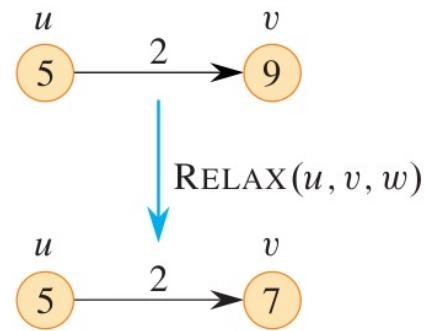
基本思路
-
Assume nonnegative weights on all edges(假设所有边的权重均为非负)
\[ \forall (u,v) \in E, w(u,v) \geq 0 \] -
Generalizing breadth-first search (BFS) to weighted graphs(将 BFS 泛化为加权图)
-
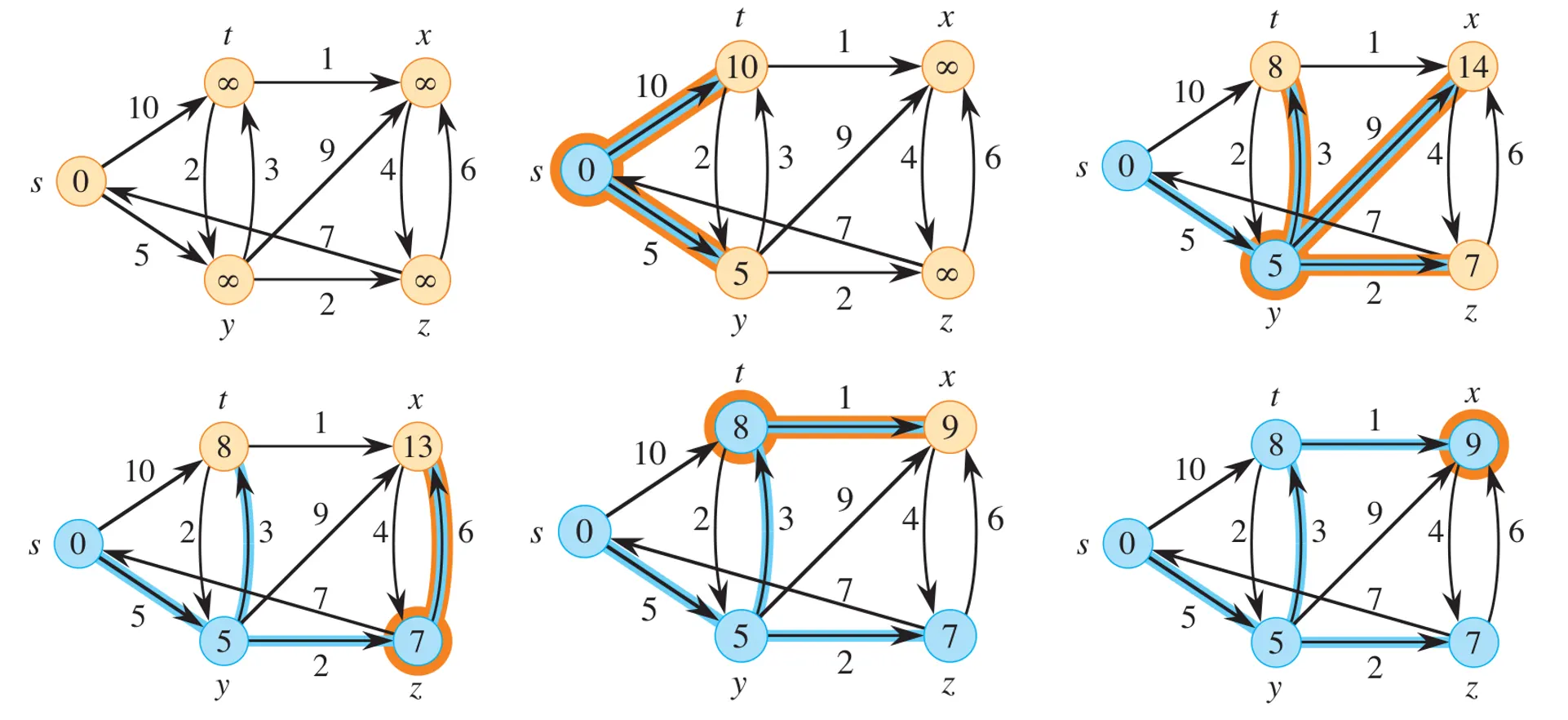
The algorithm maintains a set of vertices \(S\), whose final shortest-path weights have already been determined(该算法维护一个顶点集 \(S\) ,其最终最短路径权重已确定)
-
主要步骤
-
Selects the vertex \(u \in V - S\) with the minimum shortest-path estimate(从 \(V - S\) 中选择具有最小最短路径估计值的顶点 \(u\))
-
Using a min-priority queue \(Q\) instead of a FIFO queue(使用最小优先队列 \(Q\) 代替 FIFO 队列)
-
The key of each vertex \(v\) in \(Q\) is the shortest-path estimate \(v.d\) (队列中每个顶点 \(v\) 的键是最短路径估计值 \(v.d\) )
-
-
Relaxes all edges leaving \(u\)(松弛 \(u\) 的所有出边)
-
Repeat the above procedure \(|V|\) times(重复上述过程 \(|V|\) 次)
-
算法伪代码
DIJKSTRA(G, w, s)                      // G 是图,w 是权重函数,s 是源顶点
    INITIALIZE-SINGLE-SOURCE(G, s)
    S = ∅                              // 已确定最短路径权重的顶点集
    Q = ∅                              // 最小优先队列
    for each vertex v in G.V            // 将所有顶点插入最小优先队列 Q
        INSERT(Q, v)
    while Q ≠ ∅
        u = EXTRACT-MIN(Q)            // 从 Q 中提取具有最小 d 值的顶点 u
        S = S ∪ {u}                  // 将 u 添加到 S 中
        for each vertex v in Adj[u]  // 松弛 u 的所有出边
            RELAX(u, v, w)
    return
正确性
-
每次从未确定最短路径的顶点集合中选出 \(d\) 最小的顶点 \(u\),而一旦 \(u\) 被取出,就认为 \(u.d\) 已经是最短距离,不再更新。
-
我们要证明:这个“一旦取出就确定”的做法是正确的。
收敛性质
-
Convergence property: if \(s \xrightarrow{p} x \to y\) is a shortest path for some \(x, y \in V\), and if \(x.d = \delta(s, x)\) at any time prior to relaxing edge \((x, y)\), then \(y.d = \delta(s, y)\) at all times afterward(收敛性质:如果 \(s \xrightarrow{p} x \to y\) 是某些 \(x, y \in V\) 的最短路径,并且如果在松弛边 \((x, y)\) 之前的任何时间 \(x.d = \delta(s, x)\) ,那么在之后的所有时间 \(y.d = \delta(s, y)\) )
-
after relaxing edge \((x, y)\), we have \(y.d \leq x.d + w(x,y) = \delta(s,x) + w(x,y) = \delta(s,y)\)
- Optimal substructure: \(\delta(s,x) + w(x,y) = \delta(s,y)\)
-
and \(y.d \geq \delta(s,y)\)
-
Thus, \(y.d = \delta(s,y)\)
-
边权重均为正的情况
-
我们需要证明在每次迭代开始时,对于所有 \(v\in S\),都有 \(v.d = \delta(s,v)\)(数学归纳法)
-
对于初始状态,\(S = \{s\}\),\(s.d = 0 = \delta(s,s)\),显然成立
-
假设第 \(k\) 次迭代开始前,对于所有 \(v\in S\),都有 \(v.d = \delta(s,v)\) 成立
-
在第 \(k\) 次迭代开始前,算法将 \(u\) 添加到 \(S\),我们需要证明 \(u.d = \delta (s,u)\)(反证法)
-
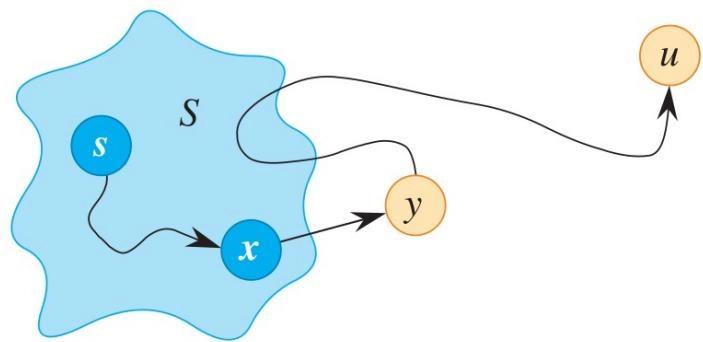
假设 \(u.d \neq \delta (s,u)\),则 \(u.d > \delta (s,u)\),则存在一条从 \(s\) 到 \(u\) 的最短路径 \(s \xrightarrow{p} u\),且 \(w(p) = \delta (s,u)\)
-
设 \(y\) 是从 \(s\) 到 \(u\) 的最短路径 \(p\) 上第一个不在 \(S\) 中的顶点,即 \(s \xrightarrow{p} x \to y\),若 \(y \neq u\)
-
\(y\) 在 \(s\) 到 \(u\) 的最短路径上,有 \(\delta (s,y) < \delta (s,u)\)
-
在这轮迭代中我们选择了 \(u\),则 \(u.d \leq y.d\)
-
此前当 \(x\) 被添加时,边 \((x, y)\) 被松弛,根据收敛性质, \(y.d = \delta (s,y)\)
-
-
综上,\(\delta (s,y) < \delta (s,u) < u.d \leq y.d = \delta (s,y)\),矛盾,故 \(u.d = \delta (s,u)\)
-
-
边权重均为非负的情况
-
We prove that at the start of each iteration \(v.d = \delta(s,v)\) for all \(v\in S\)(我们证明在每次迭代开始时,对于所有 \(v\in S\) ,都有 \(v.d = \delta(s,v)\) )
- Proof by induction
-
In each iteration, the algorithm adds \(u\) into \(S\)(在每次迭代中,算法将 \(u\) 添加到 \(S\) )
- we prove that \(u.d = \delta(s,u)\)(我们证明 \(u.d = \delta(s,u)\) )
-
Let \(y\) be the first vertex on a shortest path from \(s\) to \(u\) that is not in \(S\)(设 \(y\) 是从 \(s\) 到 \(u\) 的最短路径上第一个不在 \(S\) 中的顶点)
- Thus, \(\delta (s,y)\leq \delta (s,u)\)
-
Also, \(\delta (s,u)\leq u.d\) and \(u.d\leq y.d\)
- because we add \(u\)
-
\(\delta (s,y)\leq \delta (s,u)\leq u.d\leq y.d\)
-
Edge \((x, y)\) was relaxed when \(x\) was added(当 \(x\) 被添加时,边 \((x, y)\) 被松弛)
-
Convergence property: if \(s \xrightarrow{p} x \to y\) is a shortest path for some \(x, y \in V\), and if \(x.d = \delta(s, x)\) at any time prior to relaxing edge \((x, y)\), then \(y.d = \delta(s, y)\) at all times afterward
-
Proof: \(y.d \leq x.d + w(x,y) = \delta(s,x) + w(x,y) = \delta(s,y)\)
-
Optimal substructure
-
-
Since \(\delta (s,y)\leq \delta (s,u)\leq u.d\leq y.d\) and \(y.d \leq \delta (s,y)\)
- \(\delta (s,y) = \delta (s,u) = u.d = y.d\)
时间复杂度
-
The algorithm calls both
INSERTandEXTRACT-MINonce per vertex(算法对每个顶点调用 INSERT 和 EXTRACT-MIN)INSERTandEXTRACT-MINoperations: \(|V|\) times
-
Each edge in the adjacency list \(Adj[u]\) is examined and relaxed once. Thus, the algorithm calls
RELAX\(|E|\) times, which may lead to calls toDECREASE-KEY(邻接表 \(Adj[u]\) 中的每条边都被检查和松弛一次。因此,算法调用 RELAX \(|E|\) 次,这可能会导致调用 DECREASE-KEY)DECREASE-KEY: \(O(|E|)\) times
-
Simple implementation of min-priority queue \(Q\)(最小优先队列 \(Q\) 的简单实现)
-
Store \(v.d\) in the \(v\) th entry of an array(将 \(v.d\) 存储在数组的第 \(v\) 个条目中)
-
\(T(n) = O(V^{2})\)
-
\(O(1)\) time for each
INSERTandDECREASE-KEYoperation: \(O(|V|+|E|)\) -
\(O(V)\) time for each
EXTRACT-MINoperation: \(O(V^{2})\)
-
-
-
Binary min-heap implementation of min-priority queue(最小优先队列的二进制最小堆实现)
- \(O(\log V)\) time for each
INSERT,EXTRACT-MINandDECREASE-KEYoperation: \(O((|V|+|E|)\log V)\)
- \(O(\log V)\) time for each
Floyd-Warshall 算法
-
Can we solve an all-pairs shortest-paths problem by running Dijkstra's algorithm \(|V|\) times?(我们能否通过运行 Dijkstra 算法 \(|V|\) 次来解决全源最短路径问题?)
-
Yes
-
\(O(V^3)\) if implementing the min-priority queue with a linear array(使用线性数组实现最小优先队列的时间复杂度)
-
\(O(V^2 \log V + VE \log V)\) if implementing the min-priority queue with a binary min-heap(使用二进制最小堆实现最小优先队列的时间复杂度)
-
-
Use Floyd-Warshall algorithm to solve the all-pairs shortest-paths problem(使用 Floyd-Warshall 算法解决全源最短路径问题)
-
Negative-weight edges may be present(允许负权边)
-
But no negative-weight cycle exists(不允许负权环)
-
-
a Dynamic programming algorithm(动态规划算法)
基本思路
-
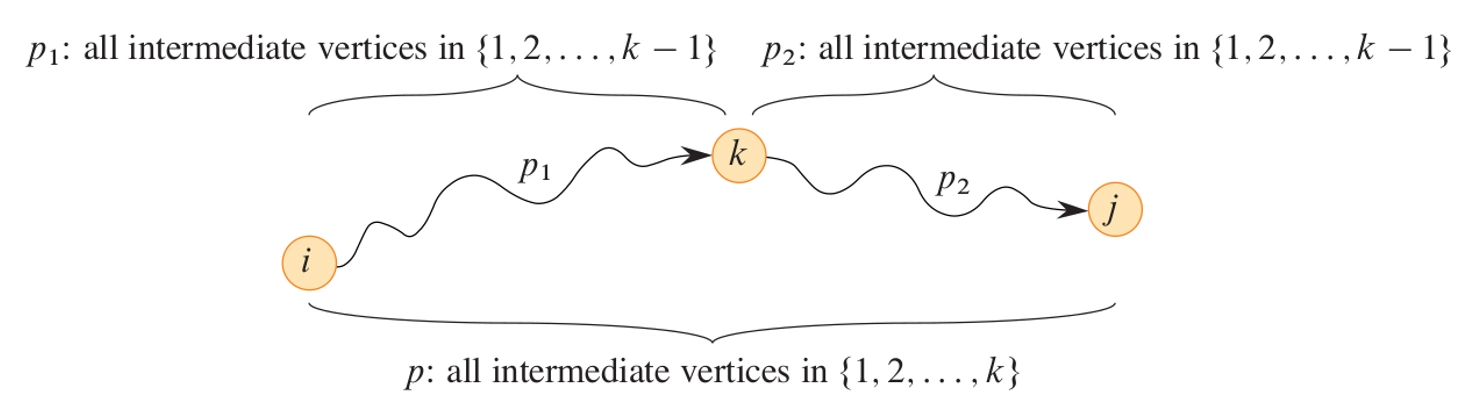
Dynamic programming: the algorithm considers shortest paths from \(i\) to \(j\) with all intermediate vertices in the set \(\{1,2,\ldots,k\}\)(动态规划:该算法考虑从 \(i\) 到 \(j\) 的所有中间顶点在集合 \(\{1,2,\ldots,k\}\) 中的最短路径)
-
If \(k\) is not an intermediate vertex, then all intermediate vertices belong to the set \(\{1,2,\ldots,k-1\}\)(如果 \(k\) 不是中间顶点,则所有中间顶点属于集合 \(\{1,2,\ldots,k-1\}\) )
-
If \(k\) is an intermediate vertex, then decompose the path into \(i \xrightarrow{p_1} k \xrightarrow{p_2} j\)(如果 \(k\) 是中间顶点,则将路径分解为 \(i \xrightarrow{p_1} k \xrightarrow{p_2} j\) )
-
\(p_1\) is a shortest path from \(i\) to \(k\)
-
\(p_2\) is a shortest path from \(k\) to \(j\)
-
-
最优子结构
-
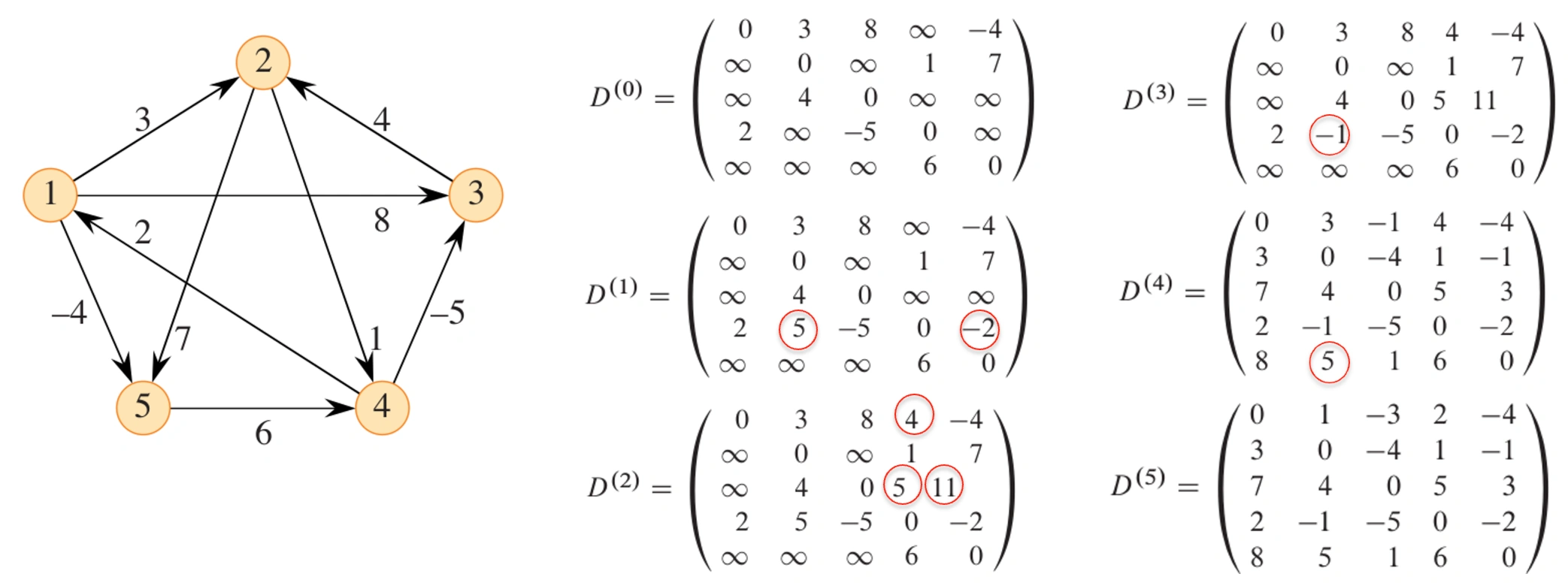
\(d_{ij}^{(k)}\) : the weight of a shortest path from vertex \(i\) to vertex \(j\) for which all intermediate vertices belong to the set \(\{1,2,\ldots,k\}\)(从顶点 \(i\) 到顶点 \(j\) 的最短路径的权重,其中所有中间顶点属于集合 \(\{1,2,\ldots,k\}\) )
\[ d_{ij}^{(k)} = \left\{ \begin{array}{ll} w_{ij} & k = 0 \\ \min \{d_{ij}^{(k - 1)},d_{ik}^{(k - 1)} + d_{kj}^{(k - 1)}\} & k\geq 1 \end{array} \right. \] -
Final answer: \(D^{(n)} = (d_{ij}^{(n)})\)
算法伪代码
- The bottom-up procedure(自底向上过程)
FLOYD-WARSHALL(W, n)                    // W 是权重矩阵,n 是顶点数
    let D^(0) = W                      // 初始化 D^(0)
    for k = 1 to n
        let D^(k) be a new n x n matrix
        for i = 1 to n
            for j = 1 to n
                D_ij^(k) = min{D_ij^(k - 1), D_ik^(k - 1) + D_kj^(k - 1)}
    return D^(n)                        // 返回最终结果
构造最短路径
-
Construct the predecessor matrix \(\Pi\)(构造前驱矩阵 \(\Pi\) )
- \(\pi_{ij}^{(k)}\) : the predecessor of vertex \(j\) on a shortest path from vertex \(i\) to vertex \(j\) for which all intermediate vertices belong to the set \(\{1,2,\ldots,k\}\)(从顶点 \(i\) 到顶点 \(j\) 的最短路径上顶点 \(j\) 的前驱,其中所有中间顶点属于集合 \(\{1,2,\ldots,k\}\) )
-
\(k=0\)
\[ \pi_{ij}^{(0)} = \left\{ \begin{array}{ll} \mathrm{NIL} & i = j~or~w_{ij} = \infty \\ i & i\neq j~and~w_{ij} < \infty \end{array} \right. \] -
For \(k\geq 1\)
\[ \pi_{ij}^{(k)} = \left\{ \begin{array}{ll} \pi_{kj}^{(k - 1)} & \text{k~is~an~intermediate~vertex} \\ \pi_{ij}^{(k - 1)} & \text{k~is~not~an~intermediate~vertex} \end{array} \right. \] -
The modified Floyd-Warshall algorithm(修改后的 Floyd-Warshall 算法)
FLOYD-WARSHALL-MODIFIED(W, n)         // W 是权重矩阵,n 是顶点数
    let D^(0) = W                     // 初始化 D^(0)
    let Π^(0) = n x n matrix           // 初始化前驱矩阵 Π^(0)
    for i = 1 to n
        for j = 1 to n
            if i = j or w_ij = ∞
                π_ij^(0) = NIL
            else
                π_ij^(0) = i
    for k = 1 to n
        let D^(k) be a new n x n matrix
        let Π^(k) be a new n x n matrix
        for i = 1 to n
            for j = 1 to n
                if D_ij^(k - 1) ≤ D_ik^(k - 1) + D_kj^(k - 1)
                    D_ij^(k) = D_ij^(k - 1)
                    π_ij^(k) = π_ij^(k - 1)
                else
                    D_ij^(k) = D_ik^(k - 1) + D_kj^(k - 1)
                    π_ij^(k) = π_kj^(k - 1)
    return D^(n), Π^(n)              // 返回最终结果

PRINT-PATH(Π, i, j)                  // 打印从 i 到 j 的最短路径
    if i == j
        print i
    else if π_ij == NIL
        print "no path from" i "to" j "exists"
    else
        PRINT-PATH(Π, i, π_ij)
        print j