算法(计算)复杂度分析概论
基本概念
算法定义
-
An algorithm is any well-defined computational procedure that takes some value, or set of values, as input and produces some value, or set of values, as output in a finite amount of time(算法是指任何明确定义的计算过程,该过程在有限时间内将某个值或一组值作为输入,并产生某个值或一组值作为输出)
-
An algorithm is a sequence of computational steps that transform the input into the output(算法是将输入转化为输出的一系列计算步骤)
算法正确性
-
An algorithm for a computational problem is correct if,
-
for every problem instance provided as input, it halts -- finishes its computing in finite time (liveness)(对于每个作为输入提供的问题实例,算法都能在有限时间内停止计算——完成其计算)
-
and outputs the correct solution to the problem instance (safety)(并输出问题实例的正确解决方案)
-
算法效率
-
Complexity analysis: determines the amount of resources required to execute an algorithm(决定了执行算法所需的资源量)
-
Computational time
-
Memory
-
Communication bandwidth (communication complexity)
-
Energy consumption
-
-
Goal: finding the "best" solution among a group of candidates
算法分类
顺序算法 (Sequential Algorithms)
-
An algorithm that is executed sequentially - once through, from start to finish, without other processing(顺序执行的算法——从开始到结束一次性执行,没有其他处理)
-
No concurrency(无并发)
-
Techniques
-
Divide-and-Conquer(分治法)
-
Dynamic Programming(动态规划)
-
Greedy Algorithms(贪心算法)
-
-
Algorithms
-
Graph Algorithms(图算法)
-
Minimum Spanning Trees(最小生成树)
-
(Single-source) Shortest Paths(单源最短路径)
-
-
-
NP-Completeness problems(NP 完全性问题)
- Traveling-salesperson problem(旅行商问题)
分布式算法 (Distributed Algorithms)
-
Algorithms used in distributed systems(分布式系统中使用的算法)
-
In contrast to sequential algorithms for centralized systems(与集中式系统的顺序算法相对)
-
distributed system: a set of processes/nodes seeking to achieve some common goal by communicating with each other(分布式系统:一组进程/节点通过相互通信寻求实现某个共同目标)
-
-
常见分布式系统类型
-
Client - server interactions(客户端-服务器交互)
-
Peer-to-peer systems(点对点系统)
-
Cloud computing systems(云计算系统)
-
-
Basic abstractions
-
Timing assumption(时序假设)
-
Synchronous systems(同步系统)
-
Asynchronous systems(异步系统)
-
-
Fault detection(故障检测)
-
Leader election(领导者选举)
-
-
Broadcast
-
Reliable broadcast(可靠广播)
-
Causal-order broadcast(因果顺序广播)
-
-
Consensus(共识)
- Paxos
算法复杂度分析 (Complexity Analysis)
增长量级 (Order of growth)
-
To ease the analysis of any algorithm, consider only the leading term of a formula(为了简化对算法的分析,仅考虑公式的最高阶项)
-
Ignore the leading term's constant coefficient(忽略最高阶项的常数系数)
-
Consider one algorithm to be more efficient than another if its worst-case running time has a lower order of growth(如果一个算法的最坏情况运行时间具有较低的增长量级,则认为它比另一个算法更高效)
渐进符号 (Asymptotic Notations)
上界 (Upper Bound)
-
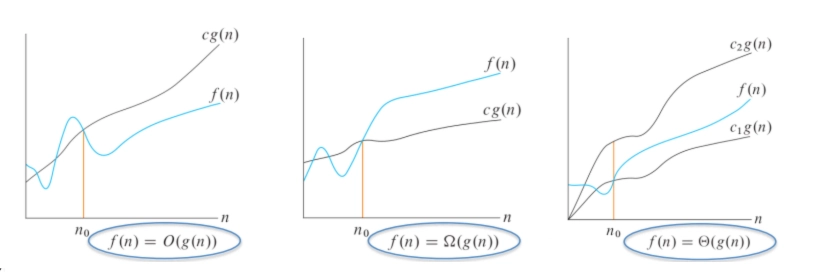
\(O\) notation: characterizes an upper bound on the asymptotic behavior of a function(描述函数渐近行为的上界)
- a function grows no faster than a certain rate(函数的增长速度不超过某个速率)
-
符号表示:
\[ f (n) = O (g (n)) \] -
定义:
\[ \exists c > 0, n_0 > 0, \forall n \geq n_0,~ 0 \leq f(n) \leq cg(n) \]
下界 (Lower Bound)
-
\(\Omega\) notation: characterizes a lower bound on the asymptotic behavior of a function(描述函数渐近行为的下界)
- a function grows at least as fast as a certain rate(函数的增长速度至少与某个速率一样快)
-
符号表示:
\[ f(n) = \Omega (g(n)) \] -
定义:
\[ \exists c > 0, n_0 > 0, \forall n \geq n_{0}, ~0 \leq cg(n) \leq f(n) \]
紧确界 (Tight Bound)
-
\(\Theta\) notation: characterizes a tight bound on the asymptotic behavior of a function(描述函数渐近行为的紧确界)
- a function grows precisely at a certain rate on the highest-order term(函数在最高阶项上以某个速率精确增长)
-
符号表示:
\[ f(n) = \Theta (g(n)) \] -
定义:
\[ \exists c_{1} > 0, c_{2} > 0, n_0 > 0, \forall n \geq n_{0}, ~0 \leq c_{1}g(n) \leq f(n) \leq c_{2}g(n) \] -
For any two functions \(f(n)\) and \(g(n)\), we have
\[ f (n) = \Theta (g (n)) \Leftrightarrow \begin{cases} f (n) = O (g (n))\\ f (n) = \Omega (g (n)) \end{cases} \]
NPC 问题(NP-Complete Problems)
定义
-
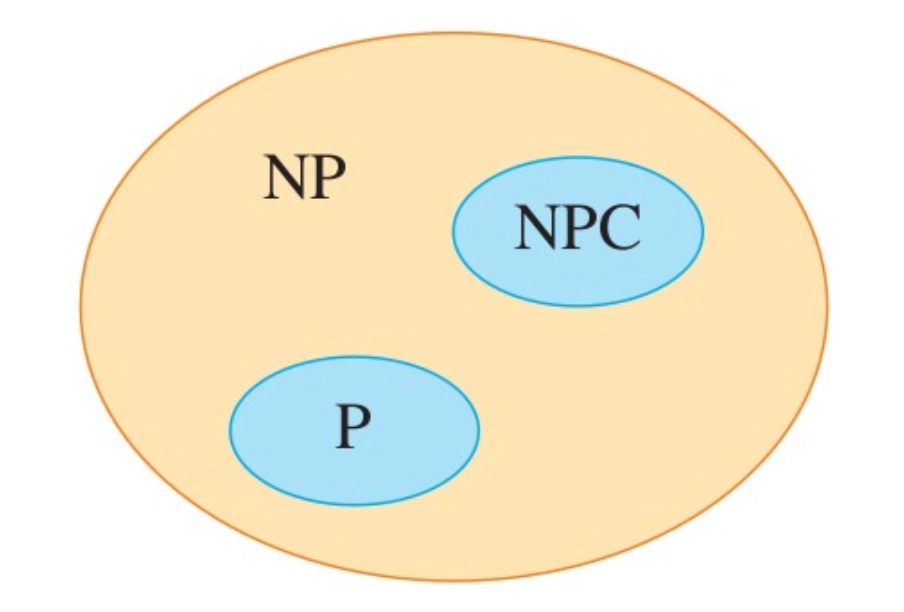
P: The class P consists of those problems that are solvable in polynomial time(多项式时间内可解的问题类)
-
NP: The class NP consists of those problems that are verifiable in polynomial time(多项式时间内可验证的问题类)
-
Given a certificate, verify that the certificate is correct in polynomial time(给定一个解答,在多项式时间内验证该解答是否正确)
-
Any problem in P also belongs to NP:\(P \subseteq NP\)(P 类中的任何问题也属于 NP 类)
-
-
NP-hard: A problem belongs to NP-hard if it is at least as hard as any problem in NP(可以不是 NP 问题,至少和 NP 问题中最难的问题一样难)
- Intractable problems(难解问题)
-
NP-complete: A problem belongs to NP-complete (NPC) if it belongs to NP and is NP-hard(属于 NP 且是 NP-hard 的问题:NP 类问题中最难的问题)
-
关系
-
If any problem in NP is not polynomial-time solvable, then no NP-complete problem is polynomial-time solvable(如果 NP 中存在问题不是多项式时间可解的,那么没有 NPC 问题是多项式时间可解的)
-
If any NP-complete problem is polynomial-time solvable, then every problem in NP has a polynomial-time algorithm, i.e., \(P = NP\)(如果任何 NPC 问题是多项式时间可解的,那么 NP 中的每个问题都有一个多项式时间算法,即 P = NP)
\[ \begin{cases} \exists~p \in \mathrm{NP}, p \notin \mathrm{P} &\Rightarrow \forall q \in \mathrm{NPC}, q \notin \mathrm{P} \\ \exists~q \in \mathrm{NPC}, q \in \mathrm{P} &\Rightarrow \forall p \in \mathrm{NP}, p \in \mathrm{P} \quad \Rightarrow \mathrm{P} = \mathrm{NP} \end{cases} \]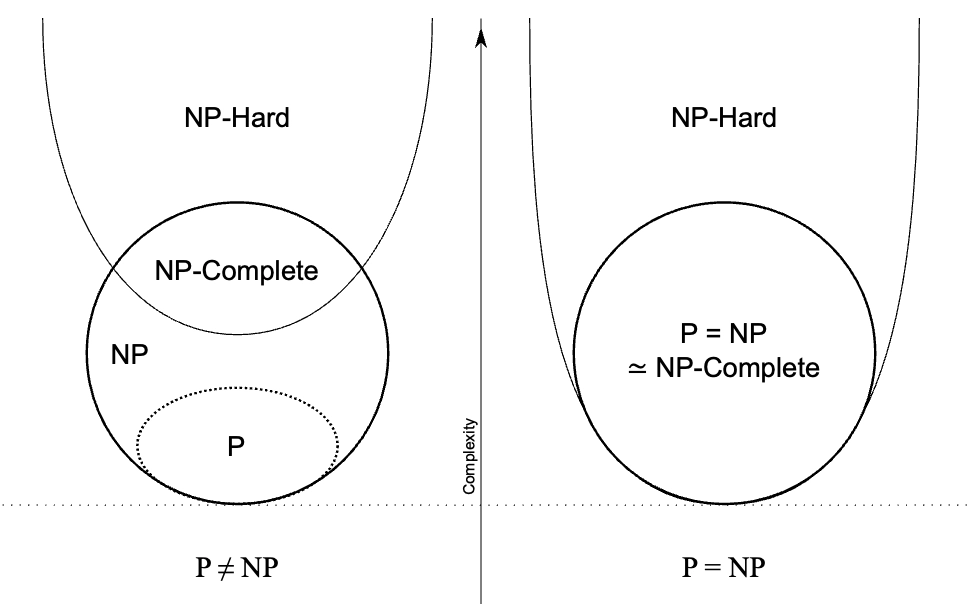
-
-
The relationship most theoretical computer scientists believe: \(P \neq NP\)(大多数理论计算机科学家相信的关系:\(P \neq NP\))
规约 (Reductions)
-
Reductions(归约)
-
Reduction is a procedure transforms any instance \(\alpha\) of \(A\) into some instance \(\beta\) of \(B\)(一个过程将 \(A\) 的任何实例 \(\alpha\) 转换为 \(B\) 的某个实例 \(\beta\))
-
The transformation takes polynomial time(转换需要多项式时间)
-
The answers are the same(答案是相同的)
-
-
If such a reduction exists, we say that \(A\) is polynomial-time reducible to \(B\), denoted by \(A \leq_{\mathrm{P}} B\)(如果存在这样的归约,我们说 \(A\) 在多项式时间内可归约为 \(B\),记为 \(A \leq_{\mathrm{P}} B\))
- B is at least as hard as A(B 至少和 A 一样难)
-
-
Using reductions to solve problems(使用归约来解决问题)
-
Given an instance \(\alpha\) of problem \(A\), use a polynomial-time reduction algorithm to transform it to an instance \(\beta\) of problem \(B\)(给定问题 \(A\) 的实例 \(\alpha\),使用多项式时间归约算法将其转换为问题 \(B\) 的实例 \(\beta\))
-
Run the polynomial-time decision algorithm for \(B\) on the instance \(\beta\)(在实例 \(\beta\) 上运行问题 \(B\) 的多项式时间决策算法)
-
Use the answer for \(\beta\) as the answer for \(\alpha\)(将 \(\beta\) 的答案用作 \(\alpha\) 的答案)
- if we have a polynomial-time algorithm for \(B\), we can solve \(A\) in polynomial time too(如果我们有一个多项式时间算法用于 \(B\),我们也可以在多项式时间内解决 \(A\))

-
证明 NPC
-
Decision problems vs. optimization problems(决策问题 vs. 优化问题)
-
Decision problems: the answer is simply yes or no(决策问题:答案仅为是或否)
- PATH (Decision problem): Given an undirected graph \(G\), vertices \(u\) and \(v\), and an integer \(k\), does a path exist from \(u\) to \(v\) consisting of at most \(k\) edges?(无向图中是否存在从 \(u\) 到 \(v\) 的最多由 \(k\) 条边组成的路径?)
-
Optimization problems: the answer is some optimal value(优化问题:答案是某个最优值)
- SHORTEST-PATH (Optimization problem): Given an undirected graph \(G\), vertices \(u\) and \(v\), what is the length of the shortest path from \(u\) to \(v\)?(无向图中从 \(u\) 到 \(v\) 的最短路径长度是多少?)
-
If a decision problem is hard, its related optimization problem is hard
-
We usually use reductions to transform a decision problem \(A\) to an optimization problem \(B\)(我们通常使用归约将决策问题 \(A\) 转换为优化问题 \(B\))
-
-
Using polynomial-time reductions in the opposite way to show that a problem \(B\) is NP-complete(以相反的方式使用多项式时间归约来证明问题 \(B\) 是 NPC 的)
-
Show that \(B\) belongs to NP(证明 \(B\) 属于 NP)
-
Select a known NP-complete problem \(A\)(选择一个已知的 NP-complete 问题 \(A\))
-
Show that \(A \leq_{\mathrm{P}} B\)(证明 \(A \leq_{\mathrm{P}} B\))
-
Conclude that \(B\) is NP-complete(得出结论 \(B\) 是 NPC 的)
-
示例
-
哈密顿回路与旅行商问题
-
哈密顿回路 (Hamiltonian cycles)
-
A hamiltonian cycle of an undirected graph \(G = (V, E)\) is a cycle that visits each vertex exactly once(一个无向图的哈密顿回路是一个恰好访问每个顶点一次的回路)
\[ \langle v_{1},v_{2},\ldots,v_{|V|}\rangle \quad \forall i, (v_{i},v_{i+1})\in E, (v_{|V|},v_{1})\in E \] -
Decision problem: whether a hamiltonian cycle exists in a given graph(决策问题:给定图中是否存在哈密顿回路)
-
-
旅行商问题 (The traveling salesman problem, TSP)
-
Given a set of cities and the distances between each pair of cities, what is the shortest possible route that visits each city exactly once and returns to the origin city?(给定一组城市以及每对城市之间的距离,访问每个城市恰好一次并返回原始城市的最短可能路线是什么?)
-
Optimization problem: find the shortest hamiltonian cycle(优化问题:找到最短的哈密顿回路)
-
-
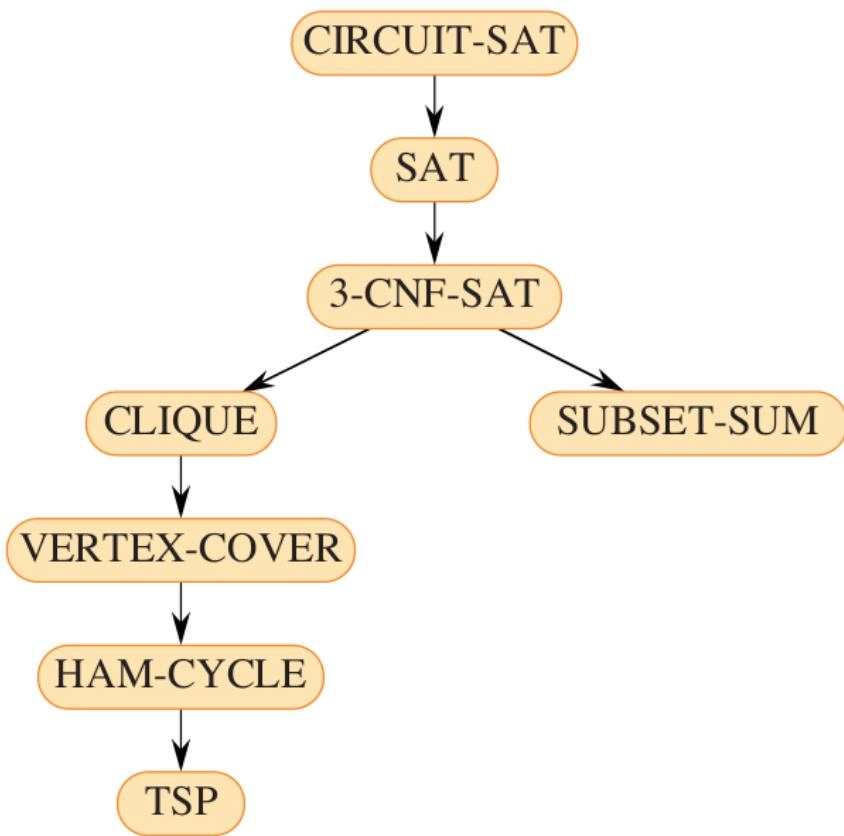
Reduction: HAM-CYCLE \(\leq_{\mathrm{P}}\) TSP
-
-
电路可满足性问题 (The circuit-satisfiability problem)
-
Given a boolean circuit \(C\) with \(n\) inputs and one output, is there an assignment of the inputs such that the output is 1?(给定一个具有 \(n\) 个输入和一个输出的布尔电路 \(C\),是否存在输入的赋值使得输出为 1?)
-
The first NP-complete problem
-
Cook-Levin Theorem: any problem in NP can be reduced in polynomial time to the circuit-satisfiability problem(Cook-Levin 定理:NP 中的任何问题都可以在多项式时间内归约为电路可满足性问题)
-
-
团问题与顶点覆盖问题
-
团问题 (The clique problem)
-
Clique: a subset of vertices of an undirected graph \(G = (V, E)\) such that every two distinct vertices are adjacent.(团:无向图 \(G = (V, E)\) 的一个顶点子集,其中每两个不同的顶点都是相邻的。)
-
Optimization problem: find a clique of maximum size(优化问题:找到最大规模的团)
-
Decision problem: whether a clique of a given size \(k\) exists(决策问题:是否存在给定大小 \(k\) 的团)
-
Naive solution: lists all \(k\) -subsets of \(V\) and checks each one to see whether it forms a clique(暴力解法:列出 \(V\) 的所有 \(k\) 子集,并检查每个子集是否形成一个团)
- Time complexity: \(O\left(\binom{|V|}{k} \cdot k^{2}\right)\)
-
-
顶点覆盖问题 (The vertex-cover problem)
-
A vertex cover of an undirected graph \(G = (V, E)\) is a subset \(V^\prime \subseteq V\) such that if \((u,v)\in E\), then \(u\in V^{\prime}\) or \(v\in V^{\prime}\) (or both)(无向图 \(G = (V, E)\) 的顶点覆盖是一个满足如果 \((u,v)\in E\),则 \(u\in V^{\prime}\) 或 \(v\in V^{\prime}\) 或两者皆是的顶点子集 \(V^\prime \subseteq V\))
-
Optimization problem: find a vertex cover of minimum size(优化问题:找到最小规模的顶点覆盖)
-
Decision problem: whether a graph has a vertex cover of a given size \(k\)(决策问题:图是否具有给定大小 \(k\) 的顶点覆盖)
-
-
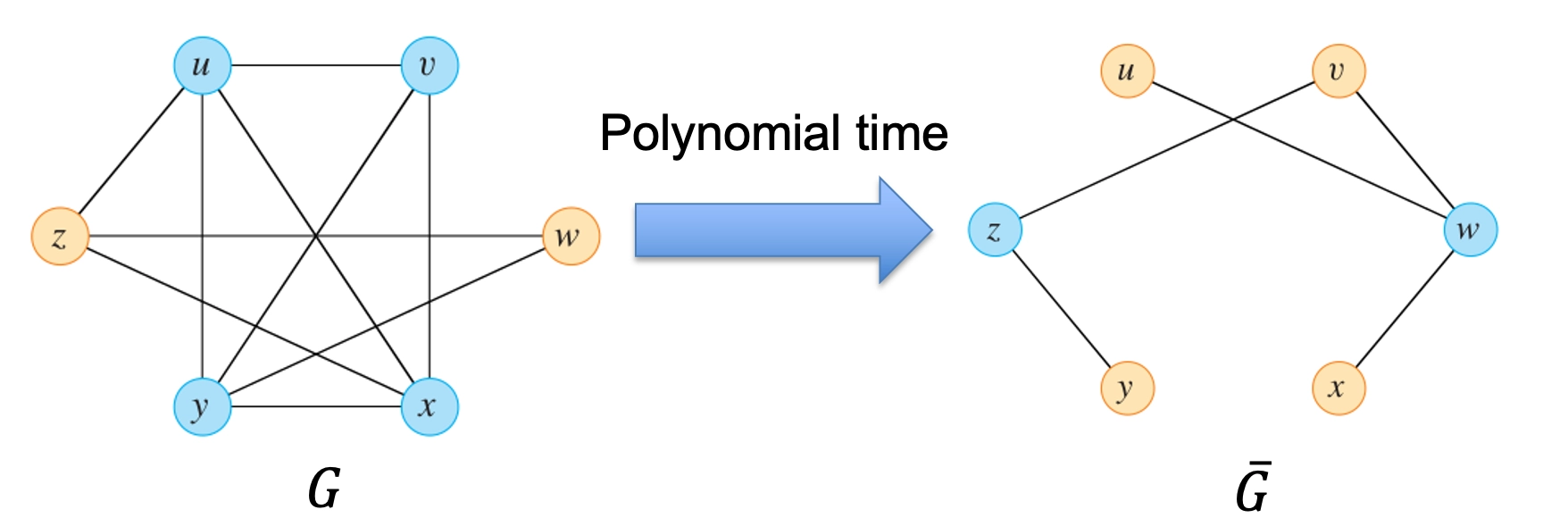
CLIQUE \(\leq_{\mathrm{P}}\) VERTEX-COVER
-
Assume CLIQUE is an NP-hard problem
-
Given an undirected graph \(G = (V, E)\), the complement of \(G\) is a graph \(\bar{G} = (V, \bar{E})\), where(给定无向图 \(G = (V, E)\),\(G\) 的补图是图 \(\bar{G} = (V, \bar{E})\),其中)
\[ \bar {E} = \{(u, v) \colon u, v \in V, u \neq v, (u, v) \notin E \} \]
-
The graph \(G\) contains a clique of size \(k\) if and only if the graph \(\bar{G}\) has a vertex cover of size \(|V| - k\)(图 \(G\) 包含大小为 \(k\) 的团当且仅当图 \(\bar{G}\) 具有大小为 \(|V| - k\) 的顶点覆盖)
-
Assume \(G\) contains a clique \(V^\prime\) of size \(|V^\prime| = k\), we try to show that \(V - V^\prime\) is a vertex cover of size \(|V| - k\) in \(\bar{G}\)
-
\(\forall (v, w) \in \bar{E}\), we have \((v, w) \notin E\)
-
Since \(V^\prime\) is a clique in \(G\), at least one of \(v\) and \(w\) is not in \(V^\prime\)
-
That means, at least one of \(v\) and \(w\) is in \(V - V^{\prime}\)
-
\(V - V^{\prime}\) is a vertex cover
-
-
Conversely,
-
Assume that \(\bar{G}\) has a vertex cover \(V^\prime \subseteq V\) of size \(|V^\prime| = k\), we try to show that \(V - V^\prime\) is a clique of size \(|V| - k\) in \(G\)
-
\(\forall (v, w) \in \overline{E}\), we have \((v, w) \notin E\)
-
Since \(V^\prime\) is a vertex cover in \(\bar{G}\), at least one of \(v\) and \(w\) is in \(V^\prime\)
-
That means, at most one of \(v\) and \(w\) is in \(V - V^{\prime}\)
-
\(V - V^{\prime}\) is a clique
-
-
The reduction can be done in polynomial time by constructing the complement graph \(\bar{G}\)(通过构造补图 \(\bar{G}\) 可以在多项式时间内完成归约)
-
-
-
More NP-complete problems