Ch3 Scanning
词法分析:Lexical Analysis
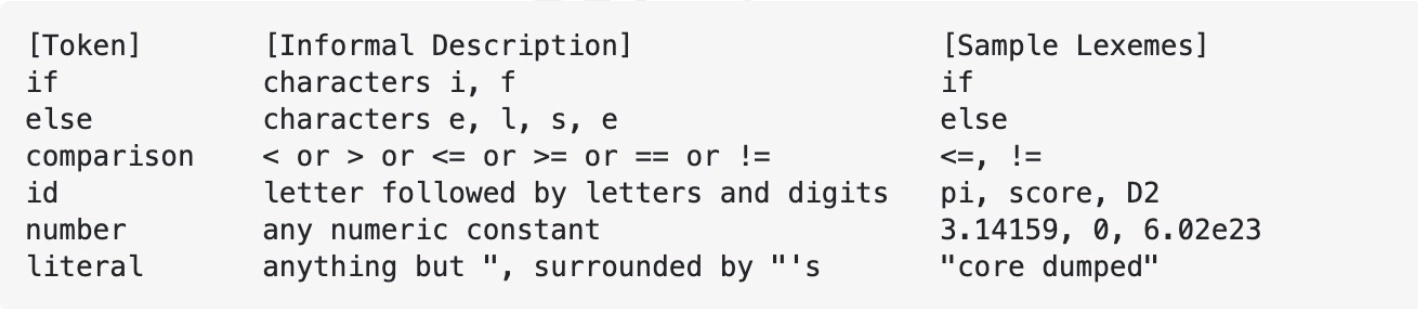
Token, Pattern, and Lexemes
-
The Analysis Partitions Input String into Substrings. (分析将输入字符串划分为子字符串。)
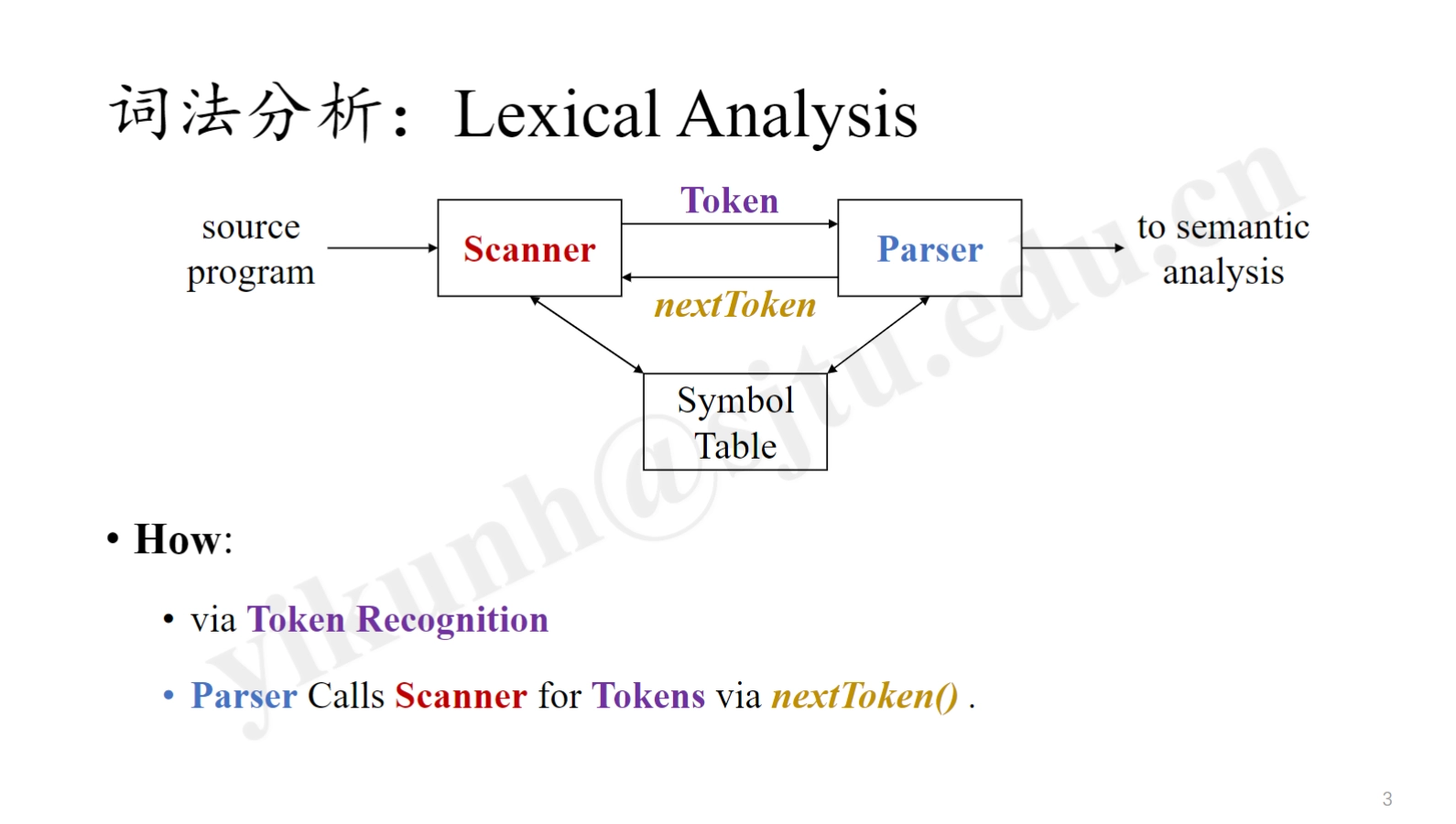
-
Token:
-
token-name: the role of lexical unit (词法单元的角色)
- often refer to Token by its token-name
-
attribute-value: any info associated to the Token (与 Token 相关的任何信息)
-
Generally, it has only ONE value: a pointer to the Symbol Table (通常只有一个值:指向符号表的指针)
-
In practice, the value of a constant can be stored as the attribute. (在实践中,常量的值可以作为属性存储。)
- constant: strings, numbers (常量:字符串、数字)
-
-
-
-
Pattern: description of the form lexemes of a token may (描述词法单元的形式)
- regular expression: \d, \w, ?, *, +, ...
-
Lexeme: a sequence of characters matches a token's pattern (与模式匹配的字符序列)
- Token vs. Lexeme: Class vs. Instance in C++
Specification of Tokens
Strings and Languages
-
String: a finite sequence of Symbols from an Alphabet (字符串:来自字母表的有限符号序列)
-
Language: any countable set of Strings (语言:任何可数的字符串集合)
-
Terms for Parts of a String s (字符串 s 的部分术语):
-
prefix:前缀
- any string obtained by removing zero or more symbols from the end of s
-
suffix:后缀
- any string obtained by removing zero or more symbols from the beginning of s
-
substring:子串
- any string obtained by removing any prefix or any suffix from s (去掉前缀或后缀)
-
subsequence:子序列
- any string obtained by removing zero or more not necessarily consecutive position of s (不一定连续的位置)
-
Operations on Languages
-
Union: (并集)
- \(L_1 ∪ L_2 = \{x | x ∈ L_1 \quad or \quad x ∈ L_2\}\)
-
Concatenation: (连接)
- \(L_1L_2 = \{xy | x ∈ L_1 \quad and \quad y ∈ L_2\}\)
-
Kleene closure: (星闭包)
-
\(L^* = \bigcup_{1=0}^\infty L^i \\= {𝜖} ∪ L ∪ L^2 ∪ L^3 ∪ ... \\= \{x | x = x_1x_2...x_n, n ≥ 0, xi ∈ L\}\)
-
𝜖 is the empty string
-
-
Positive closure: (正闭包)
- \(L^+ = \bigcup_{1=1}^\infty L^i \\= LL^* \\= \{x | x = x_1x_2...x_n, n ≥ 1, xi ∈ L\}\)
Regular Expressions
定义
-
Regular Expression (Regex): a way to describe Patterns of Tokens of a programming language. (正则表达式:描述编程语言的词法单元模式的一种方式)
-
Each Regular Expression r denotes a Language L \((r)\). (每个正则表达式 r 表示一个语言 L \((r)\))
- Regular Language, Type-3 Language
-
The Regular Expressions are built recursively out of smaller ones, using the rules. (正则表达式是用规则递归构建的)
-
语法
-
BASIS (基础)
-
𝜀 is a regular expression, and L(𝜀) = {𝜀}, the empty set. (空字符)
-
a is a symbol in a set Σ, then a is a regular expression, and L(a) = {a}. (集合中的字符)
-
-
INDUCTION (归纳):Suppose \(r\) and \(s\) are expressions denoting \(L(r)\) and \(L(s)\)
-
\(r | s\) : a regular expression denoting \(L(r) ∪ L(s)\)
-
\(rs\) : a regular expression denoting \(L(r)L(s)\)
-
\(r^*\) : a regular expression denoting \((L(r))^*\)
-
\((r)\) : a regular expression denoting \(L(r)\)
- We can add additional brackets around expressions. (我们可以在表达式周围添加额外的括号。)
-
-
定律:
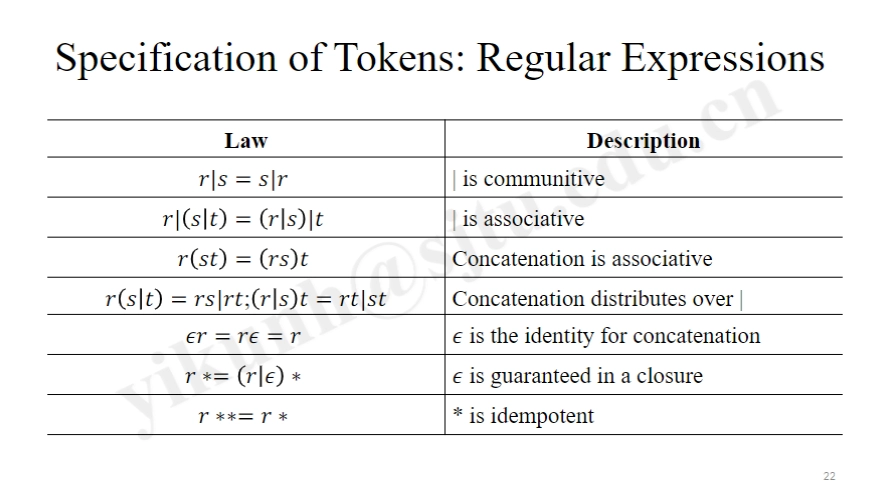
Regular Definitions
- Regular Definition: a set of productions with non-terminals derived by regular expressions. (正则定义:一组通过正则表达式派生的非终结符的产生式)
Extensions of Regex
-
\(+\) : one or more instances
-
\(r^*\) = \(r^+\) | 𝜖
-
\(r^+\) = \(rr^*\) = \(r^*r\)
-
-
\(?\) : zero or one instance
- \(r?\) = \(r\) | 𝜖
-
\([\quad]\) : character classes
-
\([abc]\) = \(a\) | \(b\) | \(c\)
-
\([a-z]\) = \(a\) | \(b\) | ... | \(z\)
-
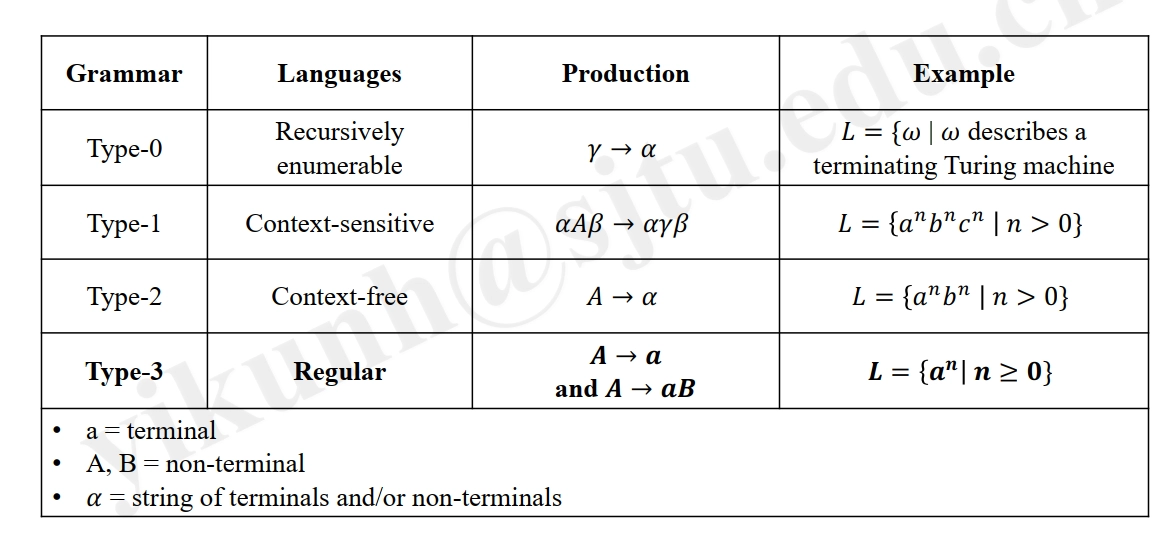
Regular Language / Grammar, and Regex
-
Regular Expression \(r\) denotes a Language \(L(r)\).
-
Regular Language is Type-3 Language (正则语言是类型 3 语言)
-
Regular Language is that denoted by Regular Expressions. (正则语言是由正则表达式表示的)
-
-
Regular Grammar is the grammar describes a Regular Language.
- with the production form of \(\mathbf{A}→\alpha\) or \(\mathbf{A}→\alpha\mathbf{B}\)
Recognition of Tokens
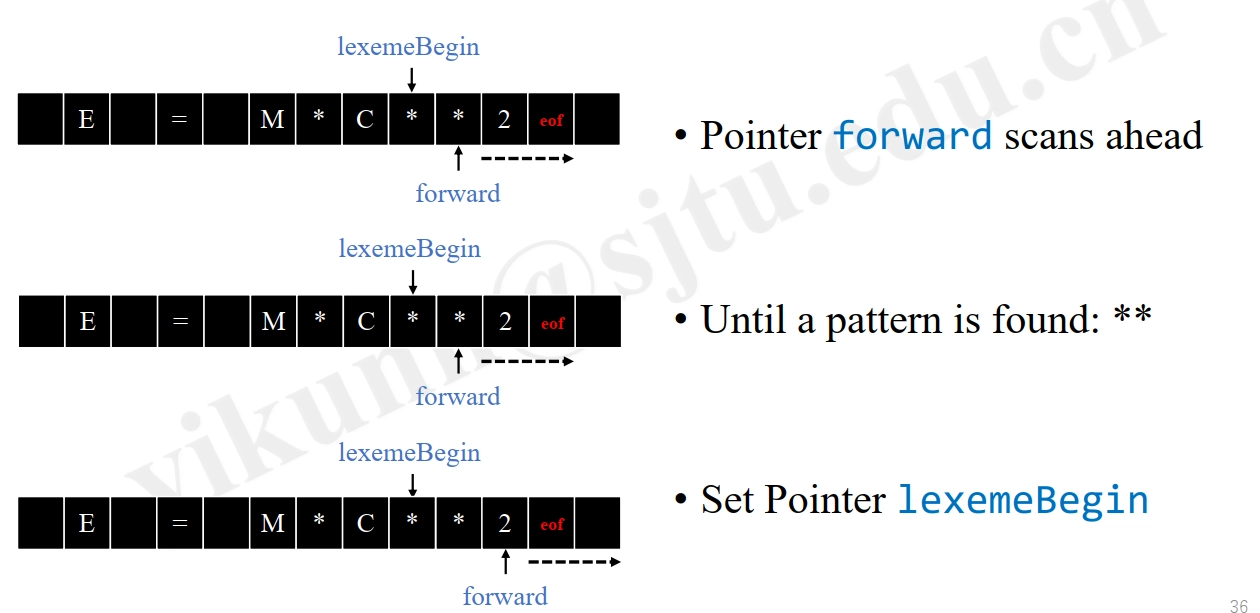
Input Buffer
Transition Diagrams
-
Transition Diagram = Nodes + Edges, a Flowchart (状态流程图 = 节点 + 边)
-
Nodes: states, conditions that could occur when looking for a lexeme that matches one pattern. (节点:状态)
-
States: Circles (状态:圆圈)
-
Start State: Arrowhead, Beginning of a Pattern (起始状态:箭头,开始)
-
End State(s): Double Circles, End of a Pattern (终止状态:双圆圈,结束)
-
-
Edge: actions, taken to transit from one State to Another. (边:动作)
- labeled by a Symbol or a set of Symbols for matching (标记为符号或符号集以进行匹配)
-
Deterministic: at most ONE edge out of a given state with a given label. (确定性:在给定状态下,最多有一条边)
-
-
Example:
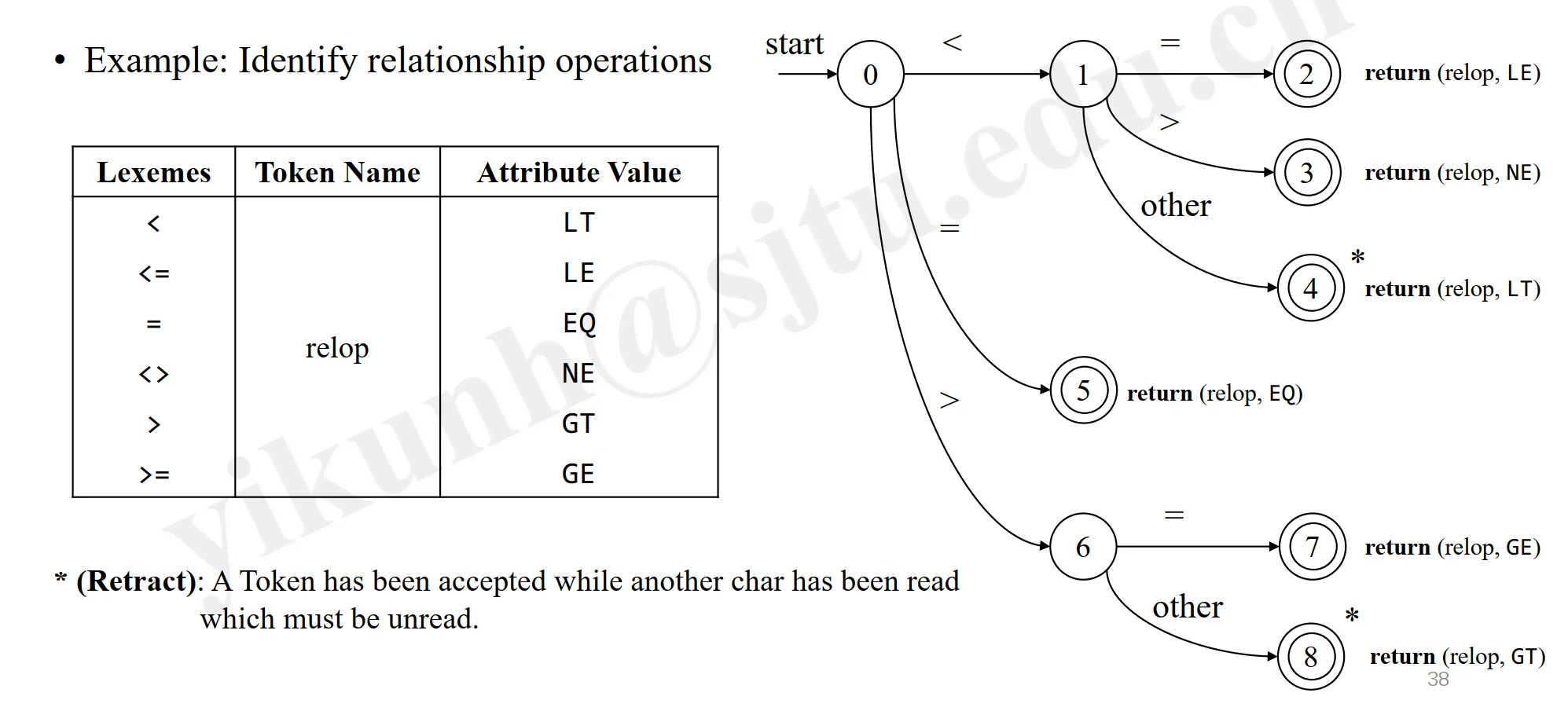
- *(Retract): A Token has been accepted while another char has been read which must be unread. (回退:一个 Token 已经被接受,而另一个不应读取字符已经被读取,必须回退)
Reserved Words (保留字)
-
Keywords look like Identifiers.
- if, then, ...
-
Add reserved words into symbol table initially. (在符号表中添加保留字)
-
Create separate transition diagrams for each keyword. (为每个关键字创建单独的转换图)
-
thenextone
-

-
有穷自动机:Finite Automata
Finite Automata
-
What: an Abstract Machine that can be in exactly one of a Finite number of States at any given time. (有限自动机:在任何给定时间只能处于有限数量的状态之一的抽象机器)
-
Finite Automation = Finite-state Automation (FSA, plural: automata) (有限自动机 = 有限状态自动机)
- Finite-state Machine (FSM), or simply State Machine (有限状态机,或简单地称为状态机)
-
changes from one state to another according to Inputs, called Transition (根据输入,从一个状态变化到另一个状态,称为转换)
-
-
Why: used as the Recognizer for Scanning, identifying Tokens (用于扫描的识别器,识别 token)
-
How: answers “YES” or “NO” about each input String (如何:对每个输入字符串回答“是”或“否”)
- determines whether the String is valid for the given Grammar (确定字符串是否符合给定的语法)
DFA vs. NFA
-
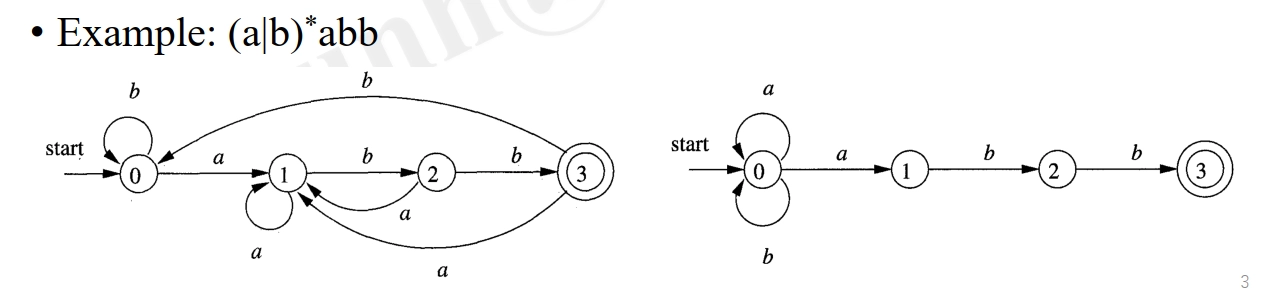
FA: Deterministic (DFA) or Non-deterministic (NFA)
-
DFA: have exactly/at most one action for each input symbol (每个输入符号有一个动作)
-
can be represented with a Transition Diagram
-
Recognition with DFA: Faster, may take More Space (识别 DFA:更快,可能占用更多空间)
-
complex to represent Regex, but more Precise, widely used (复杂表示正则表达式,但更精确,广泛使用)
-
-
NFA: can have multiple actions for the same input symbol (同一输入符号可以有多个动作)
-
can be represented with a Transition Graph
-
Recognition with NFA: Slower, may take Less Space (识别 NFA:较慢,可能占用更少的空间)
-
simply represents Regex, but less Precise (简单表示正则表达式,但不够精确)
-
-
Example:
-
Lexical Analysis Workflow with FA:
-
Regex -> NFA -> DFA
-
Regex -> DFA
-
Nondeterministic Finite Automata (NFA)
-
An NFA M = \(\mathbf{(S, 𝜮, move, 𝒔_0, F)}\) consists of:
-
\(\mathbf{S}\): a finite set of States (有限状态集)
-
\(\mathbf{𝜮}\): the Input Alphabet, excluding 𝜖 (不包含𝜖的输入符号集合)
-
\(\mathbf{move}\), a Transition Function (转换函数)
-
move(State, Symbol) = set of Next States
-
move: \(𝑆×(Σ ∪ \{𝜖\}) ⟶ ℙ(𝑆)\)
-
-
\(\mathbf{s_0} ∈ \mathbf{S}\), the Start State (or Initial State) (起始状态)
-
\(\mathbf{F} ⊆ \mathbf{S}\), a set of Accepting States (or Final States) (终止状态)
-
-
An NFA accepts Input String \(s\) iff
-
there exists some path in the Transition Graph from the Start State to one Accepting State, (存在一条路径从起始状态到一个接受状态)
-
such that symbols along the path spell out \(s\) (路径上的符号拼写出 \(s\))
-
-
Transition Tables:rows for States, columns for Input Symbols and 𝝐
- Example:
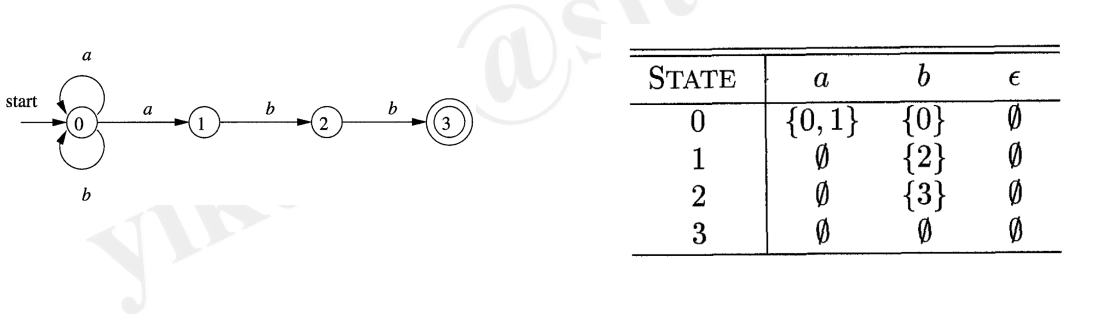
- Example:
Deterministic Finite Automata (DFA)
-
What: a Special Case of an NFA, where
-
there are no moves on symbol 𝜖, and
-
for each state s and input symbol a, there is Exactly ONE edge out of s labeled by a. (每个状态 s 和输入符号 a,恰好有一条边出 s 标记为 a)
-
COMPLETE: It defines from each state a transition for each input symbol. (完整:它定义了从每个状态到每个输入符号的转换)
- Transition function is a total function.
-
Local Automation: DFA not necessarily complete (... At Most ONE edge ...) (局部自动机:DFA 不一定是完全图)
- Transition function is a partial function.
-
-
Algorithm for Simulation
Conversion: NFA → DFA
-
Subset Construction (子集构造)
-
removing 𝜖-transitions
-
combining multiple NFA’s states into ONE constructed DFA’s state (将多个 NFA 的状态组合成一个构造的 DFA 的状态,即:等势点合并)
-
-
Definitions:
-
𝜖-closure(s):
-
s: some State
-
= Set of NFA States reached by state s via 𝜖-transitions, including s itself. (NFA 中可以通过若干个空变换到达的状态的集合)
-
-
𝜖-closure(T):
-
T: set of States
-
= \(∪_{s∈T}\) 𝜖-closure(s)
-
-
move(T, a):
-
T: set of States
-
a: Input Symbol
-
= NFA’s States reached by 𝑠 ∈ 𝑇 on a.
-
-
-
Algorithm Subset Construction
-
Input: the start State s0 and the Transition Diagram of NFA N.
-
Output: Transition Graph of DFA Dtran
add 𝝐-closure(s0) into Dstates //将初始状态s0的𝝐闭包加入Dstates while (Dstates has unsearched state S) { //当Dstates有未搜索的状态S时 tag S as searched //将S标记为已搜索 foreach input symbol a { //对每个输入符号a U = 𝝐-closure(move(S, a)) //设U为S进行a动作后状态S'的𝝐闭包 if (U is new to Dstates) { //如果U是Dstates中的新状态 add U into Dstates as unsearched //将U加入Dstates并标记为未搜索 } Dtran(S, a) = U //将Dtran(S, a)设为U } } -
最后得到的 Dtran 是一个 DFA 的转换表,Dstates 是 DFA 的状态集合。
-
-
Algorithm 𝜖-closure(T) Computation:
-
上一步中
U = 𝝐-closure(move(S, a))的实现逻辑: -
Input: the State Set T
-
Output: 𝜖-closure(T)
push all states in T onto Stack //将T中的所有状态压入栈中
while (Stack is not empty) { //当栈不为空时
    s = Stack.pop() //弹出栈顶元素s
    foreach (state u reached by s via 𝜖) { //对于每个s通过𝜖能达到的状态u
        if (u is not in 𝜖-closure(T)) { //如果u不在T的𝜖闭包中
            add u into 𝜖-closure(T) // 将其加入T的𝜖闭包
            Stack.push(u) //将u压入栈中
        }
    }
}
-
-
Example:
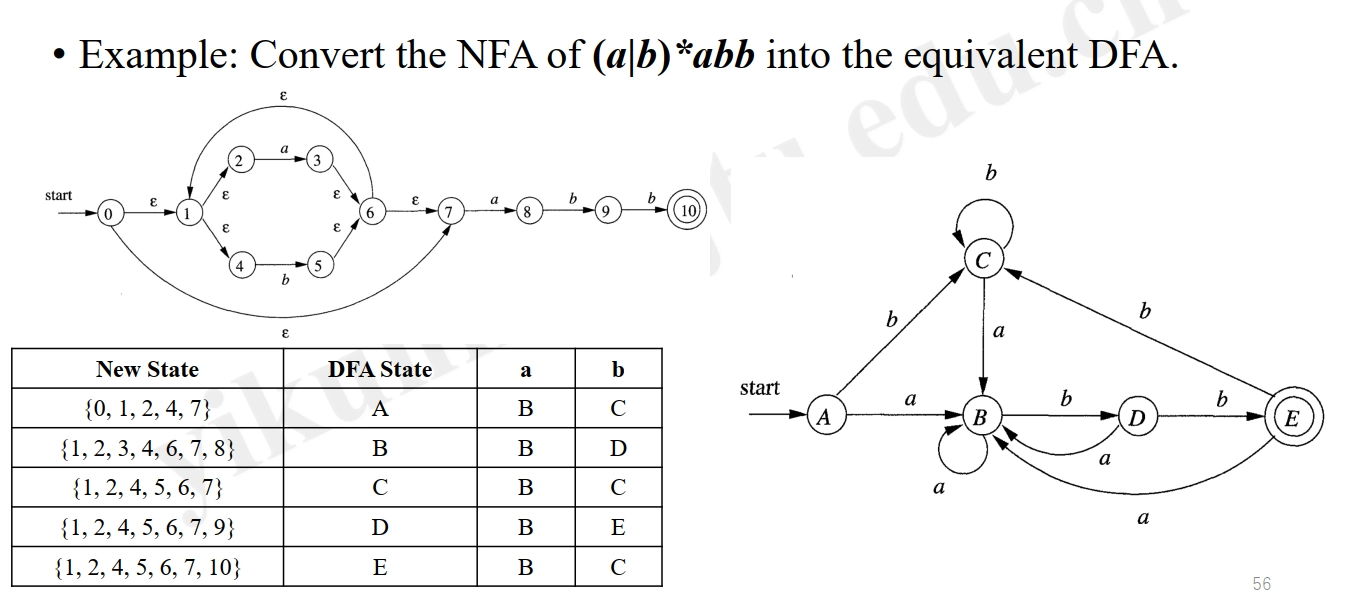
Conversion: Regex → NFA
-
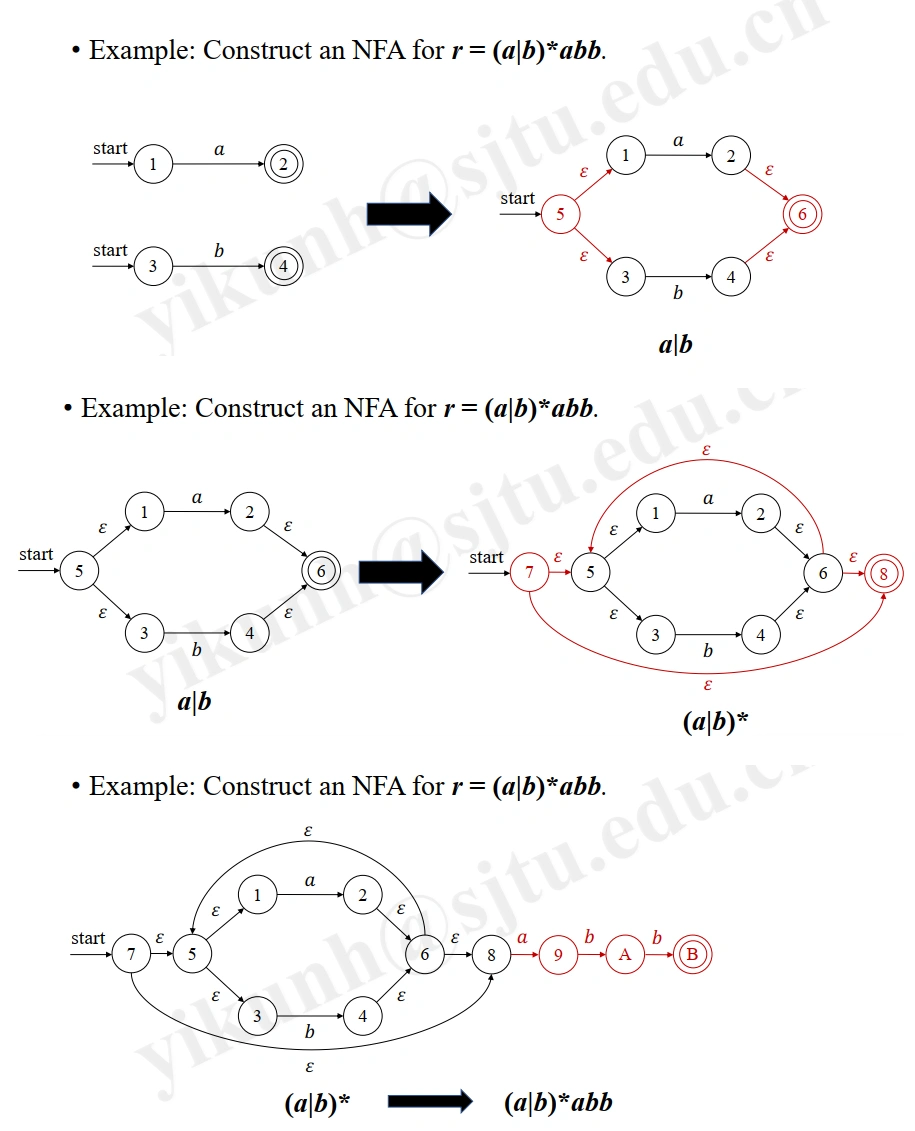
McNaughton-Yamada-Thompson Algorithm
-
Regex's Definition:
-
BASIS:
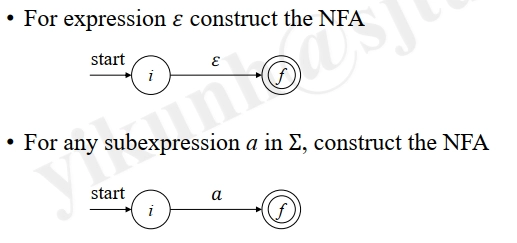
-
INDUCTION:
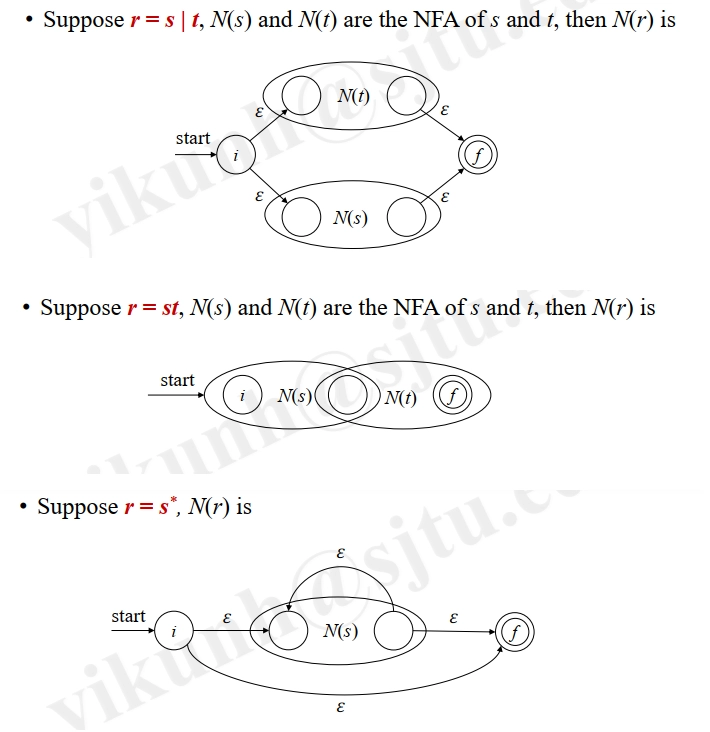
-
-
Example:
Workflow
-
The Workflow of Lexical Analyzer
-
Regex → NFA Construction
-
NFA → DFA Construction
-
Simulating DFA to Recognize Tokens
-
-
Convert Regex Directly into DFA: PASS
-
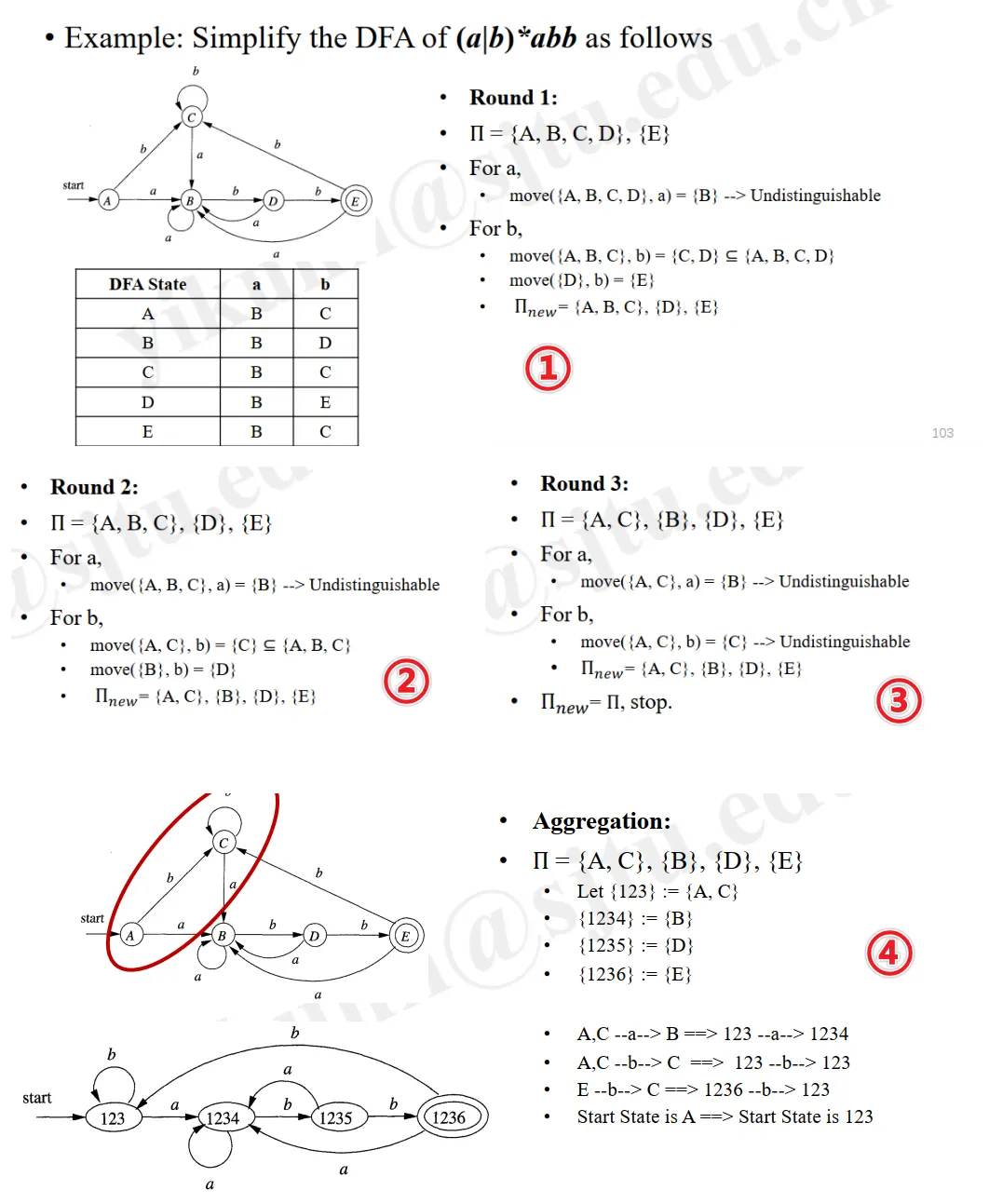
DFA Simplification: Minimizing the Number of States
DFA Simplification
-
What and Why:
-
no REDUNDANT states (无冗余状态)
-
REDUNDANCE: the states that NO accepted input string’s path passes through (没有路径到达终止状态的状态)
-
(in the transition graph)
-
-
no EQUIVALENT states (无等效状态)
-
EQUIVALENCE: states with the SAME side effects (具有相同副作用的状态)
-
(making the states indistinguishable)
-
-
Distinguish States via Input String (通过输入字符串区分状态)
-
State: s, t
-
String: x
-
x distinguishes s from t,
- if one state can reach an accepting state via x, while the other cannot. (如果一个状态可以通过 x 到达终止状态,而另一个状态不能)
-
s is distinguishable from t,
- if there is some string distinguishes them. (存在一些字符串可以区分它们)
-
Unify Indistinguishable States into One. (将不可区分的状态合并为一个)
-
-
-
How:
-
Start with the initial partition \(\mathbf{Π}\) with two groups, the accepting and non-accepting states of the DFA. (将 DFA 的接受状态和非接受状态分为两个组)
-
Let \(\mathbf{Π_{new} := Π}\). Then, for each group \(\mathbf{G}\) of \(\mathbf{Π}\): (初始时令 \(\mathbf{Π_{new} = Π}\),然后对于每个组 G)
-
For each input symbol \(\mathbf{a}\), states \(\mathbf{s},\mathbf{t}\) in \(\mathbf{G}\) are partitioned if they transit to different groups of \(\mathbf{Π}\) via \(\mathbf{a}\); (对于每个输入符号 a,如果状态 s 和 t 通过 a 转移到不同的组,则他们被划分为不同的组)
-
Replace \(\mathbf{G}\) in \(\mathbf{Π_{new}}\) by the new subgroups. (用新的子组替换 \(\mathbf{G}\))
-
-
If \(\mathbf{Π_{new}} ≠ \mathbf{Π}\), \(\mathbf{Π: = Π_{new}}\) and repeat Step 2, Step 4 otherwise. (如果 \(\mathbf{Π_{new}} ≠ \mathbf{Π}\),则令 \(\mathbf{Π: = Π_{new}}\) 并重复步骤 2,否则跳到步骤 4)
-
Aggregate the transitions among groups. (将组之间的转换聚合)
-
The resulting DFA is the minimized DFA. (得到的 DFA 是最小化的 DFA)
-
-
Example: