Ch1 密码学中的可证明安全理论
公钥加密算法的安全性定义以及 ElGamal 加密算法
可证明安全理论
基本概念
-
安全参数(Security Parameter)\(\lambda\):刻画攻击者攻破密码方案的难度
-
计算安全参数(底层困难问题的计算复杂度,依赖于算力和算法):攻破该问题至少需要 \(2^{\lambda}\) 步运算。
- 例如:分解大整数 \(n \approx 2^{2\lambda}\) 的计算复杂度为 \(2^{\lambda}\),则计算安全参数为 \(\lambda\)
-
统计安全参数(依赖于不同分布之间的统计距离,信息论安全):攻破密码算法的概率:区分猜测值和目标值之间的概率是 \(2^{-\lambda}\),则统计安全参数为 \(\lambda\)。
-
-
\(\lambda\) 的多项式大小:\(\mathrm{poly}(\lambda) = O(\lambda^{c})\),即 \(\exists c \in \mathbb{N},\lambda' \in \mathbb{N}\),使得对 \(\forall \lambda \geq \lambda'\),有
\[ \mathrm{poly}(\lambda) \leq \lambda^{c} \]- 例如:\(\mathrm{poly}(\lambda) = 4\lambda^{10} + \lambda^{3} + 1\),\(\lambda\),\(\lambda \log \lambda\),\(\lambda^{1.5}\),\(\lambda^{2}\) 等。
-
多项式时间算法:算法 \(\mathrm{ALG}(x)\) 的运行时间与输出比特长度是输入比特长度 \(\log |x|\) 的多项式大小。
-
确定性多项式时间(Deterministic Polynomial Time, DPT)算法
-
概率性多项式时间(Probabilistic Polynomial Time, PPT)算法
-
-
可忽略概率(Negligible probability):小于任意多项式倒数的概率,在密码学中认为几乎不可能发生的概率,通常记为 \(\mathrm{negl}(\lambda)\),即对任意多项式 \(\mathrm{poly}\),\(\exists \lambda' \in \mathbb{N}\),对 \(\forall \lambda \geq \lambda'\),有
\[ \mathrm{negl}(\lambda) \leq \frac{1}{\mathrm{poly}(\lambda)} \]-
性质:\(\forall c \in \mathbb{N}\),\(\exists \lambda' \in \mathbb{N}\),使得对 \(\forall \lambda \geq \lambda'\),有 \(\mathrm{negl}(\lambda) \leq \lambda^{-c}\)
-
例:\(\mathrm{negl}(\lambda) = 2^{-\lambda}\),\(2^{-\sqrt{\lambda}}\),\(\lambda^{-\lambda} = 2^{-\lambda \log \lambda}\)
-
-
不可忽略概率(Non-negligible probability):\(\text{non-negl}(\lambda)\),即存在多项式 \(\mathrm{poly}\),\(\forall \lambda' \in \mathbb{N}\),\(\exists \lambda \geq \lambda'\),有
\[ \text{non-negl}(\lambda) > 1/\mathrm{poly}(\lambda) \] -
压倒性概率(Overwhelming probability):在密码学中认为几乎一定发生的概率
\[ \mathrm{overwhelm}(\lambda) = 1 - \mathrm{negl}(\lambda) \]- 例:\(\mathrm{overwhelm}(\lambda) = 1 - 2^{-\lambda}\)
基本工具
-
布尔不等式:设 \(E_{1}, \dots, E_{p}\) 为 \(p\) 个事件(它们之间可以任意相关),则
\[ \Pr(E_{1} \vee \dots \vee E_{p}) \leq \Pr(E_{1}) + \dots + \Pr(E_{p}) \]-
设 \(E_{1}, \dots, E_{p}\) 为 \(p\) 个事件。如果 \(p = \mathrm{poly}_{0}(\lambda)\) 且 \(\Pr(E_{i}) = \mathrm{negl}_{i}(\lambda)\),则
\[ \Pr(E_{1} \vee \cdots \vee E_{p}) = \mathrm{negl}(\lambda) \]即一个可忽略概率发生的事件重复做多项式次,至少发生一次的概率是可忽略的。
-
设 \(F_{1}, \dots, F_{p}\) 为 \(p\) 个事件。如果 \(p = \mathrm{poly}_{0}(\lambda)\) 且 \(\Pr(F_{i}) = \mathrm{overwhelm}_{i}(\lambda)\),则
\[ \Pr(F_{1} \wedge \dots \wedge F_{p}) = \mathrm{overwhelm}(\lambda) \]即一个压倒性概率发生的事件重复做多项式次,每次都发生的概率是压倒性的。
-
-
全概率公式:若事件 \(A_{1}, A_{2}, \dots, A_{n}\) 构成一个完备事件组,即它们两两互不相容其和为全集,且都有正概率,则对任意一个事件 \(B\),有如下公式成立,称为全概率公式:
\[ \Pr(B) = \Pr(B \wedge A_{1}) + \Pr(B \wedge A_{2}) + \cdots + \Pr(B \wedge A_{n}) = \Pr(B\mid A_{1}) \Pr(A_{1}) + \Pr(B\mid A_{2}) \Pr(A_{2}) + \cdots + \Pr(B\mid A_{n}) \Pr(A_{n}) \]-
特别地,对于任意两随机事件 \(A\) 和 \(B\),有如下成立:
\[ \Pr(B) = \Pr(B\mid A) \Pr(A) + \Pr(B\mid \neg A) \Pr(\neg A) \]
-
-
贝叶斯公式:设 \(A\)、\(B\) 为两个事件,则
\[ \Pr(A \wedge B) = \Pr(A\mid B) \Pr(B) \]
可证明安全性的定义
-
刻画攻击者/敌手 (attacker/adversary) 的攻击能力
-
敌手的输入(例如:公开信息)
-
敌手的攻击能力(一般运行时间为多项式时间 PT,不考虑拥有无条件计算能力的敌手)
-
敌手的攻击方式(影响方案执行的行为,主动攻击、被动攻击,通过安全模型的方式刻画)
-
-
刻画安全目标
- 希望达到的目标,一般通过刻画不希望被攻破的目标定义
-
密码算法/协议 \(\Pi\) 的 X-Y 安全定义(template):任意概率多项式时间敌手在 Y 安全模型中攻破密码算法/协议 \(\Pi\) 的 X 安全目标的概率是可忽略的。
公钥加密算法的安全性
公钥加密算法的语义及正确性要求
-
语义:一个公钥加密算法(public-key encryption, PKE)包含三个概率多项式时间(PPT)算法 \((\mathrm{Gen}, \mathrm{Enc}, \mathrm{Dec})\):
-
密钥生成算法 \((PK, SK) \leftarrow \mathrm{Gen}(1^{\lambda})\):一般为概率性算法
-
加密算法 \(C \leftarrow \mathrm{Enc}(PK, M)\):\(M \in \mathbb{M}\),其中 \(\mathbb{M}\) 为消息空间
-
解密算法 \(M' \leftarrow \mathrm{Dec}(SK, C)\):一般为确定性算法,\(M' \in \mathbb{M} \cup \{\bot\}\),其中 \(\bot\) 代表解密失败
-
-
正确性要求:对于 \(\forall (PK, SK) \leftarrow \mathrm{Gen}(1^{\lambda})\),\(\forall M \in \mathbb{M}\),\(\forall C \leftarrow \mathrm{Enc}(PK, M)\),一定有
\[ \mathrm{Dec}(SK, C) = M \]
公钥加密算法的 SKH/PH/PFbH-PA 安全性
-
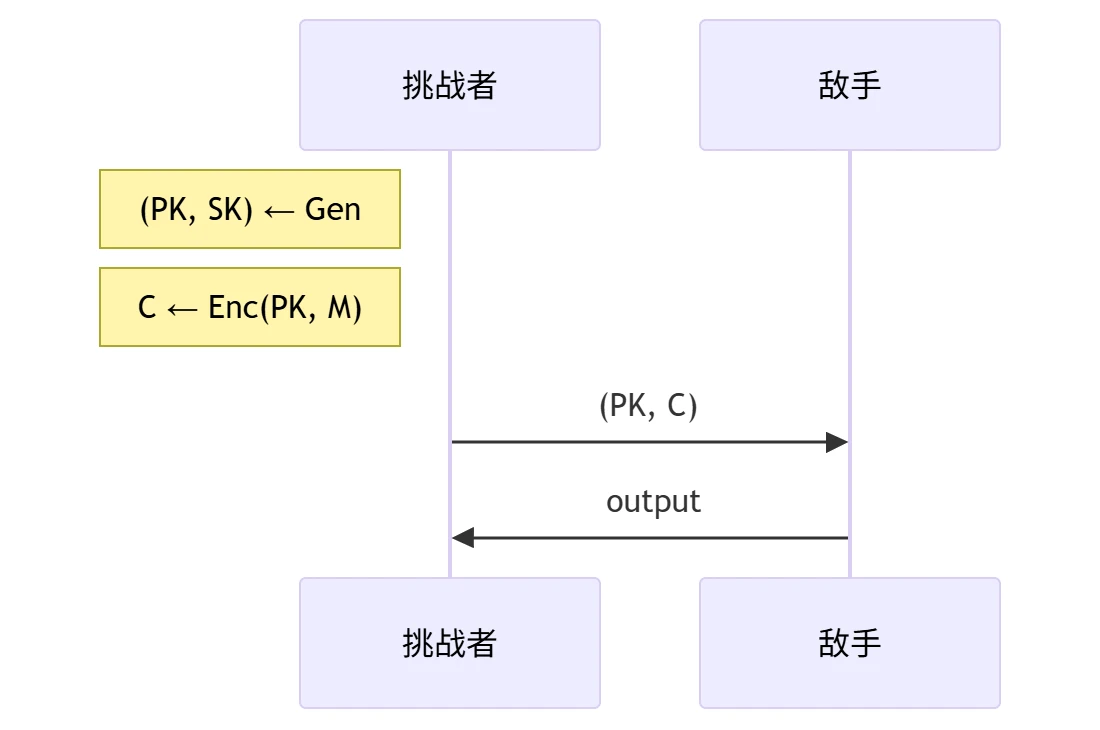
被动攻击(Passive Attacks, PA)安全模型:
-
PA 敌手攻击能力
-
输入:公开信道中的 \(PK, C\)
-
运行时间:概率多项式时间 PPT
-
攻击方式:被动攻击 PA ── 仅仅从公开信道中获取信息,不进行其他攻击
-
-
安全目标(刻画不希望该密码算法被攻破目标)
-
隐藏私钥(SK-hiding, SK):\(\mathrm{output} = SK\) 则攻破该目标
-
隐藏明文(Plaintext-hiding, PH):\(\mathrm{output} = M\) 则攻破该目标
-
隐藏明文首比特(Plaintext-first-bit-hiding, PFbH):\(\mathrm{output} = M[1]\) 则攻破该目标
-
-
公钥加密算法的 SKH/PH/PFbH-PA 安全性定义:任意概率多项式时间敌手在 PA 安全模型中攻破 SKH/PH/PFbH 安全目标的概率是可忽略的,即
\[ \Pr(\mathrm{output} = SK/M/M[1]) = \mathrm{negl}(\lambda) \]- 说明:SKH/PH/PFbH-PA 安全性定义 不能 保证加密算法的安全性。
公钥加密算法的 IND-CPA 安全性
-
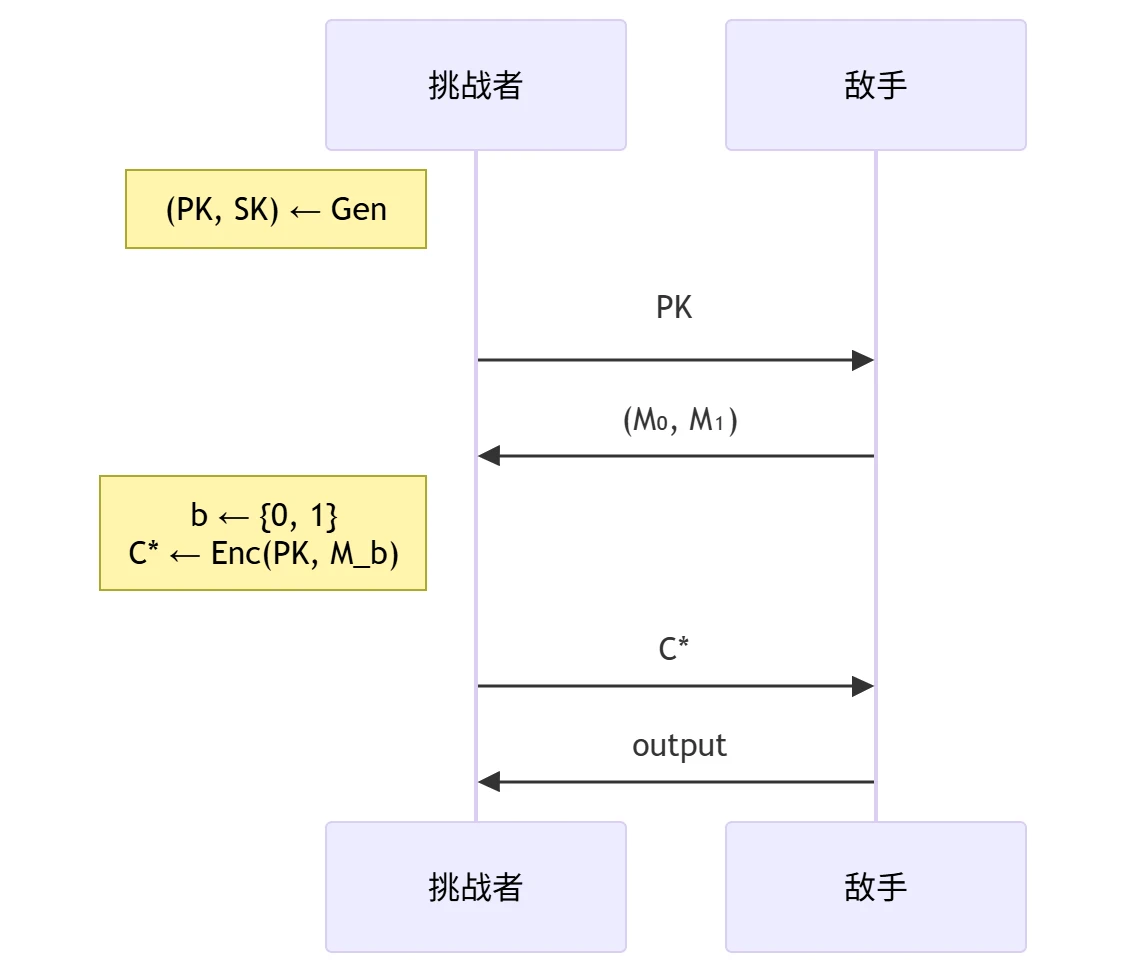
选择明文攻击(Chosen-Plaintext Attacks, CPA)安全模型:
-
CPA 敌手攻击能力:
-
输入:公开信道中的 \(PK\) 及挑战密文 \(C^{*}\)
-
运行时间:概率多项式时间 PPT
-
攻击方式:选择明文攻击 CPA ── 敌手可以提供/决定/影响加密使用的明文
-
-
IND 安全目标:不可区分性(Indistinguishability)── 敌手无法区分密文 \(C^{*}\) 加密的是 \(M_{0}\) 还是 \(M_{1}\)(即如果 \(\mathrm{output} = b\),则攻破该目标)
-
公钥加密算法的 IND-CPA 安全性定义:任意概率多项式时间敌手在 CPA 安全模型中攻破 IND 安全目标的 优势(advantage)是可忽略的,也即
\[ \mathrm{Adv} = \left| \Pr(\mathrm{output} = b) - \frac{1}{2} \right| = \mathrm{negl}(\lambda) \]-
等价定义:
\[ \begin{aligned} \mathrm{Adv} = &\left| \Pr(\mathrm{output} = b) - \frac{1}{2} \right| \\ =& \left| \Pr(\mathrm{output} = 0 \mid b = 0) \cdot \Pr(b=0) + \Pr(\mathrm{output} = 1 \mid b = 1) \cdot \Pr(b=1) - \frac{1}{2} \right| \\ =& \frac{1}{2} \left| \Pr(\mathrm{output} = 0 \mid b = 0) + \Pr(\mathrm{output} = 1 \mid b = 1) - 1 \right| \\ =& \frac{1}{2} \left| \Pr(\mathrm{output} = 0 \mid b = 0) - \Pr(\mathrm{output} = 0 \mid b = 1) \right| \\ =& \frac{1}{2} \left| \Pr(\mathrm{output} = 1 \mid b = 0) - \Pr(\mathrm{output} = 1 \mid b = 1) \right| \end{aligned} \]
-
-
IND-CPA 安全性的合理性:公钥加密算法的 IND-CPA 安全性 \(\implies\) SKH-PA/PH-PA/PFbH-PA 安全性
Proof
以 SKH-PA 安全性为例,采用反证法(安全性归约)
-
假设结论错误:算法不是 SKH-PA 安全的,即存在一个概率多项式敌手 \(\mathcal{A}\),以不可忽略的概率在 PA 安全模型中攻破 SKH 安全目标,即
\[ \mathrm{Adv}_\mathcal{A} = \Pr(\mathcal{A}(PK, C) = SK) = \text{non-negl}(\lambda) \] -
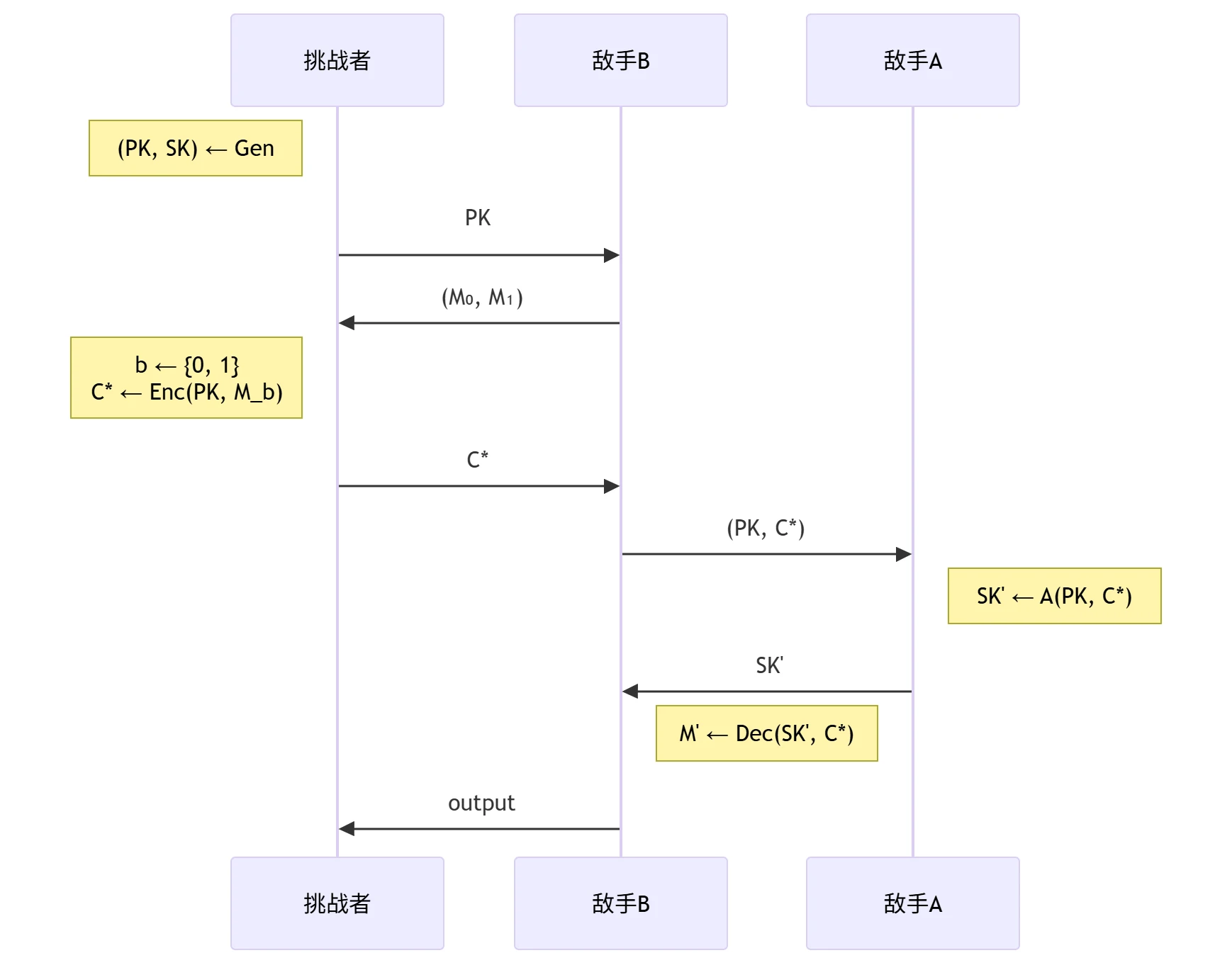
证明前提错误:构造一个概率多项式时间敌手 \(\mathcal{B}\),在 CPA 安全模型中攻破 IND 安全目标。
-
\(\mathcal{B}\) 的输入:公开信道中的 \(PK\) 及挑战密文 \(C^{*}\)
-
调用子敌手:\(\mathcal{B}\) 将 \((PK, C^{*})\) 交给 \(\mathcal{A}\),模拟 SKH-PA 实验,\(\mathcal{A}\) 输出一个候选私钥 \(SK'\)。\(\mathcal{B}\) 尝试使用 \(SK'\) 解密 \(C^{*}\),得到 \(M' = \mathrm{Dec}(SK', C^{*})\)
-
\(\mathcal{B}\) 的输出:\(\mathrm{output} = \begin{cases} 0 & M' = M_0 \\ 1 & M' = M_1 \\ \mathrm{random}\{0, 1\} & \text{otherwise} \end{cases}\)
-
\(\mathcal{B}\) 的优势:
\[ \begin{aligned} \mathrm{Adv}_\mathcal{B} = &\left| \Pr(\mathrm{output} = b) - \frac{1}{2} \right| \\ =& \left| \Pr(\mathrm{output} = b \mid SK' = SK) \cdot \Pr(SK' = SK) + \Pr(\mathrm{output} = b \mid SK' \neq SK) \cdot \Pr(SK' \neq SK) - \frac{1}{2} \right| \\ =& \left| 1 \cdot \text{non-negl}(\lambda) + \frac{1}{2} \cdot (1 - \text{non-negl}(\lambda)) - \frac{1}{2} \right| \\ =& \frac{1}{2} \cdot \text{non-negl}(\lambda) = \text{non-negl}(\lambda) \end{aligned} \]即 \(\mathcal{B}\) 在 CPA 安全模型中攻破 IND 安全目标的优势是不可忽略的,算法不是 IND-CPA 安全的,与前提矛盾。
-
-
-
结论:IND-CPA 是公钥加密算法的基本安全性要求。
公钥加密算法的 IND-mCPA 安全性
-
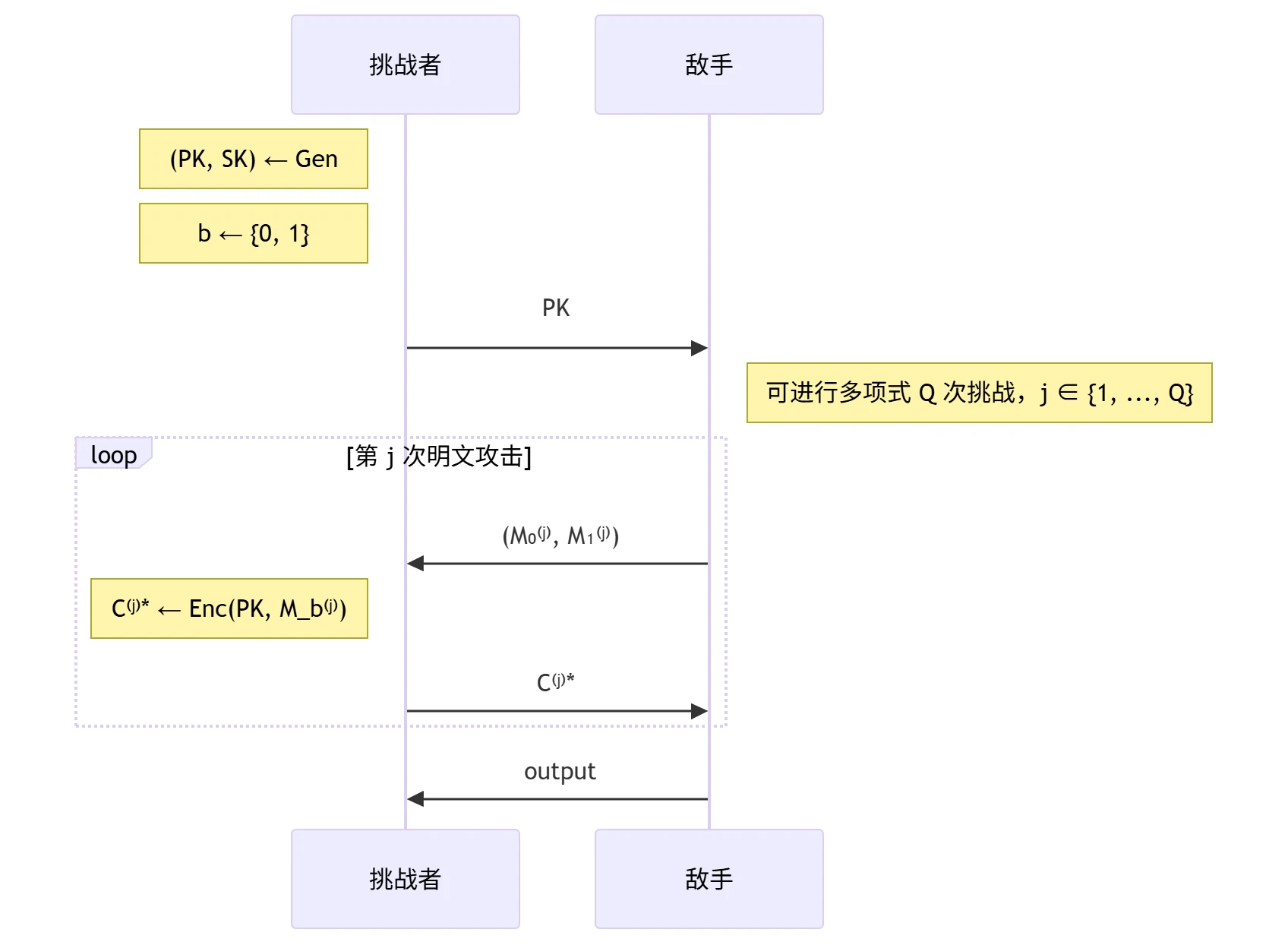
多挑战-选择明文攻击(multiple-challenge Chosen-Plaintext Attacks, mCPA)安全模型:
-
mCPA 敌手攻击能力
-
输入:公开信道中的 \(PK\) 及 多项式 个挑战密文 \(C^{*(1)}, \dots, C^{*(Q)}\)
-
运行时间:概率多项式时间 PPT
-
攻击方式:多挑战-选择明文攻击 mCPA ── 敌手可以提供/决定/影响加密使用的多个明文
-
-
IND 安全目标:敌手无法区分密文 \(C^{*(j)}\) 加密的是 \(M_{0}^{(j)}\) 还是 \(M_{1}^{(j)}\)(即如果 \(\mathrm{output} = b\),则攻破该目标)
-
公钥加密算法的 IND-mCPA 安全性定义:任意概率多项式时间敌手在 mCPA 安全模型中攻破 IND 安全目标的优势是可忽略的,即
\[ \mathrm{Adv} = \left| \Pr(\mathrm{output} = b) - \frac{1}{2} \right| = \mathrm{negl}(\lambda) \]- 等价定义:
\[ \begin{aligned} \mathrm{Adv} = &\frac{1}{2} \left| \Pr(\mathrm{output} = 1 \mid b = 0) - \Pr(\mathrm{output} = 1 \mid b = 1) \right| \\ =& \frac{1}{2} \left| \Pr(\mathrm{output} = 0 \mid b = 0) - \Pr(\mathrm{output} = 0 \mid b = 1) \right| \end{aligned} \] -
IND-CPA 与 IND-mCPA 的等价性:公钥加密算法的 IND-CPA 安全性 \(\iff\) IND-mCPA 安全性
Proof
-
必要性易证(\(\impliedby\)):IND-CPA 是 IND-mCPA \(Q=1\) 的特殊情况
-
充分性证明(\(\implies\)):采用混合论证(Hybrid Arguments)与三角不等式,核心思路是在全加密 \(M_0^{(j)}\) 和全加密 \(M_1^{(j)}\) 两个极端场景之间,插入一系列混合场景(Hybrid),证明相邻混合场景的不可区分性,最终推导出两个极端场景的不可区分性。
-
定义两个极端游戏(Game):设敌手发起 \(Q=\mathrm{poly}(\lambda)\) 次挑战,定义两个基础游戏:
-
Game 0 (\(b=0\)):对所有 \(j=1,\ldots,Q\),加密 \(M_{0}^{(j)}\),即 \(C^{*(j)} \leftarrow \mathrm{Enc}(PK, M_{0}^{(j)})\)
-
Game 1 (\(b=1\)):对所有 \(j=1,\ldots,Q\),加密 \(M_{1}^{(j)}\),即 \(C^{*(j)} \leftarrow \mathrm{Enc}(PK, M_{1}^{(j)})\)
-
-
定义混合游戏(Hybrid Game):在 Game 0 和 Game 1 之间插入 \(Q+1\) 个混合游戏 \(\mathrm{Hybrid}_{i}\),其中 \(i=0,\ldots,Q\),\(\mathrm{Hybrid}_{i}\) 定义为对前 \(i\) 个挑战加密 \(M_{1}^{(j)}\),对后 \(Q-i\) 个挑战加密 \(M_{0}^{(j)}\),即
\[ \mathrm{Hybrid}_{i} : C^{*(j)} \leftarrow \begin{cases} \mathrm{Enc}(PK, M_{1}^{(j)}) & j \leq i \\ \mathrm{Enc}(PK, M_{0}^{(j)}) & j > i \end{cases} \] -
分析混合游戏:易知 Game 0 等价于 \(\mathrm{Hybrid}_{0}\),Game 1 等价于 \(\mathrm{Hybrid}_{Q}\),由 引理:若算法满足 IND-CPA 安全,则对 \(\forall i \in \{1, \dots, Q\}\),有
\[ \left| \Pr(\mathrm{output} = 1 \mid \mathrm{Hybrid}_{i-1}) - \Pr(\mathrm{output} = 1 \mid \mathrm{Hybrid}_{i}) \right| = \mathrm{negl}(\lambda) \] -
累加相邻场景的差距:由三角不等式,最终有
\[ \begin{aligned} \mathrm{Adv} =& \left| \Pr(\mathrm{output} = 1 \mid b = 0) - \Pr(\mathrm{output} = 1 \mid b = 1) \right| \\ =&\left| \Pr(\mathrm{output} = 1 \mid \mathrm{Hybrid}_{0}) - \Pr(\mathrm{output} = 1 \mid \mathrm{Hybrid}_{Q}) \right| \\ =&\left| \sum_{i=1}^{Q} \Pr(\mathrm{output} = 1 \mid \mathrm{Hybrid}_{i-1}) - \Pr(\mathrm{output} = 1 \mid \mathrm{Hybrid}_{i}) \right| \\ \leq& \sum_{i=1}^{Q} \left| \Pr(\mathrm{output} = 1 \mid \mathrm{Hybrid}_{i-1}) - \Pr(\mathrm{output} = 1 \mid \mathrm{Hybrid}_{i}) \right| \\ =& Q(\lambda) \cdot \mathrm{negl}(\lambda) \\ =& \mathrm{negl}(\lambda) \end{aligned} \]即 Game 0 与 Game 1 的差距是可忽略的,算法满足 IND-mCPA 安全性。
-
-
引理证明:采用反证法,由区分 \(\mathrm{Hybrid}_{i-1}\) 与 \(\mathrm{Hybrid}_{i}\) 的敌手 \(\mathcal{A}\) 来构造攻破 IND-CPA 安全性的敌手 \(\mathcal{B}\)。
-
\(\mathrm{Hybrid}_{i-1}\) 与 \(\mathrm{Hybrid}_{i}\) 的差别只在于第 \(i\) 个挑战密文,与 IND-CPA 刻画的安全性十分接近。
-
假设存在一个概率多项式时间敌手 \(\mathcal{A}\),以不可忽略的概率区分 \(\mathrm{Hybrid}_{i-1}\) 与 \(\mathrm{Hybrid}_{i}\),即
\[ \mathrm{Adv}_\mathcal{A} = \left| \Pr(\mathrm{output}_\mathcal{A} = 1 \mid \mathrm{Hybrid}_{i-1}) - \Pr(\mathrm{output}_\mathcal{A} = 1 \mid \mathrm{Hybrid}_{i}) \right| = \text{non-negl}(\lambda) \] -
构造针对 IND-CPA 安全性的敌手 \(\mathcal{B}\):
-
\(\mathcal{B}\) 将 IND-CPA 实验中的 \(PK\) 交给 \(\mathcal{A}\)
-
\(\mathcal{B}\) 接收 \(\mathcal{A}\) 的前 \(i-1\) 对明文 \((M_{0}^{(j)}, M_{1}^{(j)})\),修改为 \((M_{1}^{(j)}, M_{1}^{(j)})\) 进行 IND-CPA 实验,相当于固定加密 \(M_{1}^{(j)}\),将密文交给 \(\mathcal{A}\)
-
\(\mathcal{B}\) 接收 \(\mathcal{A}\) 的第 \(i\) 对明文 \((M_{0}^{(i)}, M_{1}^{(i)})\),将其作为 IND-CPA 实验的挑战明文,接收挑战密文 \(C^{*(i)}\) 交给 \(\mathcal{A}\)
-
\(\mathcal{B}\) 接收 \(\mathcal{A}\) 的后 \(Q-i\) 对明文 \((M_{0}^{(j)}, M_{1}^{(j)})\),同理,加密 \(M_{0}^{(j)}\) 交给 \(\mathcal{A}\)
-
-
则 \(\mathcal{B}\) 的输出 \(\mathrm{output}_{\mathcal{B}} = \begin{cases} 0 & \mathrm{output}_{\mathcal{A}}=0 \\ 1 & \mathrm{output}_{\mathcal{A}}=1 \end{cases}\)
-
\(\mathcal{B}\) 的优势:
\[ \begin{aligned} \mathrm{Adv}_\mathcal{B} = &\left| \Pr(\mathrm{output}_{\mathcal{B}} = b) - \frac{1}{2} \right| \\ =& \frac{1}{2} \left| \Pr(\mathrm{output}_{\mathcal{B}} = 1 \mid b=0) - \Pr(\mathrm{output}_{\mathcal{B}} = 1 \mid b=1) \right| \\ =& \frac{1}{2} \left| \Pr(\mathrm{output}_{\mathcal{A}} = 1 \mid \mathrm{Hybrid}_{i-1}) - \Pr(\mathrm{output}_{\mathcal{A}} = 1 \mid \mathrm{Hybrid}_{i}) \right| \\ =& \frac{1}{2} \cdot \text{non-negl}(\lambda) =\text{non-negl}(\lambda) \end{aligned} \]
-
-
则 \(\mathcal{B}\) 能以不可忽略的优势打破 IND-CPA 安全性,与假设矛盾,因此引理成立。
-
-
公钥加密算法的 IND-CCA 安全性
-
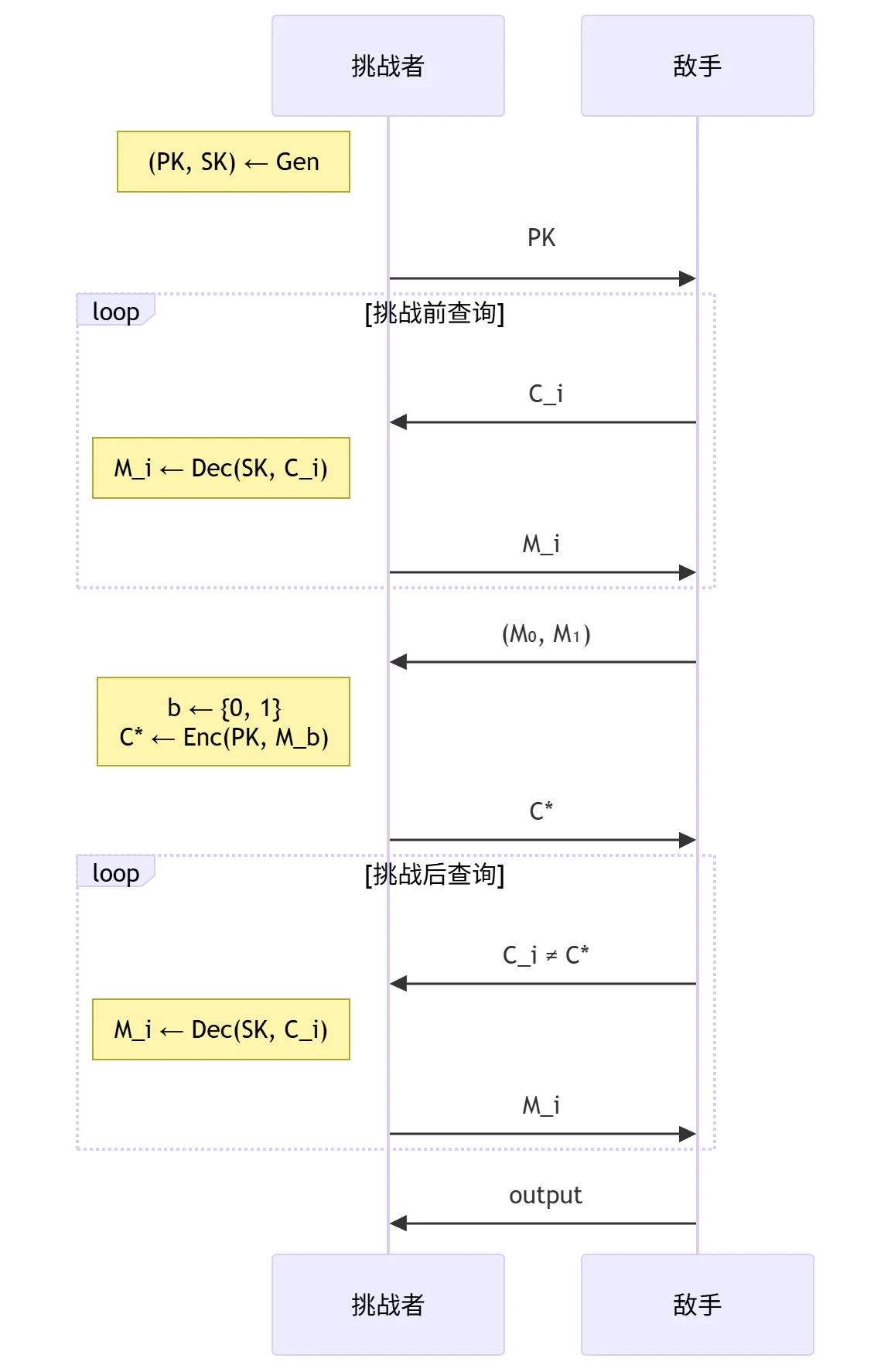
选择密文攻击(Chosen-Ciphertext Attacks, CCA)安全模型:
-
CCA 敌手攻击能力:
-
输入:公开信道中的 \(PK\) 及挑战密文 \(C^{*}\)
-
运行时间:概率多项式时间 PPT
-
攻击方式:
-
选择明文攻击:敌手可以提供/决定/影响加密使用的明文
-
选择密文攻击:敌手可以获得除 \(C^{*}\) 外任意密文的解密结果
-
-
-
IND 安全目标:敌手无法区分密文 \(C^{*}\) 加密的是 \(M_{0}\) 还是 \(M_{1}\)(即如果 \(\mathrm{output} = b\),则攻破该目标)
-
公钥加密算法的 IND-CCA 安全性定义:任意概率多项式时间敌手在 CCA 安全模型中攻破 IND 安全目标的优势是可忽略的,即
\[ \mathrm{Adv} = \left| \Pr(\mathrm{output} = b) - \frac{1}{2} \right| = \mathrm{negl}(\lambda) \]
ElGamal 加密算法
群的基本知识
-
设 \((G,\cdot,1)\) 为 有限交换群,其中 \(1\) 为 \(G\) 中关于运算 \(\cdot\) 的单位元,则群 \(G\) 满足以下性质:
-
有限性:\(|G| < \infty\)
-
封闭性:\(\forall a, b \in G\),\(a \cdot b \in G\)
-
交换性:\(\forall a, b \in G\),\(a \cdot b = b \cdot a\)
-
单位元:\(\forall a \in G\),\(a \cdot 1 = 1 \cdot a = a\)
-
逆元:\(\forall a \in G\),存在 \(a^{-1} \in G\),使得 \(a \cdot a^{-1} = a^{-1} \cdot a = 1\)
-
-
生成元(Generator):\(a \in G\),集合 \(\langle a \rangle = \{a^{i} : i \in \mathbb{Z}\}\) 是 \(G\) 的子群,称为循环子群(Cyclic Subgroup),称 \(a\) 为循环群 \(\langle a \rangle\) 的生成元。
-
特别地,如果 \(\langle g \rangle = G\),则称 \(g\) 是 \(G\) 的生成元,\(G\) 是由 \(g\) 生成的循环群。
-
群的阶:\(|\langle a \rangle| = \mathrm{ord}(a) = \min\{n \in \mathbb{N} : a^{n} = 1\}\),即 \(a\) 的阶。
- 拉格朗日定理:\(\mathrm{ord}(a) \mid |G|\)
-
素数阶群:如果 \(G\) 的阶 \(|G|\) 是素数,则 \(G\) 中的任意非单位元都是生成元,且 \(G\) 为循环群。
-
如果群 \(G=\langle g \rangle\) 为循环群,则 \(G\) 中元素的运算为 \(\log|G|\) 的多项式时间。
-
-
离散对数(Discrete Logarithm, DLOG):对于 \(a \in G\) 和 \(b = a^{x} \in \langle a \rangle\),则称 \(x\in\{0,1,\dots,\mathrm{ord}(a)-1\}\) 为 \(b\) 相对于 \(a\) 的离散对数,记为 \(\mathrm{DLOG}_{G,a}(b)\)。
-
DLOG 问题的困难性与群的运算有关。
-
公认 DLOG 计算困难的群:
-
有限域的子群:\(G\) 为模 \(n\) 乘法群 \((\mathbb{Z}_n^*, \cdot)\) 的 \(p\) 阶循环子群,其中 \(n = 2p + 1\),且 \(n\) 和 \(p\) 均为素数。
- 有限域上的离散对数问题(FFDLP)在数域筛法 NFS 下的求解复杂度为 \(O\left(2^{\log^{\frac{1}{3}} p \cdot \log \log^{\frac{2}{3}} p}\right)\),为亚指数级别。
-
椭圆曲线群:\(G=(E(\mathbb{Z}_p), +)\),其中 \(E(\mathbb{Z}_p)\) 是定义在有限域 \(\mathbb{Z}_p\) 上的椭圆曲线 \(E\) 的点集,运算为点加法。
- 椭圆曲线上的离散对数问题(ECDLP)在 Pollard's rho 算法下的求解复杂度为 \(O(\sqrt{p})=O(2^{\frac{1}{2} \log p})\),为指数级别。
-
-
底层困难问题
-
离散对数问题(Discrete Logarithm, DLOG):\(G\) 为循环群,其阶为素数 \(p\)、生成元为 \(g\),并均匀选取 \(h \leftarrow G\)
-
输入:\((G, p, g, h)\)
-
输出:\(d = \mathrm{DLOG}_g\, h\)
-
-
计算性 Diffie-Hellman 问题(Computational Diffie-Hellman, CDH):\(G\) 为循环群,其阶为素数 \(p\)、生成元为 \(g\),均匀选取 \(x, y \leftarrow \mathbb{Z}_p\)
-
输入:\((G, p, g, g^x, g^y)\)
-
输出:\(g^{xy}\),也称为 \((g^x, g^y)\) 的 CDH 值
-
-
判定性 Diffie-Hellman 问题(Decisional Diffie-Hellman, DDH):\(G\) 为循环群,其阶为素数 \(p\)、生成元为 \(g\),均匀选取 \(x, y, z \leftarrow \mathbb{Z}_p, \beta \leftarrow \{0, 1\}\),并定义 \(z_\beta = \begin{cases} g^{xy} & \beta=0 \\ g^{z} & \beta=1 \end{cases}\)
-
输入:\((G, p, g, g^x, g^y, z_\beta)\)
-
输出:\(\beta\)
-
DDH 问题的困难性:任意 PPT 敌手在 DDH 安全模型中攻破 DDH 安全目标的优势是可忽略的,即
\[ \mathrm{Adv} = \left| \Pr(\mathrm{output} = \beta) - \frac{1}{2} \right| = \mathrm{negl}(\lambda) \]
-
-
定理:DDH 问题困难 \(\implies\) CDH 问题困难 \(\implies\) DLOG 问题困难
ElGamal 加密算法简介
-
密钥生成算法 \((PK, SK) \leftarrow \mathrm{Gen}(1^\lambda)\):
-
选择循环群 \(G\),其阶为素数 \(p\)、生成元为 \(g\)
-
均匀选取 \(s \leftarrow \mathbb{Z}_p\),计算 \(h := g^s\)
-
输出 \(PK = (G, p, g, h)\),\(SK = s\)
-
-
加密算法 \(C \leftarrow \mathrm{Enc}(PK, M)\):消息空间为 \(\mathbb{M} = G\)
-
均匀选取 \(r \leftarrow \mathbb{Z}_p\)
-
计算 \(C_1 := g^r\)
-
计算 \(C_2 := h^r \cdot M\)
-
输出 \(C := (C_1, C_2)\)
-
-
解密算法 \(M' \leftarrow \mathrm{Dec}(SK, C = (C_1, C_2))\):
- 计算并输出 \(M' := C_2 \cdot (C_1^s)^{-1}\)
ElGamal 加密算法的 IND-CPA 安全性
-
定理:DDH 问题困难 \(\iff\) ElGamal 算法是 IND-CPA 安全的
Proof
-
充分性证明(\(\implies\)):反证法(安全性归约)
-
假设结论错误:ElGamal 算法不是 IND-CPA 安全的,即存在一个概率多项式时间敌手 \(\mathcal{A}\),以不可忽略的概率在 ElGamal 算法 CPA 安全模型中攻破 IND 安全目标,即
\[ \mathrm{Adv}_\mathcal{A} = \left| \Pr(\mathrm{output}_\mathcal{A} = b) - \frac{1}{2} \right| = \text{non-negl}(\lambda) \] -
证明前提错误:构造一个概率多项式时间敌手 \(\mathcal{B}\),在 DDH 安全模型中攻破 DDH 安全目标。
-
\(\mathcal{B}\) 的输入:\((G, p, g, g^x, g^y, z_\beta)\)
-
调用子敌手:\(\mathcal{B}\) 将 \(PK = (G, p, g, h=g^x)\) 交给 \(\mathcal{A}\),\(\mathcal{A}\) 输入两个消息 \(M_0, M_1 \in G\),\(\mathcal{B}\) 将挑战密文设置为 \(C^{*} = (g^y, z_\beta \cdot M_b)\) 交给 \(\mathcal{A}\),则
-
\(\beta = 0\) 时:\(C^{*} = (g^y, M_b \cdot g^{xy})\),与 ElGamal 加密 \(M_b\) 的密文分布相同,则
\[ \left|\Pr(\mathrm{output}_\mathcal{A}=b\mid \beta=0) - \frac{1}{2}\right| = \left| \Pr(\mathrm{output}_\mathcal{A} = b) - \frac{1}{2} \right| = \text{non-negl}(\lambda) \]也即 \(\Pr(\mathrm{output}_\mathcal{A}=b \mid \beta=0) = \frac{1}{2} \pm \text{non-negl}(\lambda)\)
-
\(\beta = 1\) 时:\(C^{*} = (g^y, M_b \cdot g^{z})\),由于 \(z \leftarrow \mathbb{Z}_p\) 均匀分布,\(M_b \cdot g^{z}\) 也均匀分布在 \(G\) 中,则密文不包含任何关于 \(b\) 的信息,\(\Pr(\mathrm{output}_\mathcal{A}=b \mid \beta=1) = \frac{1}{2}\)
-
-
\(\mathcal{B}\) 的输出:\(\mathrm{output}_\mathcal{B} = \begin{cases} 0 & \mathrm{output}_\mathcal{A} = b \\ 1 & \mathrm{output}_\mathcal{A} \neq b \end{cases}\)
-
\(\mathcal{B}\) 的优势:
\[ \begin{aligned} \mathrm{Adv}_\mathcal{B} =& \left| \Pr(\mathrm{output}_\mathcal{B} = \beta) - \frac{1}{2} \right| \\ =& \frac{1}{2} \left| \Pr(\mathrm{output}_\mathcal{B} = 0 \mid \beta = 0) - \Pr(\mathrm{output}_\mathcal{B} = 0 \mid \beta = 1) \right| \\ =& \frac{1}{2} \left| \Pr(\mathrm{output}_\mathcal{A} = b \mid \beta = 0) - \Pr(\mathrm{output}_\mathcal{A} = b \mid \beta = 1) \right| \\ =& \frac{1}{2} \left| \left( \frac{1}{2} \pm \text{non-negl}(\lambda) \right) - \frac{1}{2} \right| \\ =& \frac{1}{2} \cdot \text{non-negl}(\lambda) = \text{non-negl}(\lambda) \end{aligned} \] -
则 \(\mathcal{B}\) 能以不可忽略的优势打破 DDH 安全性,与假设矛盾,因此 ElGamal 算法满足 IND-CPA 安全性。
-
-
-
必要性证明(\(\impliedby\)):反证法(安全性归约)
-
假设结论错误:DDH 问题不困难,即存在一个概率多项式时间敌手 \(\mathcal{B}\),以不可忽略的概率在 DDH 安全模型中攻破 DDH 安全目标,即
\[ \mathrm{Adv}_\mathcal{B} = \left| \Pr(\mathrm{output}_\mathcal{B} = \beta) - \frac{1}{2} \right| = \text{non-negl}(\lambda) \] -
证明前提错误:构造一个概率多项式时间敌手 \(\mathcal{A}\),在 ElGamal 算法 CPA 安全模型中攻破 IND 安全目标。
-
\(\mathcal{A}\) 的输入:\(PK = (G, p, g, h=g^s)\) 和 \(C^* = (C_1, C_2) = (g^r, M_b\cdot h^r)\)
-
调用子敌手:\(\mathcal{A}\) 将 \((G, p, g, g^s, g^r, C_2/M_0)\) 交给 \(\mathcal{B}\),
-
\(b = 0\) 时:\(C_2 = M_0 \cdot g^{sr}\),则 \(C_2/M_0 = g^{sr}\),与 DDH 问题中取 \(\beta = 0\) 等价
-
\(b = 1\) 时:\(C_2 = M_1 \cdot g^{sr}\),则 \(C_2/M_0 = M_1/M_0 \cdot g^{sr}\),由于 \(M_0, M_1\) 均匀分布在 \(G\) 中,则 \(C_2/M_0\) 也均匀分布在 \(G\) 中,与 DDH 问题中取 \(\beta = 1\) 等价
-
-
\(\mathcal{A}\) 的输出:\(\mathrm{output}_\mathcal{A} = \begin{cases} 0 & \mathrm{output}_\mathcal{B} = 0 \\ 1 & \mathrm{output}_\mathcal{B} = 1 \end{cases}\)
-
\(\mathcal{A}\) 的优势:
\[ \begin{aligned} \mathrm{Adv}_\mathcal{A} =& \left| \Pr(\mathrm{output}_\mathcal{A} = b) - \frac{1}{2} \right| \\ =& \frac{1}{2} \left| \Pr(\mathrm{output}_\mathcal{A} = 0 \mid b = 0) - \Pr(\mathrm{output}_\mathcal{A} = 0 \mid b = 1) \right| \\ =& \frac{1}{2} \left| \Pr(\mathrm{output}_\mathcal{B} = 0 \mid b = 0) - \Pr(\mathrm{output}_\mathcal{B} = 0 \mid b = 1) \right| \\ =& \frac{1}{2} \left| \Pr(\mathrm{output}_\mathcal{B} = 0 \mid \beta = 0) - \Pr(\mathrm{output}_\mathcal{B} = 0 \mid \beta = 1) \right| \\ =& \mathrm{Adv}_\mathcal{B} = \text{non-negl}(\lambda) \end{aligned} \] -
则 \(\mathcal{A}\) 能以不可忽略的优势打破 ElGamal 算法的 IND-CPA 安全性,与假设矛盾,因此 DDH 问题困难。
-
-
-
ElGamal 加密算法不满足 IND-CCA 安全性
-
攻击思路:利用 CCA 安全模型中敌手可以获得除密文之外的任何信息的能力,构造一个敌手 \(\mathcal{A}\),在 CCA 安全模型中攻破 ElGamal 算法的 IND-CCA 安全性。
-
\(\mathcal{A}\) 的输入:\(PK = (G, p, g, h=g^s)\) 和密文 \(C^* = (C_1^*, C_2^*) = (g^r, M_b\cdot h^r)\)
-
\(\mathcal{A}\) 对 \(C^*\) 进行修改,构造一个新的密文 \(C' = (C_1', C_2') = (C_1^*, C_2^* \cdot M')\) 进行解密查询,得到 \(M'' = M_b \cdot M'\)
-
\(\mathcal{A}\) 的输出:\(\mathrm{output} = \begin{cases} 0 & M''/M' = M_0 \\ 1 & M''/M' = M_1 \end{cases}\)
-
则 \(\mathcal{A}\) 能以概率 1 打破 ElGamal 算法的 IND-CCA 安全性。
-
数字签名算法的安全性定义以及 Schnorr 签名算法
数字签名算法的安全性
数字签名简介
-
数字签名的要求:
-
可认证性:能够验证消息源,以及消息的真实性/完整性
-
不可否认性:签名能够被公开验证
-
-
数字签名实现安全认证的条件:
-
生成签名相对容易
-
识别和验证签名相对容易
-
在计算上不可伪造:
-
对新消息伪造签名不可行
-
对已有签名伪造新签名并通过认证不可行
-
-
数字签名算法的语义及正确性要求
-
语义:一个数字签名方案 \(\mathrm{DS}\) 包含三个概率多项式时间(PPT)算法 \((\mathrm{Gen}, \mathrm{Sign}, \mathrm{Verify})\):
-
密钥生成算法:\((PK, SK) \leftarrow \mathrm{Gen}(1^\lambda)\):⼀般为概率性算法
-
签名算法:\(\sigma \leftarrow \mathrm{Sign}(SK, M)\):\(M \in \mathbb{M}\),其中 \(\mathbb{M}\) 是消息空间
-
验证算法:\(0/1 \leftarrow \mathrm{Verify}(PK, M, \sigma)\):一般为确定性算法;输出 \(1\) 表示验证通过
-
-
正确性要求(Correctness):对任意 \((PK, SK) \leftarrow \mathrm{Gen}(1^\lambda)\)、任意 \(M \in \mathbb{M}\)、任意 \(\sigma \leftarrow \mathrm{Sign}(SK, M)\),均有
\[ \mathrm{Verify}(PK, M, \sigma) = 1 \]
数字签名算法的 EUF-CMA 安全性
-
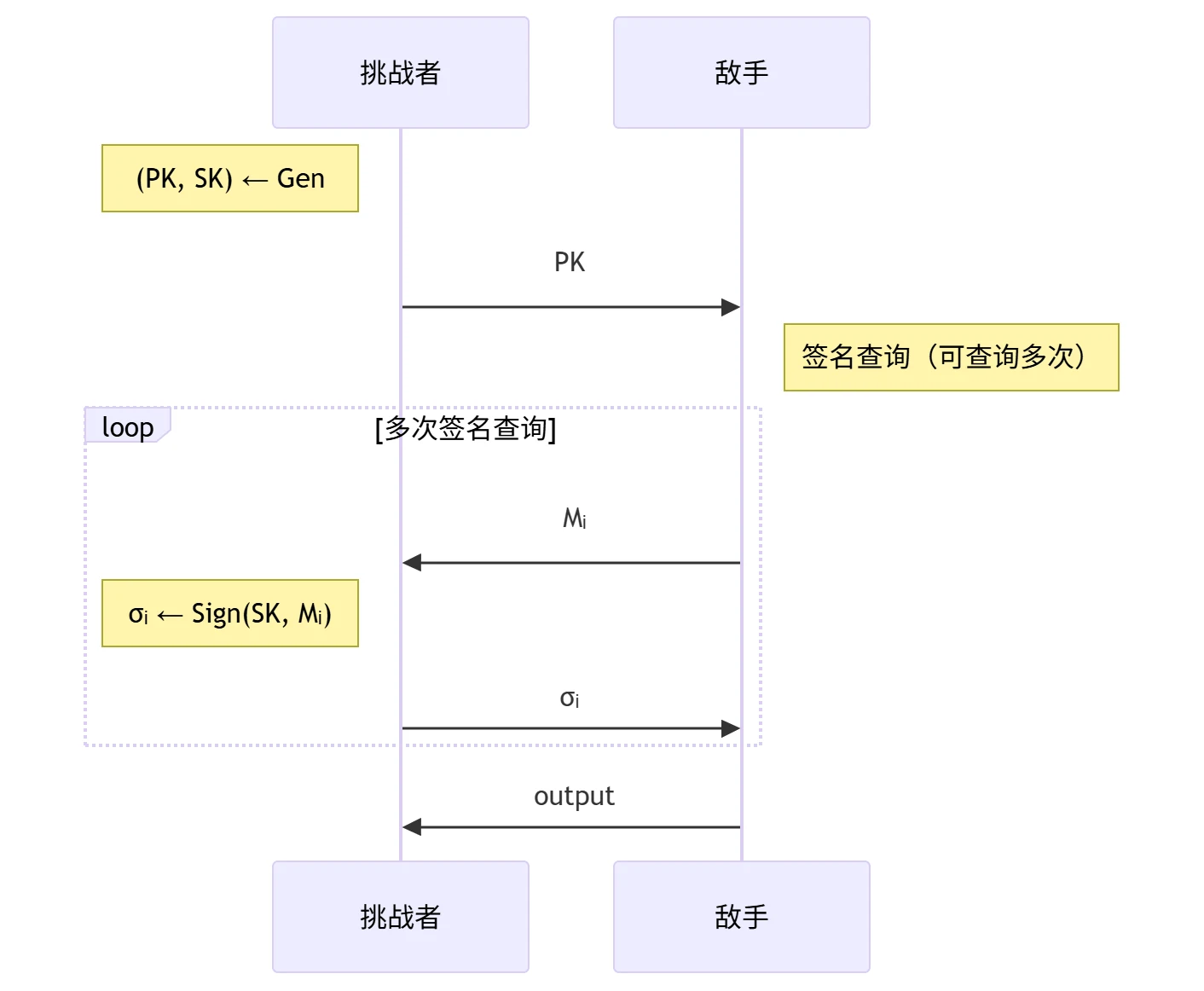
选择消息攻击(Chosen Message Attacks, CMA)安全模型:
-
CMA 敌手攻击能力:
-
输入:公开信道中的 \(PK, M, \sigma\)
-
运行时间:概率多项式时间 PPT
-
攻击方式:选择消息攻击 CMA ── 敌手可以提供/决定/影响签名使用的消息
-
-
EUF 安全目标:存在不可伪造性(Existential Unforgeability, EUF)── 敌手无法为一个 未查询过的新消息 \(M^*\) 伪造有效签名 \(\sigma^*\)(即如果 \(\mathrm{output} = (M^*, \sigma^*)\),满足 \(M^* \notin \{M_i\}\) 和 \(\mathrm{Verify}(PK, M^*, \sigma^*) = 1\),则攻破该目标)
-
数字签名算法的 EUF-CMA 安全性定义: 任意概率多项式时间敌手在 CMA 安全模型中攻破 EUF 安全目标的 优势 是可忽略的,即
\[ \mathrm{Adv}_{\mathrm{EUF-CMA}} = \Pr\left[ \mathrm{output} = (M^*, \sigma^*) \left| \begin{array}{l} (1)\ M^* \notin \{ M_i \} \\ (2)\ \mathrm{Verify}(\mathrm{PK}, M^*, \sigma^*) = 1 \end{array} \right.\right] = \mathrm{negl}(\lambda) \]
数字签名算法的 sEUF-CMA 安全性
-
sEUF 安全目标:强存在不可伪造性(Strong Existential Unforgeability, sEUF)── 敌手不仅无法为一个 未查询过的新消息 \(M^*\) 伪造有效签名 \(\sigma^*\),也无法为一个已签名消息 \(M_i\) 伪造 新的有效签名 \(\sigma^* \neq \sigma_i\)(即如果 \(\mathrm{output} = (M^*, \sigma^*)\),满足 \((M^*, \sigma^*) \notin \{(M_i, \sigma_i)\}\) 和 \(\mathrm{Verify}(PK, M^*, \sigma^*) = 1\),则攻破该目标)
-
数字签名算法的 sEUF-CMA 安全性定义: 任意概率多项式时间敌手在 CMA 安全模型中攻破 sEUF 安全目标的 优势 是可忽略的,即
\[ \mathrm{Adv}_{\mathrm{sEUF-CMA}} = \Pr\left[ \mathrm{output} = (M^*, \sigma^*) \left| \begin{array}{l} (1)\ (M^*, \sigma^*) \notin \{ (M_i, \sigma_i) \} \\ (2)\ \mathrm{Verify}(\mathrm{PK}, M^*, \sigma^*) = 1 \end{array} \right.\right] = \mathrm{negl}(\lambda) \]
EUF-CMA 与 sEUF-CMA 安全性之间的关系
-
一般情况:sEUF-CMA 安全 \(\impliedby\) EUF-CMA 安全
\[ \mathrm{Adv}_{\mathrm{sEUF-CMA}} \leq \mathrm{Adv}_{\mathrm{EUF-CMA}} \] -
若满足唯一性要求:sEUF-CMA 安全 \(\iff\) EUF-CMA 安全
\[ \mathrm{Adv}_{\mathrm{sEUF-CMA}} = \mathrm{Adv}_{\mathrm{EUF-CMA}} \]- 唯一性要求(uniqueness):\(\forall (PK,SK) \leftarrow \mathrm{Gen}(1^\lambda), \forall M \in \mathbb{M}\),存在唯一的 \(\sigma\) 使得 \(\mathrm{Verify}(PK, M, \sigma) = 1\)。
身份证明协议的安全性
身份证明协议简介
-
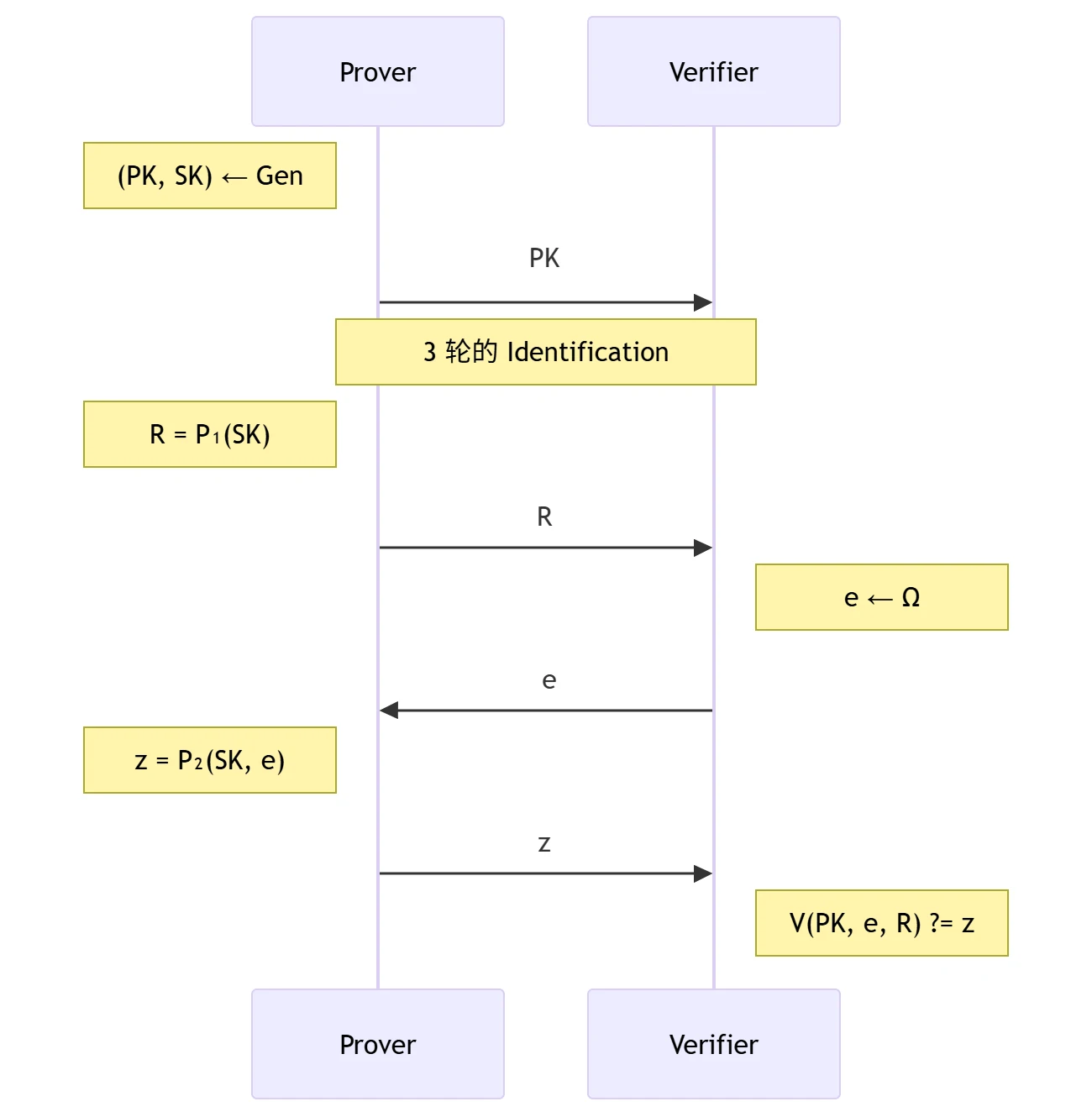
核心:证明者向验证者证明自己拥有公钥 \(PK\) 所对应的私钥 \(SK\)
-
交互流程(3 轮的 Identification):
身份证明协议的 UI-PA 安全性
-
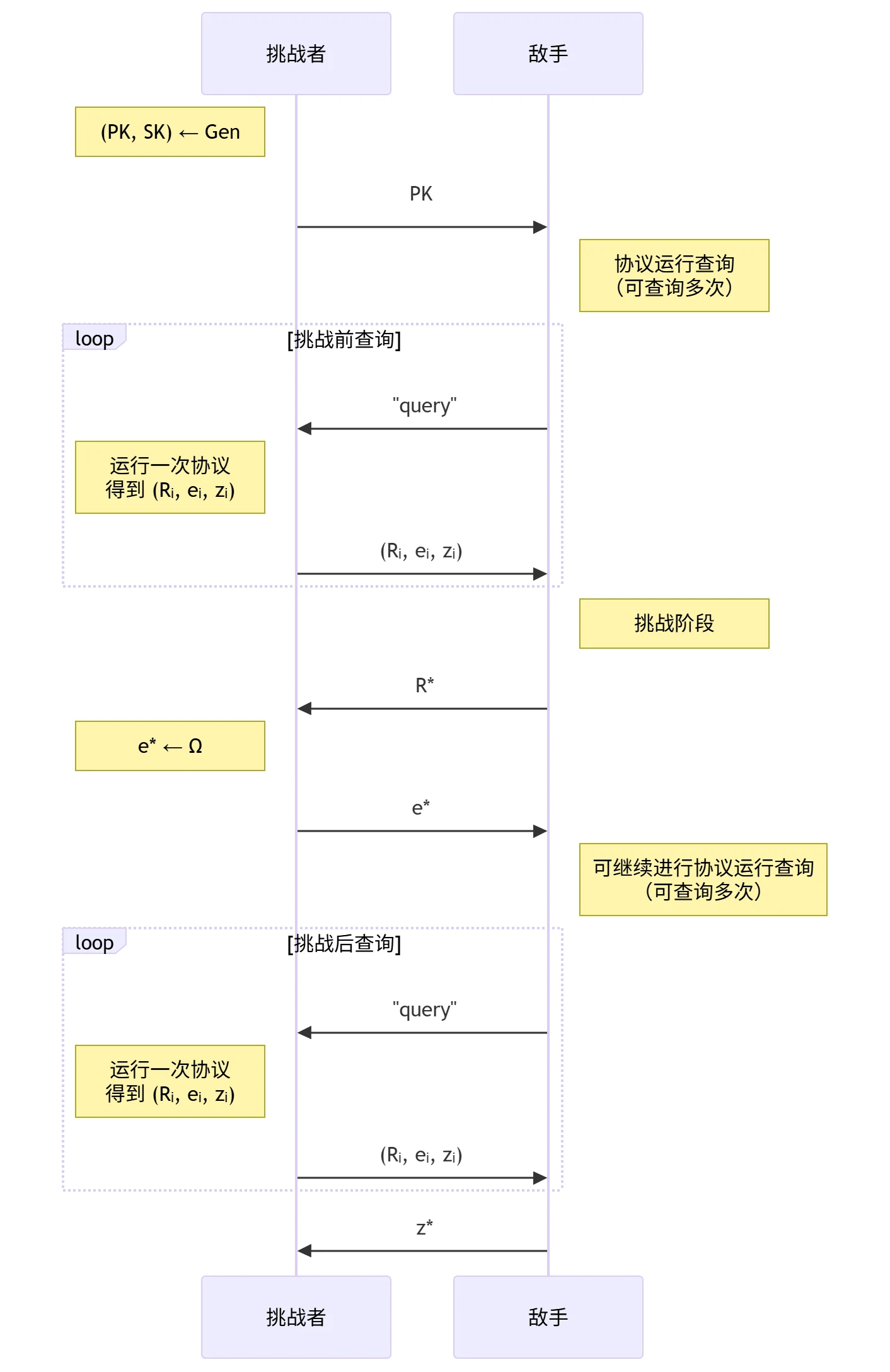
被动攻击(Passive Attacks, PA)安全模型:
-
PA 敌手攻击能力:
-
输入:公开信道中的 \(PK\) 及多次运行协议生成的 \((R_i, e_i, z_i)\)
-
运行时间:概率多项式时间 PPT
-
-
UI 安全目标:不可假冒性(Unimpersonation, UI)── 敌手无法冒充 Prover 通过协议的验证算法(即如果 \(\mathrm{output} = (R^*, e^*, z^*)\) 满足 \(V(PK, e^*, R^*) = z^*\),则攻破该目标)
-
身份证明协议的 UI-PA 安全性定义:任意概率多项式时间敌手在 P A 安全模型中攻破 UI 安全目标的 优势 是可忽略的,即
\[ \mathrm{Adv}_{\mathrm{UI-PA}} = \Pr\left( \mathrm{output} = z^* \left| V(PK, e^*, R^*) = z^* \right.\right) = \mathrm{negl}(\lambda) \]
Fiat-Shamir 变换
-
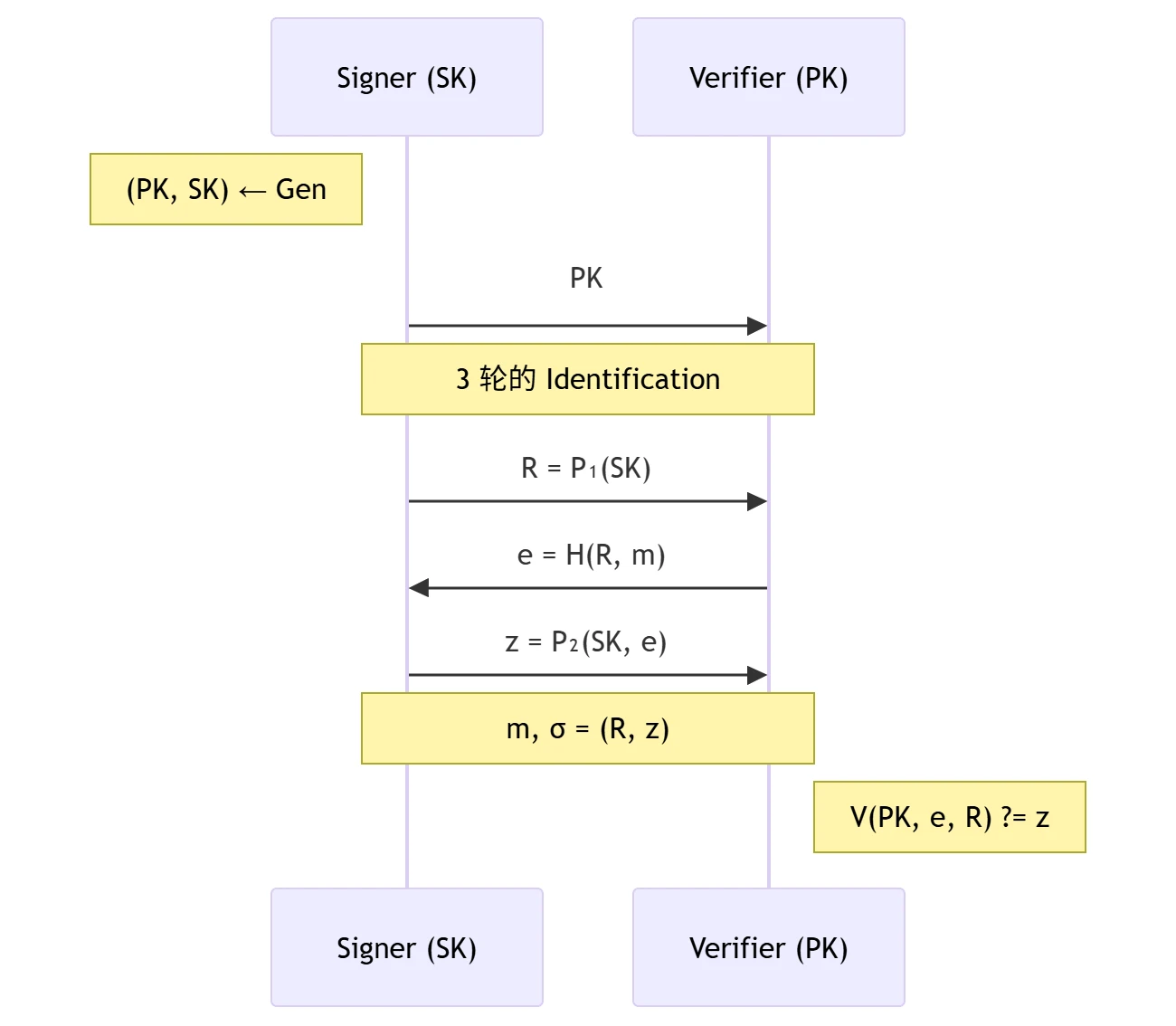
核心:为了使用身份证明协议进行签名,证明者(签名者)可将挑战 \(e\) 用哈希函数 \(\mathrm{H}(\cdot)\) 计算,自己独立地执行协议,无需与验证者交互。
-
交互流程:
-
Fiat-Shamir 变换的安全性:身份证明协议是 UI-PA 安全的 + \(\mathrm{H}\) 为 RO \(\implies\) 通过 Fiat-Shamir 变换得到的签名算法是 EUF-CMA 安全的
- 证明:参考后续 Schnorr 签名算法的安全性证明
Random Oracle 模型(随机预言机)
-
Random Oracle 模型(随机预言机)是对哈希函数 \(\mathrm{H}: G \to \{0,1\}^{m}\) 的假设,用于安全性证明中。
-
核心假设:
-
Oracle-预言机假设:敌手无法自己计算 \(\mathrm{H}\) 的值,只能通过查询“预言机” \(\mathrm{H}(\cdot)\) 的方式获得 \(\mathrm{H}\) 的值:每一次查询,敌手向预言机 \(\mathrm{H}(\cdot)\) 提交一个 \(X\),\(\mathrm{H}(\cdot)\) 返回输出 \(\mathrm{H}(X)\)。
-
Random-随机性假设:随机预言机 \(\mathrm{H}(\cdot)\) 在每一个 \(X\) 上的输出值 \(\mathrm{H}(X)\) 都是服从值域 \(\{0,1\}^m\) 上均匀分布的,其随机性来源于预言机 \(\mathrm{H}(\cdot)\) 内部。
-
Programmable-可编程性假设:在安全性证明中,“随机预言机” \(\mathrm{H}(\cdot)\) 由环境/挑战者向敌手提供。
-
-
推论:
-
Oracle 假设 + Random 假设:如果敌手没有向预言机 \(\mathrm{H}(\cdot)\) 查询过某个输入 \(X\),那么 \(\mathrm{H}(X)\) 的值对于敌手而言是完全均匀的。
-
Oracle 假设 + Programmable 假设:环境/挑战者知道敌手向预言机 \(\mathrm{H}(\cdot)\) 查询过哪些输入 \(X\)。
-
Random 假设 + Programmable 假设:环境/挑战者针对敌手的每一次预言机 \(\mathrm{H}(\cdot)\) 查询 \(X\),返回值域 \(\{0,1\}^m\) 上均匀分布的值作为 \(\mathrm{H}(X)\) 的值。
-
-
说明:
- RO 模型刻画了敌手只能 黑盒 的调用 Hash Function,敌手无法仅阅读 Hash Function 的代码而不调用 Hash Function 推断出 \(\mathrm{H}(X)\) 的值。
Schnorr 身份证明协议与签名算法
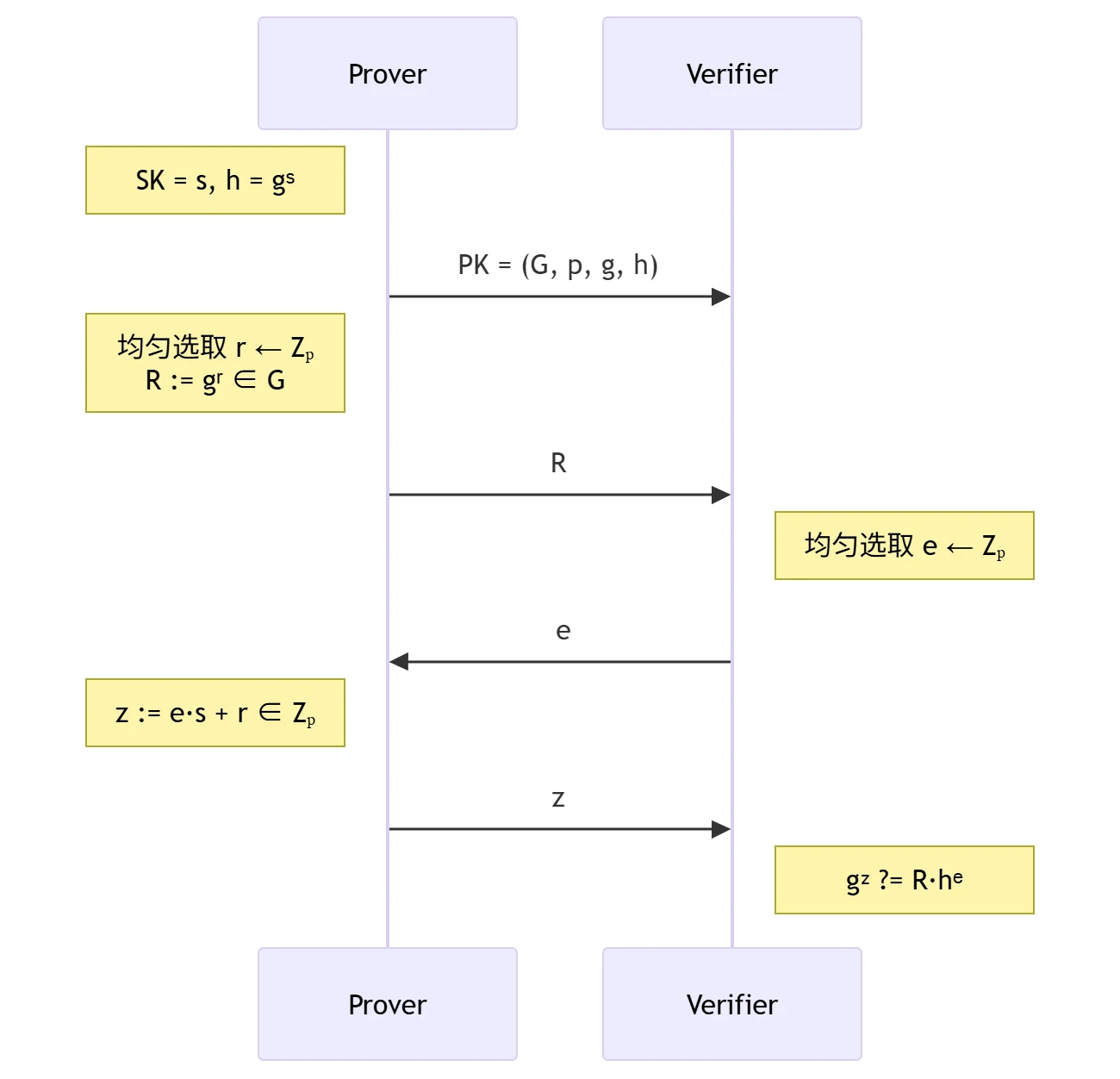
Schnorr 身份证明协议
-
目的:Prover 向 Verifier 证明自己拥有 \(PK\) 所对应的私钥 \(SK\)。
-
交互流程:基于椭圆曲线上的离散对数问题
Schnorr 签名算法
-
组件:Hash Function \(\mathrm{H}: \{0,1\}^{*} \to \mathbb{Z}_p\)
-
密钥生成算法 \((PK, SK) \leftarrow \mathrm{Gen}(1^\lambda)\):
-
选择循环群 \(G\),其阶为素数 \(p\)、生成元为 \(g\)
-
均匀选取 \(s \leftarrow \mathbb{Z}_p\),计算 \(h := g^s \in G\)
-
输出 \(PK = (G, p, g, h)\),\(SK = s\)
-
-
签名算法 \(\sigma \leftarrow \mathrm{Sign}(SK, M)\),消息空间为 \(\mathbb{M}=\{0,1\}^{*}\)
-
均匀选取 \(r \leftarrow \mathbb{Z}_{p}\),计算 \(R:=g^{r} \in G\)
-
计算 \(e:=\mathrm{H}(R, M) \in \mathbb{Z}_{p}\)
-
计算 \(z:=e \cdot s+r \in \mathbb{Z}_{p}\)
-
输出 \(\sigma:=(R, z)\)
-
-
验证算法 \(0/1 \leftarrow \mathrm{Verify}(PK, M, \sigma=(R, z))\)
-
计算 \(e:=\mathrm{H}(R, M) \in \mathbb{Z}_{p}\)
-
验证 \(g^{z} \stackrel{?}{=} h^{e} \cdot R\),相等输出 \(1\),否则输出 \(0\)
-
安全性分析
Schnorr 签名算法的 EUF-CMA 安全性
-
断言 1:如果在数字签名的 EUF-CMA 安全模型下,存在攻击者 \(\mathcal{A}\) 以不可忽略的概率攻破 Schnorr 签名。设 \(\mathcal{A}\) 的输出为 \((M^{*}, \sigma^{*}=(R^{*}, z^{*}))\),即
\[ \mathrm{Adv}_{\mathcal{A}}=\Pr\left(\mathrm{output}_{\mathcal{A}}=(M^{*}, \sigma^{*})\left| h^{\mathrm{H}(R^{*}, M^{*})} \cdot R^{*}=g^{z^{*}}\right.\right)=\text{non-negl}(\lambda) \]则 \(\mathcal{A}\) 以不可忽略的概率查询过 \((R^{*}, M^{*})\) 的 Hash 值。
Proof
-
证明:反证法,假设 \(\mathcal{A}\) 没有查询过 \((R^{*}, M^{*})\) 的 Hash 值,则在 \(\mathrm{H}\) 为 RO 假设下,\(\mathrm{H}(R^{*}, M^{*})\) 对 \(\mathcal{A}\) 是 \(\mathbb{Z}_{p}\) 中均匀随机的元素,因此 \(h^{\mathrm{H}(R^{*}, M^{*})}\) 对 \(\mathcal{A}\) 是 \(G\) 中均匀随机的元素。则 \(\mathcal{A}\) 猜对 \(z^{*} \in \mathbb{Z}_{p}\) 满足
\[ h^{\mathrm{H}(R^{*}, M^{*})}=g^{z^{*}} \cdot (R^{*})^{-1} \]的概率为 \(\frac{1}{|G|}=\frac{1}{p}=negl(\lambda)\),与假设矛盾。
-
-
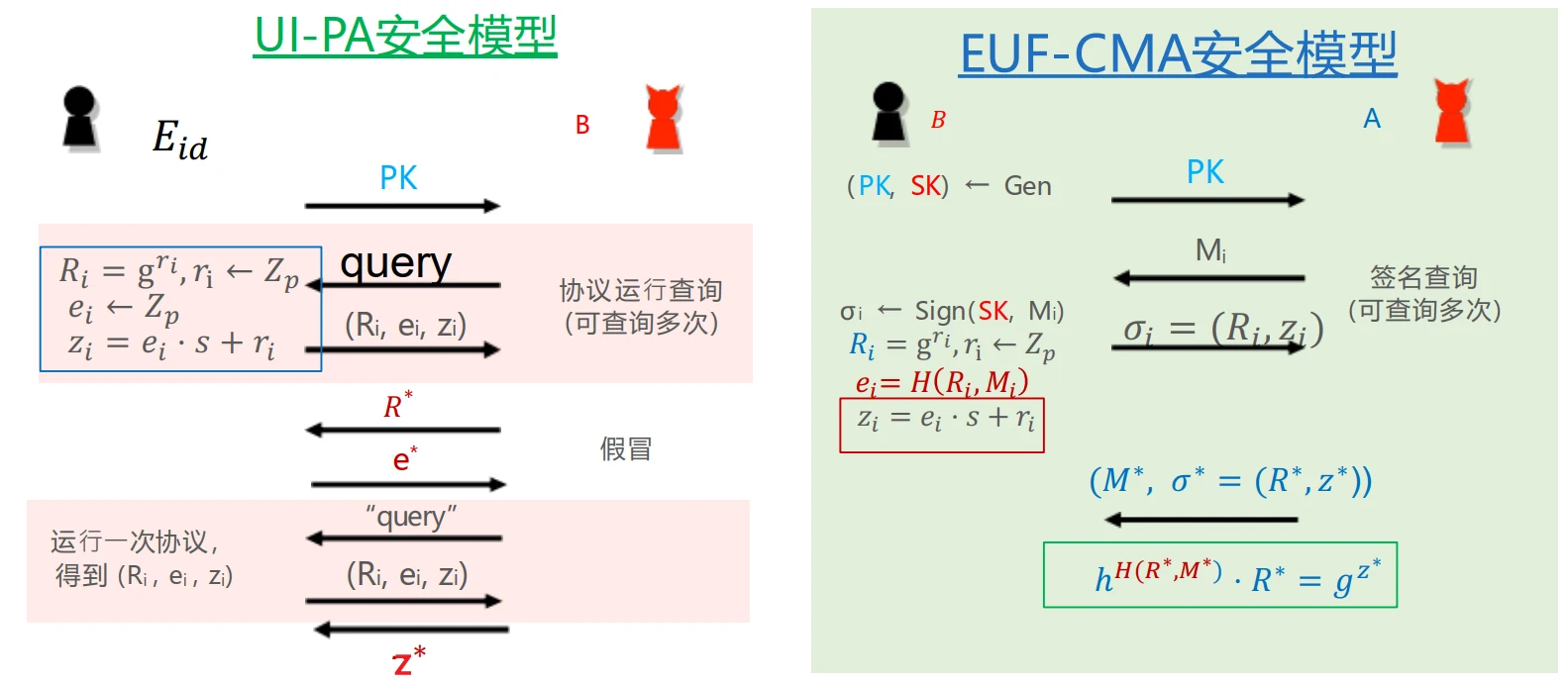
引理 1(Fiat-Shamir 转换):Schnorr 身份证明协议是 UI-PA 安全的 + \(\mathrm{H}\) 为 RO \(\implies\) Schnorr 签名算法是 EUF-CMA 安全的
- 思路:将 \(\mathcal{A}\) 作为 \(\mathcal{B}\) 的子算法,为 \(\mathcal{A}\) 提供合法的输入,以及返回合法的签名查询。利用 \(\mathcal{A}\) 的输出结果帮助 \(\mathcal{B}\) 在 UI-PA 中的输出正确的结果。
Proof
-
证明:使用反证法(安全性规约)
-
假设结论错误:Schnorr 签名算法不是 EUF-CMA 安全的,即存在 PPT 敌手 \(\mathcal{A}\) 以不可忽略的概率攻破 Schnorr 签名算法的 EUF-CMA 安全性。
- 即 \(\mathcal{A}\) 通过若干次签名查询后,可以输出一个未查询过的消息 \(M^{*}\) 以及一个有效签名 \(\sigma^{*}=(R^{*}, z^{*})\),以不可忽略的概率满足 \(h^{\mathrm{H}(R^{*}, M^{*})} \cdot R^{*}=g^{z^{*}}\)
-
证明前提错误:构造一个 PPT 敌手 \(\mathcal{B}\),在 UI-PA 安全模型下攻破 Schnorr 身份证明协议。
-
\(\mathcal{B}\) 的策略:
-
\(\mathcal{B}\) 将公钥 \(PK\) 作为输入提供给 \(\mathcal{A}\);设 \(\mathcal{A}\) 进行的哈希查询次数为 \(Q(\lambda)\),则 \(\mathcal{B}\) 随机选择 \(j \in [1, Q(\lambda)]\) 赌 \(\mathcal{A}\) 最终输出的消息 \(M^{*}=M_j\)
-
当 \(\mathcal{A}\) 使用 \(M_i\) 进行第 \(i\) 次 签名查询 时:\(\mathcal{B}\) 由于本身不具备私钥 \(SK\),无法生成合法的签名,因此向挑战者 \(E_{id}\) 发起查询,拿到一组合法记录 \((R_i, e_i, z_i)\),并将 \(\sigma_i=(R_i, z_i)\) 返回给 \(\mathcal{A}\),并自身记录 \(\mathrm{H}(R_i, M_i) = e_i\)
- 此时若 \(\mathcal{A}\) 要对签名查询进行验证,计算时需要 \(\mathrm{H}(R_i, M_i)\),只能向 \(\mathcal{B}\) 查询哈希结果,必然能通过检验
-
当 \(\mathcal{A}\) 使用 \((R_k, M_k)\) 进行第 \(k\) 次 哈希查询 时:
-
若 \(k=j\) 且 \(M_j \notin \{M_i\}\),即 \(\mathcal{A}\) 的第 \(j\) 次哈希查询的消息 \(M_j\) 没有在之前的签名查询中出现过,则 \(\mathcal{B}\) 向 \(E_{id}\) 输入 \(R_j\) 并把返回的 \(e_j\) 当作自己的哈希输出,并记录 \(\mathrm{H}(R_j, M_j) = e_j\)
-
若 \(k=j\) 且 \(M_j \in \{M_i\}\),则重新选择 \(j \in [1, Q(\lambda)]\),直到满足 \(M_j \notin \{M_i\}\)
-
若 \(k \in [1, Q(\lambda)] \setminus \{j\}\),\(\mathcal{B}\) 查询是否有 \(\mathrm{H}(R_k, M_k)\) 的记录:
-
若有则直接返回
-
若没有则随机选择 \(e \leftarrow \mathbb{Z}_p\) 返回并记录 \(\mathrm{H}(R_k, M_k) = e\)
-
-
-
最终当 \(\mathcal{A}\) 输出 \((M^{*}, \sigma^{*}=(R^{*}, z^{*}))\) 时,若 \(M^{*}=M_j\),则 \(\mathcal{B}\) 输出 \(z^{*}\) 作为自己的输出,否则视为失败。
-
-
\(\mathcal{B}\) 的优势:
\[ \begin{aligned} \mathrm{Adv}_{\mathcal{B}} &\geq \Pr\left[ \begin{array}{l} (1)\ \mathcal{A} \text{ 成功攻破 Schnorr 签名算法的 EUF-CMA 安全性} \\ (2)\ \mathcal{A} \text{ 查询过 } (R^{*}, M^{*}) \text{ 的 Hash 值} \\ (3)\ \mathcal{B} \text{ 赌对了 } j \text{(即 } M^{*}=M_j \text{)} \end{array} \right] \\ &\geq \text{non-negl}(\lambda) \cdot \text{non-negl}(\lambda) \cdot \frac{1}{Q(\lambda)} \\ &= \text{non-negl}(\lambda) \end{aligned} \] -
因此,\(\mathcal{B}\) 以不可忽略的概率攻破 Schnorr 身份证明协议的 UI-PA 安全性,与前提矛盾。
-
-
Schnorr 身份证明协议的 UI-PA 安全性证明
-
引理 2:DL 问题困难 \(\implies\) Schnorr 身份证明协议是 UI-PA 安全的
Proof
-
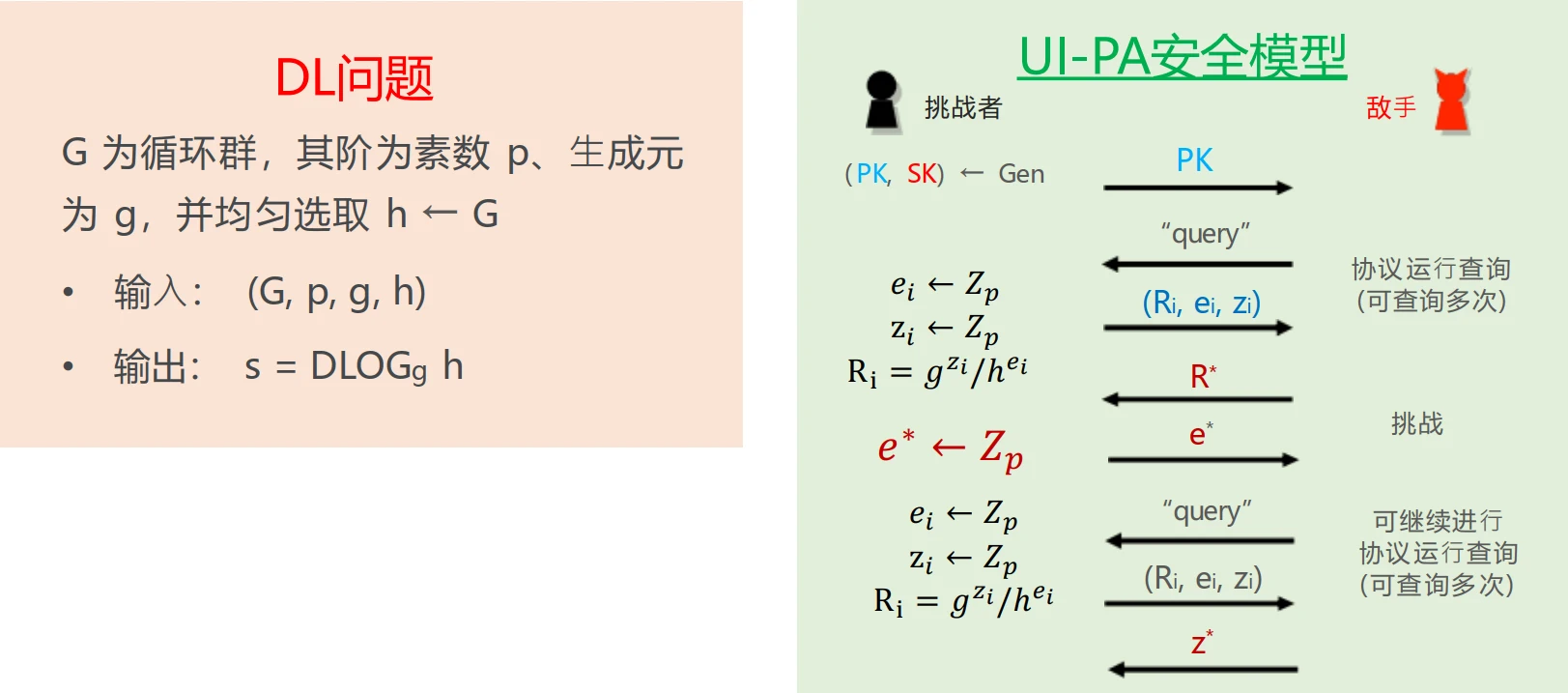
证明:安全性归约,由攻破 UI-PA 安全性的敌手 \(\mathcal{A}\) 来构造解决 DL 问题的敌手 \(\mathcal{B}\)。
-
假设结论错误:Schnorr 身份证明协议不是 UI-PA 安全的,即存在 PPT 敌手 \(\mathcal{A}\) 以不可忽略的概率攻破 Schnorr 身份证明协议的 UI-PA 安全性,即
\[ \mathrm{Adv}_{\mathcal{A}} = \Pr\left( \mathrm{output} = (R^{*}, e^{*}, z^{*}) \left| h^{e^{*}} \cdot R^{*}=g^{z^{*}} \right.\right) = \text{non-negl}(\lambda) \] -
证明前提错误:构造一个 PPT 敌手 \(\mathcal{B}\) 解决 DL 问题。
-
\(\mathcal{B}\) 的策略:Rewind 技术
-
\(\mathcal{B}\) 将 DL 问题的输入 \(PK=(G, p, g, h)\) 作为 Schnorr 身份证明协议的公钥提供给 \(\mathcal{A}\)
-
对于 \(\mathcal{A}\) 的每一次协议运行查询,\(\mathcal{B}\) 随机选取 \(e_i, z_i \leftarrow \mathbb{Z}_p\),计算 \(R_i = g^{z_i}/h^{e_i}\),为 \(\mathcal{A}\) 提供完美模拟的合法三元组 \((R_i, e_i, z_i)\)
-
第一次调用:\(\mathcal{B}\) 调用 \(\mathcal{A}\) 直到 \(\mathcal{A}\) 输出 \(R^*\) 时,\(\mathcal{B}\) 均匀随机选择 \(e_1^* \leftarrow \mathbb{Z}_p\) 作为挑战发送给 \(\mathcal{A}\),并收到 \(\mathcal{A}\) 的应答输出 \(z_1^*\)
-
第二次调用:\(\mathcal{B}\) 再次调用 \(\mathcal{A}\),所有使用的随机数(包括 \(\mathcal{A}\) 内部的随机数和 \(\mathcal{B}\) 模拟查询的随机数)均与第一次调用 完全相同。因此 \(\mathcal{A}\) 会再次输出同样的 \(R^*\)。此时 \(\mathcal{B}\) 使用 不同 的随机数均匀选择一个新的挑战 \(e_2^* \leftarrow \mathbb{Z}_p\) 发送给 \(\mathcal{A}\),并收到 \(\mathcal{A}\) 的新应答输出 \(z_2^*\)
-
解 DL:如果两次调用 \(\mathcal{A}\) 都成功伪造,则有:
\[ \begin{cases} R^* \cdot h^{e_1^*} = g^{z_1^*} \\ R^* \cdot h^{e_2^*} = g^{z_2^*} \end{cases} \]若 \(e_1^* \neq e_2^*\),两式相除消去 \(R^*\) 可得 \(h^{e_1^* - e_2^*} = g^{z_1^* - z_2^*}\)。代入 \(h = g^s\),即可解出 DL 问题的解:
\[ s \equiv (e_1^* - e_2^*)^{-1}(z_1^* - z_2^*) \pmod p \]
-
-
\(\mathcal{B}\) 的优势:
-
用变量 \(\omega\) 代表 \(\mathcal{B}\) 除了返回挑战 \(e^*\) 之外所使用的所有随机数集合(即决定 \(\mathcal{A}\) 输出 \(R^*\) 的所有前置上下文)
-
定义指示函数 \(\mathrm{V}(\omega, e^*) = 1\) 当且仅当 \(\mathcal{A}\) 在随机数 \(\omega\) 和挑战 \(e^*\) 下成功返回正确的 \(z^*\)(即 \(R^* \cdot h^{e^*} = g^{z^*}\))
-
则 \(\mathcal{B}\) 成功解决 DL 问题的概率(即两次都成功且挑战值不同的概率)为:
\[ \begin{aligned} \mathrm{Adv}_{\mathcal{B}} &= \Pr_{\omega, e_1^*, e_2^*}[\mathrm{V}(\omega, e_1^*) = 1 \land \mathrm{V}(\omega, e_2^*) = 1 \land e_1^* \neq e_2^*] \\ &= \Pr_{\omega, e_1^*, e_2^*}[\mathrm{V}(\omega, e_1^*) = 1 \land \mathrm{V}(\omega, e_2^*) = 1] - \Pr_{\omega, e_1^*, e_2^*}[\mathrm{V}(\omega, e_1^*) = 1 \land \mathrm{V}(\omega, e_2^*) = 1 \land e_1^* = e_2^*] \\ &\ge \Pr_{\omega, e_1^*, e_2^*}[\mathrm{V}(\omega, e_1^*) = 1 \land \mathrm{V}(\omega, e_2^*) = 1] - \Pr[e_1^* = e_2^*] \\ &\ge \Pr_{\omega, e_1^*, e_2^*}[\mathrm{V}(\omega, e_1^*) = 1 \land \mathrm{V}(\omega, e_2^*) = 1] - 1/p \\ &= \sum_{W\in\Omega_\omega} \Pr[\omega=W] \cdot \Pr_{e_1^*, e_2^*}[\mathrm{V}(W, e_1^*) = 1 \land \mathrm{V}(W, e_2^*) = 1] - 1/p \\ &= \sum_{W\in\Omega_\omega} \Pr[\omega=W] \cdot \Pr_{e_1^*}[\mathrm{V}(W, e_1^*) = 1] \cdot \Pr_{e_2^*}[\mathrm{V}(W, e_2^*) = 1] - 1/p \\ &= \sum_{W\in\Omega_\omega} \Pr[\omega=W] \cdot \Pr_{e^*}[\mathrm{V}(W, e^*) = 1]^2 - 1/p \\ &\ge \left(\sum_{W\in\Omega_\omega} \Pr[\omega=W] \cdot \Pr_{e^*}[\mathrm{V}(W, e^*) = 1]\right)^2 - 1/p \\ &= \Pr_{\omega, e^*}[\mathrm{V}(\omega, e^*) = 1]^2 - 1/p \\ &= \mathrm{Adv}_{\mathcal{A}}^2 - 1/p \\ &\ge \text{non-negl}(\lambda)^2 - \text{negl}(\lambda) \\ &= \text{non-negl}(\lambda) \end{aligned} \]
-
-
因此,\(\mathcal{B}\) 以不可忽略的概率成功解决 DL 问题,与 DL 问题困难的假设矛盾。得证!
-
-
-
定理
DSA 身份证明协议与签名算法
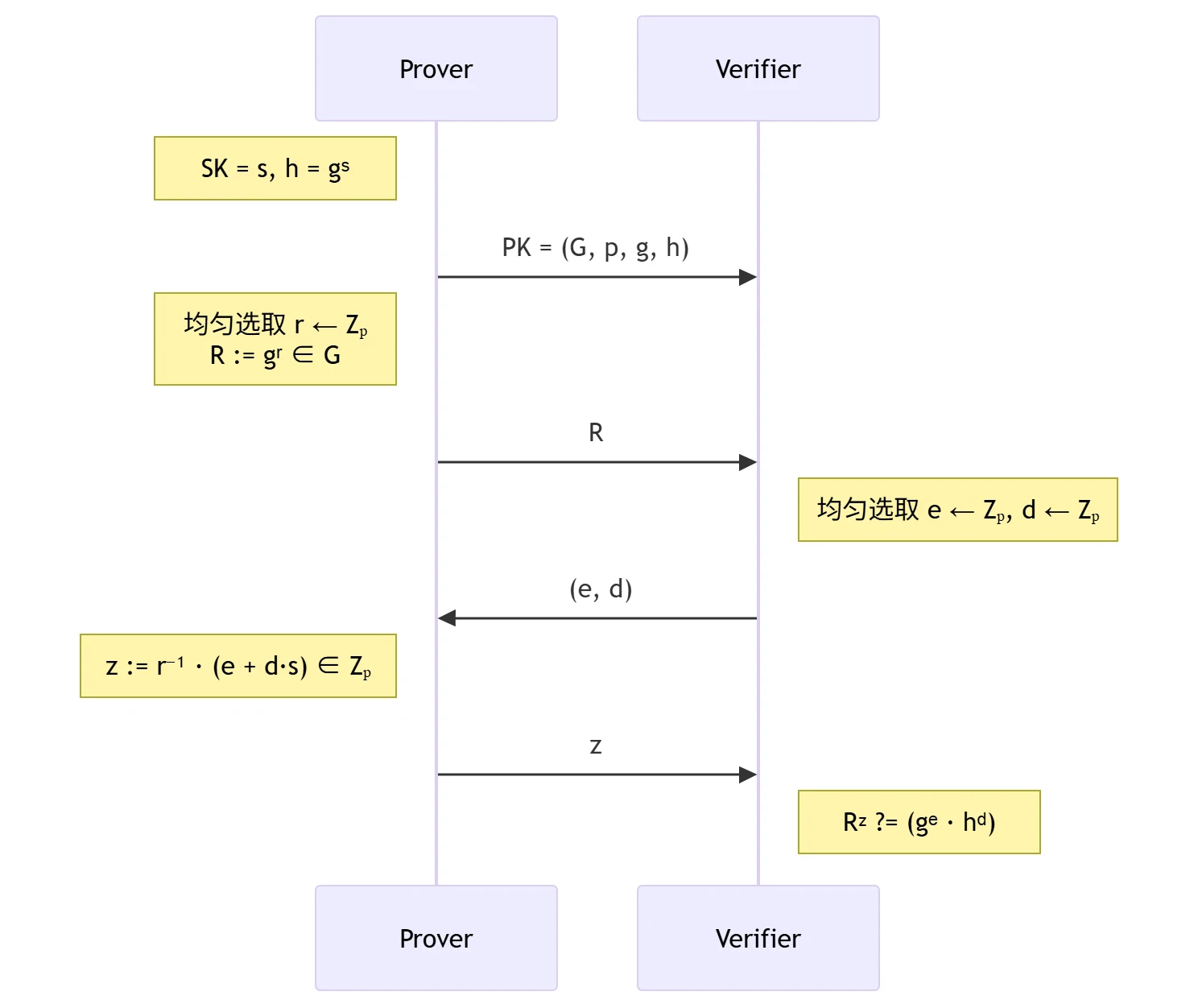
DSA 身份证明协议
-
目的:Prover 向 Verifier 证明自己拥有 \(PK\) 所对应的私钥 \(SK\)。
-
交互流程:基于椭圆曲线上的离散对数问题
DSA 签名算法
-
组件:Hash Functions
-
\(\mathrm{H}: \{0,1\}^{*} \to \mathbb{Z}_p\)
-
\(\mathrm{F}: G \to \mathbb{Z}_p\)
-
-
密钥生成算法 \((PK, SK) \leftarrow \mathrm{Gen}(1^\lambda)\):
-
选择循环群 \(G\),其阶为素数 \(p\)、生成元为 \(g\)
-
均匀选取 \(s \leftarrow \mathbb{Z}_p\),计算 \(h := g^s \in G\)
-
输出 \(PK = (G, p, g, h)\),\(SK = s\)
-
-
签名算法 \(\sigma \leftarrow \mathrm{Sign}(SK, M)\),消息空间为 \(\mathbb{M}=\{0,1\}^{*}\)
-
均匀选取 \(r \leftarrow \mathbb{Z}_{p}\),计算 \(R:=g^{r} \in G\)
-
计算 \(e:=\mathrm{H}(M) \in \mathbb{Z}_{p}\)
-
计算 \(d:=\mathrm{F}(R) \in \mathbb{Z}_{p}\)
-
计算 \(z:=r^{-1}(e + d \cdot s) \in \mathbb{Z}_{p}\)
-
输出 \(\sigma:=(d, z)\)
-
-
验证算法 \(0/1 \leftarrow \mathrm{Verify}(PK, M, \sigma=(d, z))\)
-
计算 \(e:=\mathrm{H}(M) \in \mathbb{Z}_{p}\)
-
计算 \(R:=(g^e \cdot h^d)^{z^{-1}} \in G\)
-
计算 \(d':=\mathrm{F}(R) \in \mathbb{Z}_{p}\)
-
验证 \(d \stackrel{?}{=} d'\),相等输出 \(1\),否则输出 \(0\)
-
安全性分析
DSA 与 ECDSA 签名算法的应用
-
DSA 为上述算法在大整数循环群 \(G=\mathbb{Z}_N^*\) 的 \(p\) 阶子群上的具体实现,其中 \(\mathrm{F}: G \to \mathbb{Z}_p\) 定义为 \(\mathrm{F}(R) = R \bmod p\)
-
ECDSA 为上述算法在椭圆曲线循环群 \(G\) 上的具体实现,其中 \(\mathrm{F}: G \to \mathbb{Z}_p\) 定义为 \(\mathrm{F}(R=(x_R, y_R)) = x_R \bmod p\)。
基于上述具体 \(F\) 函数的 DSA / ECDSA 签名算法的安全性没有基于标准困难问题的安全性证明,但也不存在有效的攻击方法,因此在实际应用中被广泛使用。