Ch4 Parsing
词法分析:Lexical Analysis
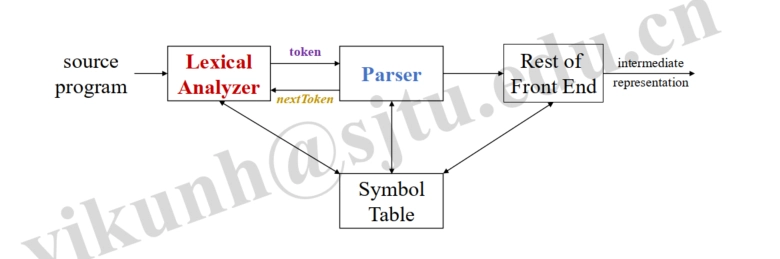
Parser
-
What: Given Tokens, Parsing Verifies whether the Token Names Can Be Generated by the Grammar for the Source Language. (给定 tokens,解析会验证 token 名称是否可以由源语言的语法生成)
-
Why: We expect the Parser
-
to report Syntax Errors (报告语法错误)
-
to recover from Errors to continue following processes. (从错误中恢复以继续后续过程)
-
-
How: Derivation or Reduction
- Top-down and Bottom-up Parsing
Compiler Errors
-
Lexical Errors
- The string does not match the pattern of any token. (字符串与任何 token 的模式不匹配)
-
Syntactic Errors
- The string does not meet the requirements of the grammar. (字符串不符合语法要求)
-
Semantic Errors: Type Mismatching (语义错误:类型不匹配)
Error-Recovery Strategies
-
Panic-Mode Recovery
-
Discarding input symbols one at a time until meeting synchronizing tokens (丢弃输入符号,直到遇到同步 tokens)
- synchronizing tokens, e.g. “;”, “}”, etc., decided by designers
-
simple, but may cause more errors
-
-
Phrase-Level Recovery
-
Local Correction on Input, allowing the parser to continue (允许解析器继续)
-
e.g., “,” → “;”, delete/insert “;”
-
designers’ responsibility
-
-
helpless if error occurs before the point of detection
-
-
Error Productions
-
augmenting grammar with productions generating erroneous constructs (用产生错误构造的产生式扩充语法)
-
relying on designers
-
-
Global Correction
-
choosing a minimal sequence of changes for a globally least-cost correction (选择一系列最小的变化,以实现全局最低成本的修正)
-
costly, yardstick? should defined by designers
-
Context-Free Grammar (CFG)
Definition
-
A Context-Free Grammar consists of:
-
Terminals
-
Non-terminals
-
Start Symbol
-
Productions: \(\mathbf{A} \rightarrow \mathbf{\alpha}\)
-
Header / Left Side → Body / Right Side
-
Header: A Non-terminal
-
Body: zero or more Terminals or Non-terminals
-
-
\(\mathbf{V_N} \rightarrow (\mathbf{V_T}|\mathbf{V_N})^*\)
-
-
Derivation
-
What: Beginning with the Start Symbol, replace a Non-terminal by the body of one of its Production. (从起始符号开始,用其产生式的右侧替换非终结符)
-
Why:
-
corresponding to Top-down Construction of a Parse Tree (对应于自顶向下构造解析树)
-
helpful for Bottom-up Parsing
-
-
How:
-
\(\Rightarrow\) : derive in one step
-
\(\overset{*}{\Rightarrow}\) : derive in zero or more steps
-
\(\alpha \overset{*}{\Rightarrow} \alpha\)
-
if \(\alpha \overset{*}{\Rightarrow} \beta\) and \(\beta \overset{*}{\Rightarrow} \gamma\), then \(\alpha \overset{*}{\Rightarrow} \gamma\)
-
-
\(\overset{+}{\Rightarrow}\) : derive in one or more steps
-
-
\(\mathbf{S} \overset{*}{\Rightarrow} \alpha\)
-
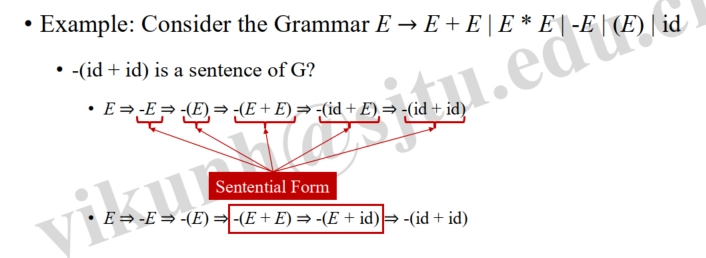
\(\alpha\) is a Sentential Form of S. (\(\alpha\) 是 S 的一个句子形式)
-
\(\alpha\) may contain Terminals, Non-terminals, or may be Empty.
-
Sentence: a Sentential Form without Non-terminals. (没有非终结符的句子形式)
-
-
What is a Language?
-
\(L(G)\): set of Sentences generated by the Grammar \(G\)
-
A string of terminals $ \omega \in L(G) $ if and only if $ \omega $ is a Sentence of $ G $ (or $ S \overset{*}{\Rightarrow} \omega $).
-
-
Example:
-
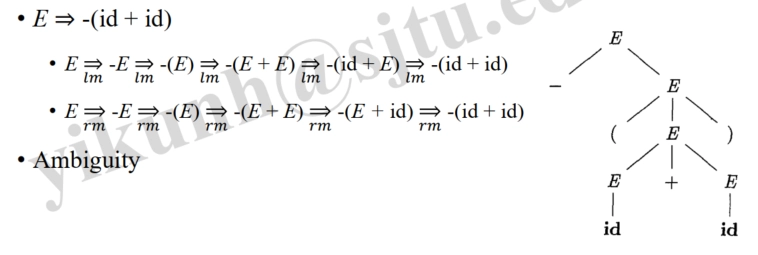
Leftmost Derivation: the Leftmost Non-terminal is always replaced at first (最左边的非终结符总是第一个被替换)
- $ \alpha \overset{lm}{\Rightarrow} \beta $
-
Rightmost Derivation: $ \alpha \overset{rm}{\Rightarrow} \beta $
-
Parse Trees and Derivations
-
What: A Graphical Representation of a Derivation (派生的图形表示)
- filtering out the order in which productions applied to replace non-terminals (过滤出应用于替换非终结符的产生式的顺序)
-
Example:
-
Top-Down Parsing
-
What: Create the Parse Tree from Top to Bottom (从上到下创建解析树)
- from root to leaves (从根到叶)
-
Why: for Parsing
-
How: Derive an Input String in the Leftmost Manner (以最左边的方式派生输入字符串)
-
consistent with string scanning (与字符串扫描一致)
-
Key: determine the production to be applied for a non-terminal (确定要应用于非终结符的产生式)
-
Recursive-Descent Parsing
-
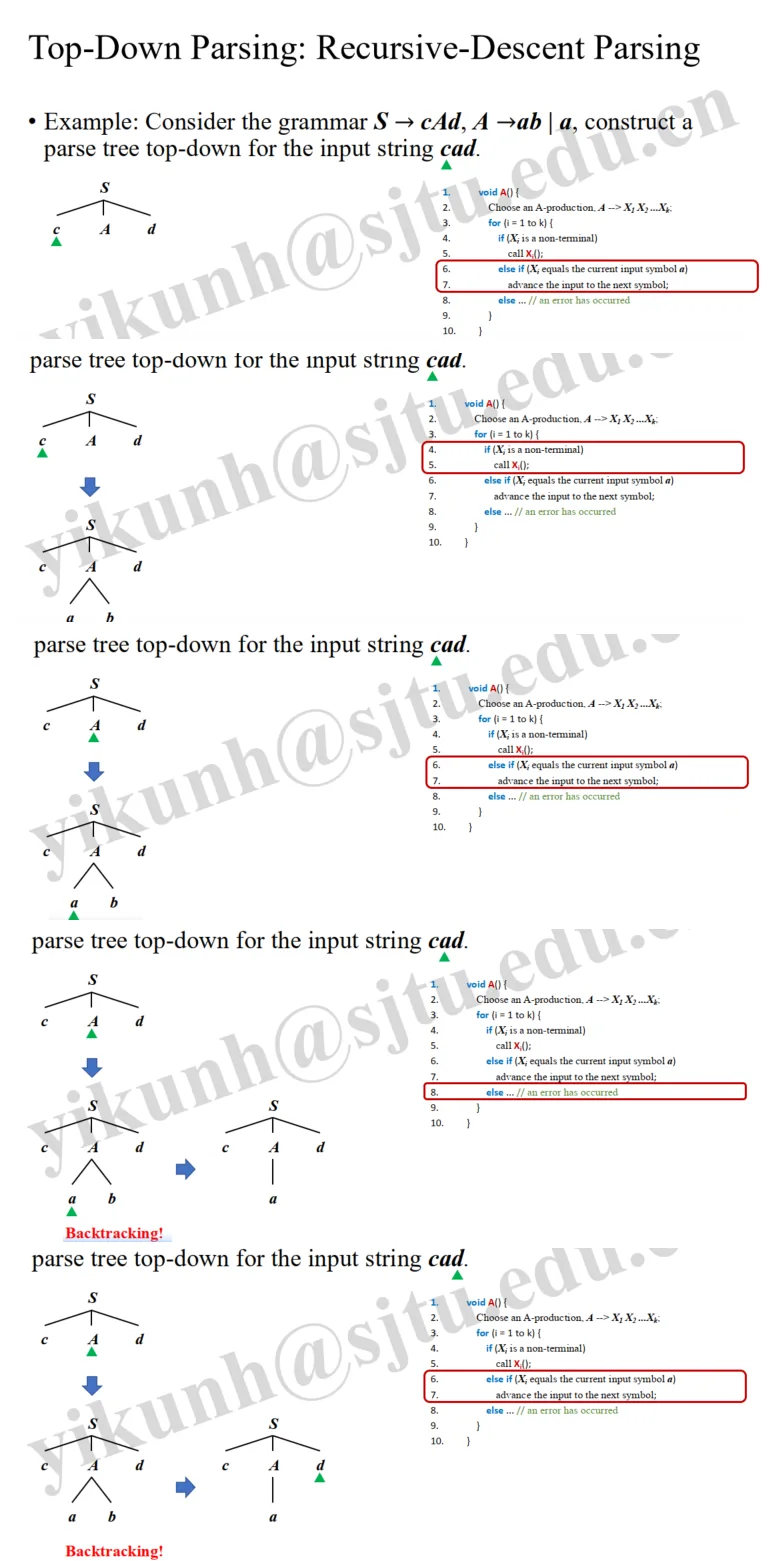
require backtracking to find right production (需要回溯以找到正确的产生式)
-
general, but inefficient
-
-
Predictive Parsing
-
a special case of Recursive-Descent Parsing
-
no backtracking, choosing by looking ahead at input symbols (无需回溯,通过提前查看输入符号进行选择)
-
-
Recursive-Descent Parsing
void A() {
    // Choose an A-production, A --> X1 X2 ...Xk;
    for (i = 1 to k) {
        if (Xi is a non-terminal)
            call Xi();
        else if (Xi equals the current input symbol a)
            advance the input to the next symbol;
        else ... // an error has occurred
    }
}
- Example:
Left Recursion (左递归)
-
What: The Grammar has a non-terminal A such that there exists a derivation \(\mathbf{A} \overset{+}{\Rightarrow} \mathbf{A} \alpha\) (文法有一个非终结符 A,使得存在一个派生 \(\mathbf{A} \overset{+}{\Rightarrow} \mathbf{A} \alpha\))
-
Why: Recursive-Descent Parsing cannot handle Left Recursion. (递归下降解析无法处理左递归)
-
How: Transform the grammar to eliminate Left Recursion. (转换文法以消除左递归)
-
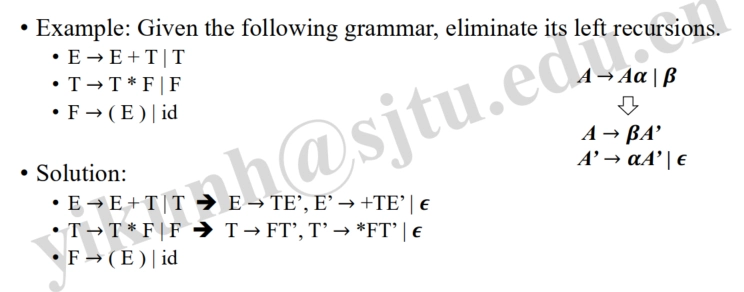
Immediate Elimination: \(\mathbf{A} \rightarrow \mathbf{A} \alpha | \beta \quad \Rightarrow \mathbf{A} \rightarrow \beta \mathbf{A'} , \mathbf{A'} \rightarrow \alpha \mathbf{A'} | 𝝐\)
-
$ \mathbf{A} \rightarrow \mathbf{A}\alpha_1 | \dots | \mathbf{A}\alpha_m | \beta_1 | \dots | \beta_n \quad \Rightarrow \mathbf{A} \rightarrow (\beta_1 | \dots | \beta_n) \mathbf{A'}, \mathbf{A'} \rightarrow (\alpha_1 | \dots | \alpha_m) \mathbf{A'} | \epsilon $
-
-
Example:
Left Recursion Elimination (消除左递归)
-
INPUT: Grammar G without Cycles or 𝝐-productions (无循环或𝝐产生式的文法)
-
Cycle: \(\mathbf{A} \overset{+}{\Rightarrow} \mathbf{A}\)
-
𝝐-production: \(\mathbf{A} \rightarrow \epsilon\)
-
-
OUTPUT: Equivalent Grammar without Left Recursions (没有左递归的等效文法)
-
Steps:
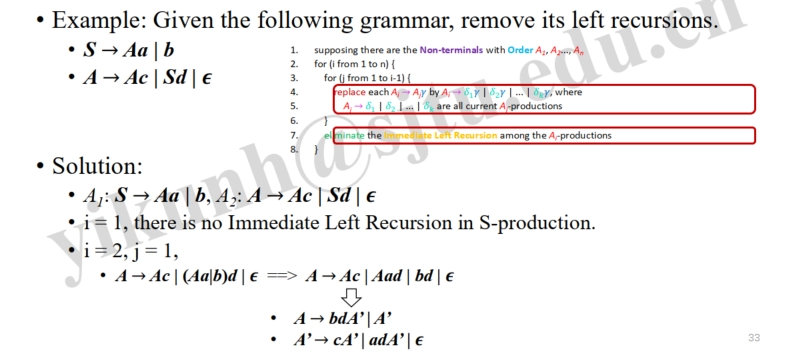
supposing there are the Non-terminals with Order A1, A2..., An for (i from 1 to n) { for (j from 1 to i-1) { replace each Ai → Aj𝛾 by Ai → 𝛿1𝛾 | 𝛿2𝛾 | ... | 𝛿𝑘𝛾, where: Aj → 𝛿1 | 𝛿2 | ... | 𝛿𝑘 are all current Aj-productions } eliminate the Immediate Left Recursion among the Ai-productions } -
Example:
Predictive Parsing
-
What: recursive-descent parsers needing no backtracking (不需要回溯的递归下降解析器)
-
can be constructed for LL(k) grammar (可以为 LL(k)文法构造)
-
L: scanning input from Left to right
-
L: producing a Leftmost derivation
-
k: using k input symbols of lookahead at each step to make decision
-
-
-
Why: a unique production to apply, or none to use (error)
-
Example: LL(1)
- stmt → i f (expr) stmt else stmt | w hile (expr) stmt | { stmt_list}
-
How: FIRST and FOLLOW
- assist in choosing which production to apply, based on the next input symbol (根据下一个输入符号选择应用哪个产生式)
FIRST and FOLLOW
-
FIRST: the set of terminals that begin strings derived from a non-terminal or a string of grammar symbols. (从非终结符或语法符号字符串派生的字符串开始的终结符集合)
-
FIRST(𝜶): what the first symbol would be for 𝜶
-
𝜶: string of grammar symbols
-
return: set of terminals that begin strings derived from 𝜶
- first symbols of strings derived from 𝜶
-
HOW:
-
if \(\mathbf{X}\) is a terminal, then \(\mathbf{FIRST(X)} = \{\mathbf{X}\}\)
-
if \(\mathbf{X}\) is a non-terminal, and \(\mathbf{X} \rightarrow \mathbf{Y_1} \mathbf{Y_2} \dots \mathbf{Y_k}\)
-
add all non-𝝐 symbols of \(\mathbf{Y_1}\) to \(\mathbf{FIRST(X)}\)
-
add all non-𝝐 symbols of \(\mathbf{Y_2}\) to \(\mathbf{FIRST(X)}\), if \(\epsilon \in \mathbf{FIRST(Y_1)}\)
-
···
-
add all non-𝝐 symbols of \(\mathbf{Y_k}\) to \(\mathbf{FIRST(X)}\), if \(\epsilon \in \mathbf{FIRST(Y_1)}\) and \(\epsilon \in \mathbf{FIRST(Y_2)}\) and ··· and \(\epsilon \in \mathbf{FIRST(Y_{k-1})}\)
-
add 𝝐 to \(\mathbf{FIRST(X)}\), if \(\epsilon \in \mathbf{FIRST(Y_1)}\) and \(\epsilon \in \mathbf{FIRST(Y_2)}\) and ··· and \(\epsilon \in \mathbf{FIRST(Y_k)}\)
-
-
-
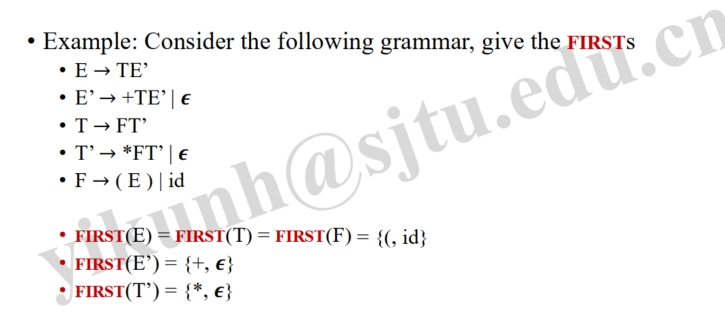
Example:
-
-
FOLLOW: the set of terminals that can appear immediately to the right of a non-terminal in some sentential form. (在某些句子形式中,可以出现在非终结符右侧的终结符集合)
-
FOLLOW(N): what is the next symbol of N
-
N: a non-terminal
-
return: set of terminals can appear immediately after N in a sentential form
-
HOW:
-
place $ in \(\mathbf{FOLLOW(S)}\)
-
S: start symbol
-
$: input right end-marker
-
-
for each production \(\mathbf{M} \rightarrow \alpha \mathbf{N} \beta\)
-
add all symbols in \(\mathbf{FIRST(\beta)}\) to \(\mathbf{FOLLOW(N)}\), except 𝝐
-
if \(\epsilon \in \mathbf{FIRST(\beta)}\), add all symbols in \(\mathbf{FOLLOW(M)}\) to \(\mathbf{FOLLOW(N)}\)
-
-
for each production \(\mathbf{M} \rightarrow \alpha \mathbf{N}\)
- add all symbols in \(\mathbf{FOLLOW(M)}\) to \(\mathbf{FOLLOW(N)}\)
-
-
Example:
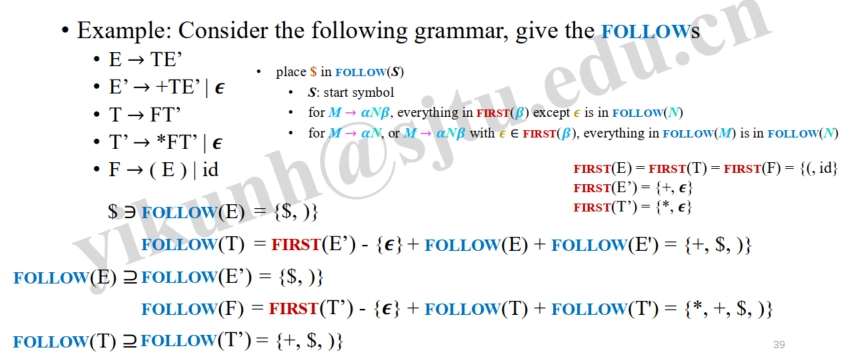
-
LL(1) Grammar
-
What: Any \(\mathbf{A} \rightarrow \mathbf{\alpha} \ | \ \mathbf{\beta}\) Represents two Distinct Productions (\(\mathbf{A} \rightarrow \mathbf{\alpha} \ | \ \mathbf{\beta}\) 表示两个不同的产生式)
-
\(\mathbf{FIRST(\alpha)}\) and \(\mathbf{FIRST(\beta)}\) are disjoint sets.(二者是互不相交的集合)
-
For no terminal \(\mathbf{a}\), do both \(\mathbf{\alpha}\) and \(\mathbf{\beta}\) derive strings beginning with \(\mathbf{a}\). (二者不会同时派生以 \(\mathbf{a}\) 开头的字符串)
-
At most one of \(\mathbf{\alpha}\) and \(\mathbf{\beta}\) can derive the empty string. (至多一个 \(\mathbf{\alpha}\) 和 \(\mathbf{\beta}\) 可以派生空字符串)
-
-
If \(\mathbf{\epsilon} \in \mathbf{FIRST(\beta)}\), then \(\mathbf{FIRST(\alpha)}\) and \(\mathbf{FOLLOW(A)}\) are disjoint sets. (如果 \(\mathbf{\epsilon} \in \mathbf{FIRST(\beta)}\),则 \(\mathbf{FIRST(\alpha)}\) 和 \(\mathbf{FOLLOW(A)}\) 是互不相交的集合)
-
-
Why: Proper Production is Selected by Looking ONLY at the Next Input Symbol. (通过仅查看下一个输入符号来选择适当的产生式)
-
How: By Parsing Table, a Two-Dimensional Array
- \(\mathbf{M[A, a]} = \mathbf{\alpha}\), when deriving \(\mathbf{A}\), apply \(\mathbf{A} \rightarrow \mathbf{\alpha}\) if coming up with \(\mathbf{a}\). (当派生 \(\mathbf{A}\) 时,如果出现 \(\mathbf{a}\),则应用 \(\mathbf{A} \rightarrow \mathbf{\alpha}\))
LL(1) Parsing
-
Predictive Parsing Table Construction
-
INPUT: Grammar G.
-
OUTPUT: Parsing Table M.
-
STEPS: For each production \(\mathbf{A} \rightarrow \mathbf{\alpha}\):
-
For each terminal \(\mathbf{a} \in \mathbf{FIRST(\alpha)}\), add \(\mathbf{A} \rightarrow \mathbf{\alpha}\) to \(\mathbf{M[A, a]}\).
-
If \(\mathbf{\epsilon} \in \mathbf{FIRST(\alpha)}\), then for each terminal \(\mathbf{b} \in \mathbf{FOLLOW(A)}\), add \(\mathbf{A} \rightarrow \mathbf{\alpha}\) to \(\mathbf{M[A, b]}\).
-
If \(\mathbf{\epsilon} \in \mathbf{FIRST(\alpha)}\) and \(\mathbf{\$} \in \mathbf{FOLLOW(A)}\), add \(\mathbf{A} \rightarrow \mathbf{\alpha}\) to \(\mathbf{M[A, \$]}\).
-
-
Example:
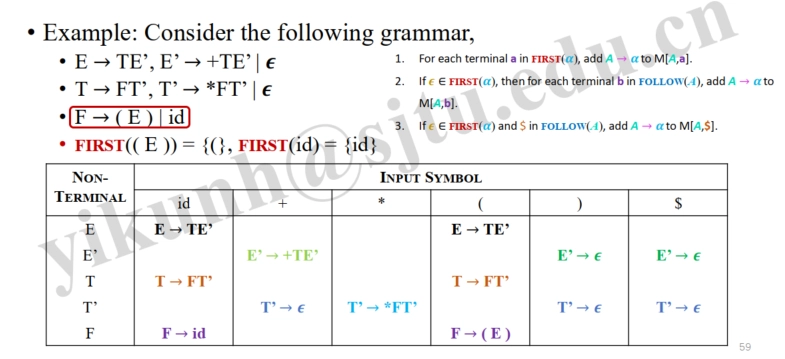
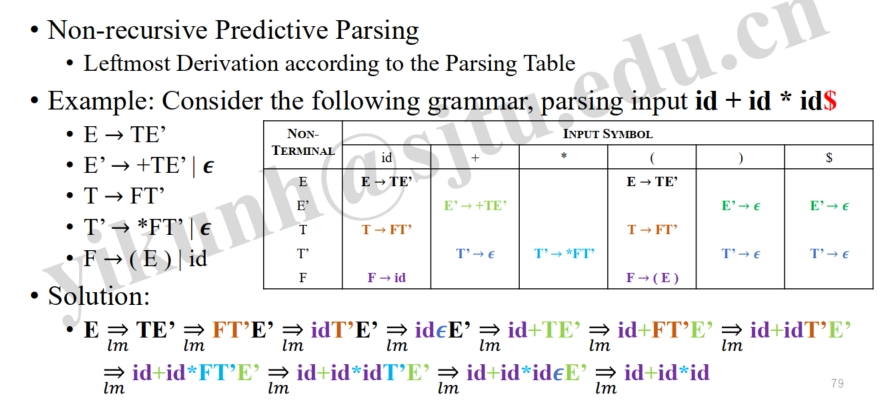
-
-
Implementation
- Stack-based Method, mimicking a leftmost derivation (基于栈的方法,模仿最左派生)
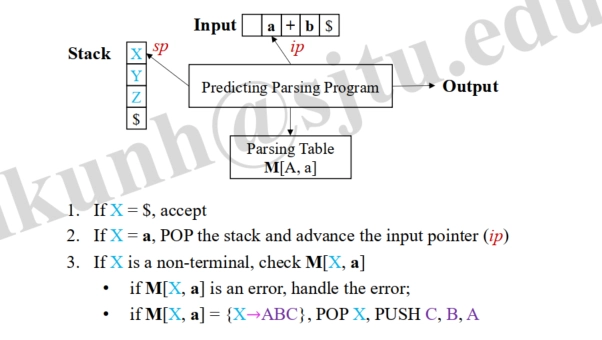
Left Factoring
-
When the decision is not clear, defer it until seeing enough symbols. (当决策不明确时,推迟到看到足够的符号为止)
-
Left-Factored:
- \(\mathbf{A} \rightarrow \mathbf{𝜶} \mathbf{𝜷_1} | \mathbf{𝜶} \mathbf{𝜷_2}\quad by \quad \mathbf{A} \rightarrow \mathbf{𝜶} \mathbf{A'}, \mathbf{A'} \rightarrow \mathbf{𝜷_1} | \mathbf{𝜷_2}\)
-
How:
-
For each non-terminal \(\mathbf{A}\), find the longest common prefix \(\mathbf{𝜶}\) of its alternatives.
-
If \(\mathbf{𝜶}\) is not empty, replace all of the \(\mathbf{A}\)-productions
-
-
Example:
- \(\mathbf{A} \rightarrow \mathbf{𝜶} \mathbf{𝜷_1} | \mathbf{𝜶} \mathbf{𝜷_2} | ... | \mathbf{𝜶} \mathbf{𝜷_n} | \mathbf{𝜸}\quad \quad by \quad \quad \mathbf{A} \rightarrow \mathbf{𝜶} \mathbf{A'} | 𝜸, \mathbf{A'} \rightarrow \mathbf{𝜷_1} | \mathbf{𝜷_2} | ... | \mathbf{𝜷_n}\)
Non-LL(1) Grammar
-
Non-LL(1) Grammars:
-
grammars with Left Recursion (左递归的文法)
-
grammars not Left Factored (未左因子化的文法)
-
grammars with Ambiguity (歧义文法)
-
-
Thus, before Predictive Parsing,
-
perform Left Factoring (左因子化)
-
eliminate Left Recursion (prerequisite of the elimination?) (消除左递归)
-
remove Ambiguity (消除歧义)
-
Bottom-Up Parsing
-
What: the construction of a parse tree beginning at the leaves and working up to the root (从叶子开始构建解析树,直到根)
-
Why: not all grammars can be made LL(1)
-
How: construct rightmost derivation in the reverse order
-
Reduction: “Reversed Derivation”(归约:反向派生)
-
from the string to the start symbol (从字符串到起始符号)
-
The body of a production is replaced by the non-terminal at its header. (用产生式的头部替换产生式的主体)
-
-
\(S \overset{rm}{\Rightarrow} \gamma_0 \overset{rm}{\Rightarrow} \gamma_1 \overset{rm}{\Rightarrow} \dots \overset{rm}{\Rightarrow} \gamma_n \overset{rm}{\Rightarrow} \omega\)
- find the rightmost derivation in the reverse order: “leftmost reduction” (找到右侧派生的反向顺序:最左侧归约)
-
“L eft-to-Right, R ightmost Derivation in Reverse”: LR Parsing
-
-
Example:
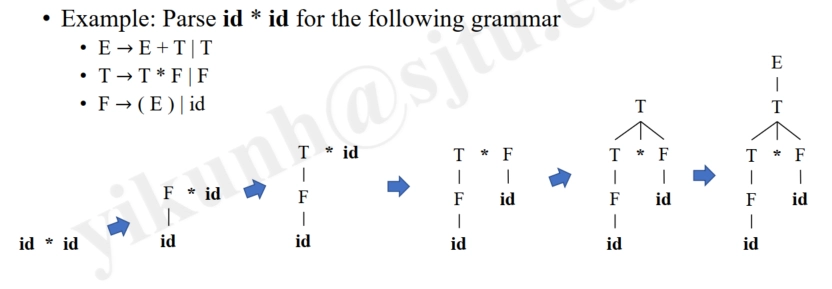
- \(E \Rightarrow T \Rightarrow T * F \Rightarrow T * id \Rightarrow F * id \Rightarrow id * id\)
Handles
-
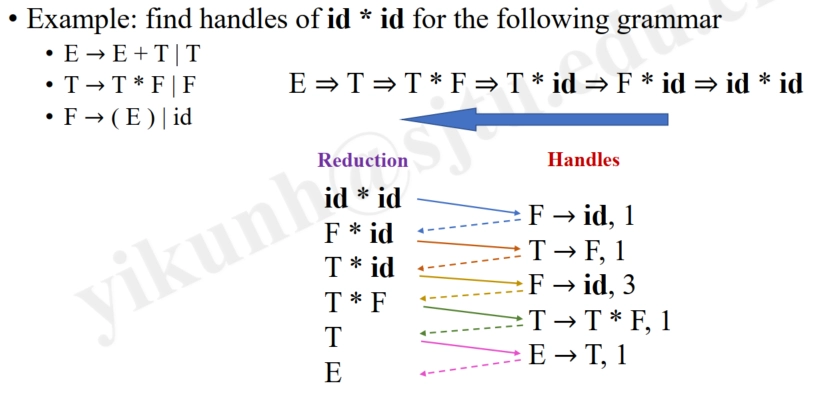
What: if \(\mathbf{S} \overset{*}{\Rightarrow} \mathbf{\alpha A \omega} \overset{}{\Rightarrow} \mathbf{\alpha \beta \omega}\), then production \(\mathbf{A \rightarrow \beta}\) in the position following \(\mathbf{\alpha}\) is a handle of \(\mathbf{\alpha \beta \omega}\).
-
a substring that matches the body of a production, representing a step of reduction (与产生式的主体匹配的子字符串,表示归约的一步)
-
a pair of values: (production, position)
-
-
Why: handle pruning for bottom-up parsing (处理底向上解析的剪枝)
- identify handles and reduce them to the appropriate leftmost non-terminals (识别句柄并将其归约到适当的最左非终结符)
-
How: by using a stack to keep track of the current position in the input string and the corresponding production rules (使用栈来跟踪输入字符串中的当前位置和相应的产生式规则)
-
Example:
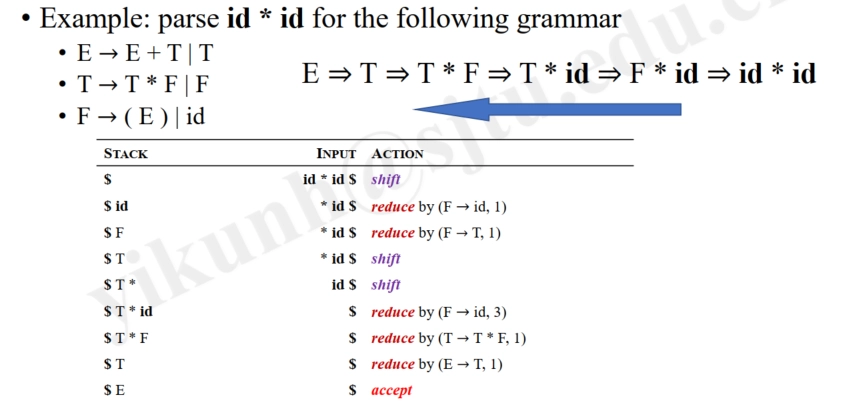
Shift-Reduce Parsing (移进归约解析)
-
How: Stack + Input Buffer
-
Stack: reduced Grammar Symbols
-
Input Buffer: rest of the String to be parsed
-
-
Actions
-
Shift: move the next symbol onto stack
-
Reduce: replace the handle on the top of stack
-
Accept: announce the success of parsing
-
Error: discover syntax errors, and call for recovery
-
-
Example:
Operator-Precedence Parsing (运算符优先解析)
-
What: a shift-reduce parser handling operator-precedence grammar (处理运算符优先文法的移位归约解析器)
-
operator-precedence grammar: a subset of LR(1) grammar (运算符优先文法:LR(1)文法的一个子集)
-
for each Production:
-
no 𝝐 in the body (主体中没有空字符)
-
no two consecutive non-terminals in the body (在主体中没有两个连续的非终结符)
-
-
-
Why: to handle expressions with operator precedence and associativity (处理具有运算符优先级和结合性的表达式)
-
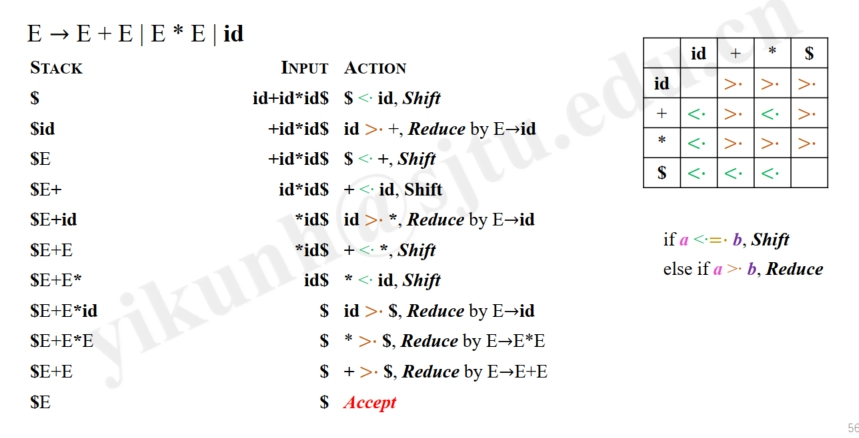
How: find handles according precedence
-
Precedence (优先级)
-
\(\mathbf{a} <· \mathbf{b}\): a’s precedence is lower than b’s
-
\(\mathbf{a} =· \mathbf{b}\): … is equal to …
-
\(\mathbf{a} >· \mathbf{b}\): … is higher than …
-
-
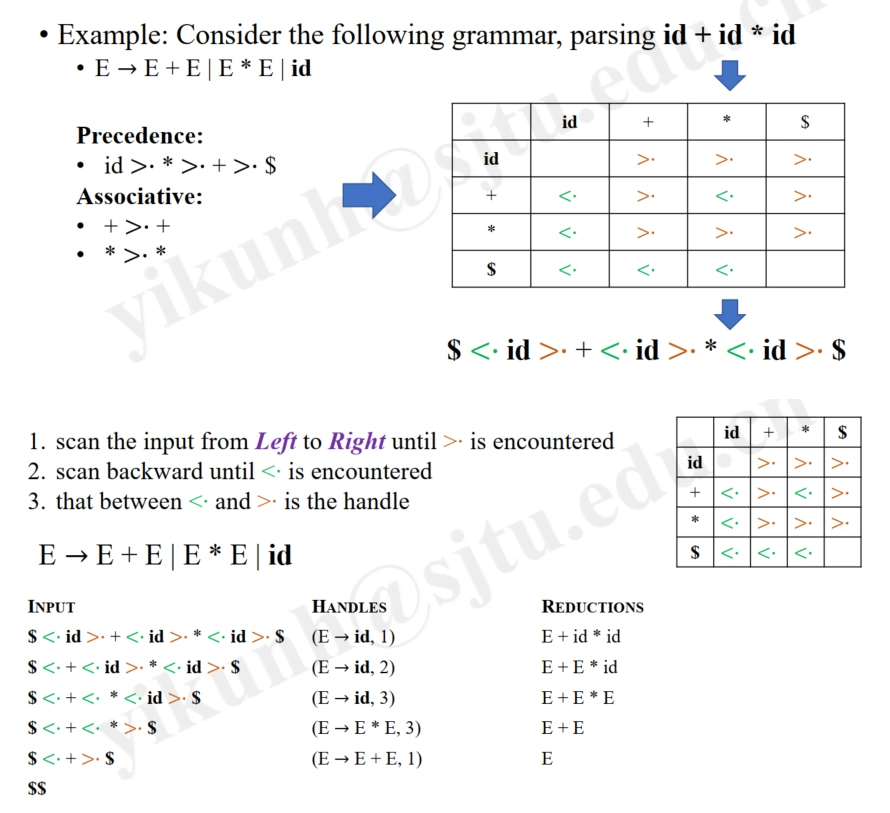
Precedence Climbing Method (优先级爬升法)
-
scan the input from Left to Right until >· is encountered
-
then, scan backward until <· is encountered
-
that between <· and >· is the handle
-
-
Implementation with STACK (栈实现)
-
let \(\mathbf{a}\) be the top Terminal on the STACK (栈顶终结符)
-
let \(\mathbf{b}\) be the INPUT Symbol under processing (正在处理的输入符号)
-
if \(\mathbf{a} <· or =· \mathbf{b}\), Shift
-
else if \(\mathbf{a} >· \mathbf{b}\), Reduce
-
-
-
Example:
OPP: Precedence Relation Construction (优先级关系构造)
Precedence Relation
-
If operator \(\mathbf{a}\) has higher precedence than \(\mathbf{b}\)
-
\(\mathbf{a} >· \mathbf{b}\)
-
\(\mathbf{b} <· \mathbf{a}\)
-
-
If \(\mathbf{a}\) and \(\mathbf{b}\) has equal precedence
-
if left-associative, then \(\mathbf{a} >· \mathbf{b}\) and \(\mathbf{b} >· \mathbf{a}\)
-
if right-associative, then \(\mathbf{a} <· \mathbf{b}\) and \(\mathbf{b} <· \mathbf{a}\)
-
-
For all operator \(\mathbf{a}\)
-
\(\mathbf{a} <· id, \quad id >· \mathbf{a}\)
-
\(\text{\$} <· \mathbf{a}, \quad \mathbf{a} >· \text{\$}\)
-
\(\mathbf{a} <· (,\quad ( <· \mathbf{a}, \quad \mathbf{a} >· ), \quad ) >· \mathbf{a}\)
-
\((=· )\)
-
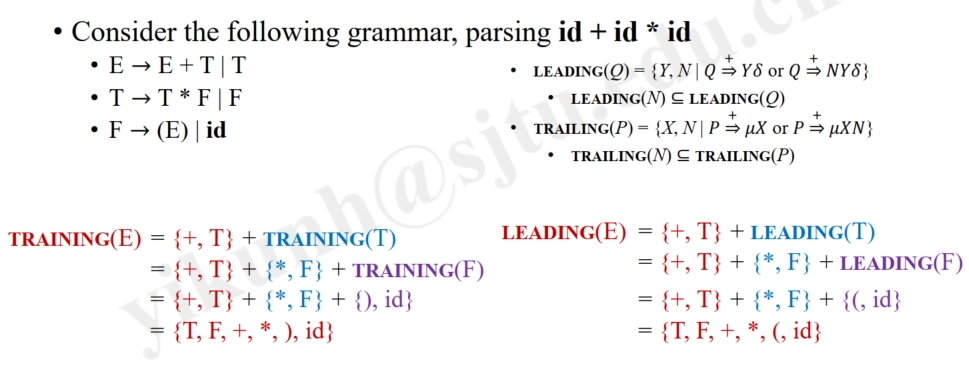
LEADING and TRAILING
-
LEADING: the set of symbols that can appear at the beginning of a string derived from a non-terminal (可以出现在从非终结符派生的字符串开头的符号集合)
-
\(\mathbf{LEADING(Q)} = \{\mathbf{Y}, \mathbf{N} \ | \ \mathbf{Q} \overset{+}{\Rightarrow} \mathbf{Y\delta} \ or\ \mathbf{Q} \overset{+}{\Rightarrow} \mathbf{N Y \delta}, \mathbf{N} \in \mathbf{V_n}, \mathbf{Y} \in \mathbf{V_t}\}\)
-
for \(\mathbf{Q} \rightarrow \mathbf{Y \delta}\) or \(\mathbf{Q} \rightarrow \mathbf{N Y \delta}\), we have:
-
\(\mathbf{Y}, \mathbf{N} \in \mathbf{LEADING(Q)}\)
-
\(\mathbf{LEADING(N)} \subseteq \mathbf{LEADING(Q)}\)
-
-
TRAILING: the set of symbols that can appear at the end of a string derived from a non-terminal (可以出现在从非终结符派生的字符串末尾的符号集合)
-
\(\mathbf{TRAILING(P)} = \{\mathbf{X}, \mathbf{N} \ | \ \mathbf{P} \overset{+}{\Rightarrow} \mu \mathbf{X} \ or \ \mathbf{P} \overset{+}{\Rightarrow} \mu \mathbf{X} \mathbf{N}, \mathbf{N} \in \mathbf{V_n}, \mathbf{X} \in \mathbf{V_t}\}\)
-
for \(\mathbf{P} \rightarrow \mu \mathbf{X}\) or \(\mathbf{P} \rightarrow \mu \mathbf{X} \mathbf{N}\), we have:
-
\(\mathbf{X}, \mathbf{N} \in \mathbf{TRAILING(P)}\)
-
\(\mathbf{TRAILING(N)}\subseteq\mathbf{TRAILING(P)}\)
-
-
Example:
Constructing Precedence Relations
-
\[ \mathbf{X} =· \mathbf{Y} \]
-
if there is \(\mathbf{A} \rightarrow \mathbf{\alpha X Y \beta}\), where \(\mathbf{X}, \mathbf{Y} \in \mathbf{V}\), \(\mathbf{\alpha}, \mathbf{\beta} \in \mathbf{V^*}\)
-
or, there is \(\mathbf{A} \rightarrow \mathbf{\alpha X N Y \beta}\), where \(\mathbf{N} \in \mathbf{V_n} \cup \{\mathbf{\epsilon}\}\), \(\mathbf{X}, \mathbf{Y} \in \mathbf{V_t}\)
-
adjacent symbols have equal precedence (相邻符号具有相等的优先级)
-
at least one of them is a terminal (至少有一个是终结符)
-
e.g., \(\mathbf{E} + \mathbf{T}\), \(\mathbf{T} * \mathbf{F}\), \(\mathbf{E} += \mathbf{T}\)
-
-
\[ \mathbf{X} <· \mathbf{Y} \]
-
if there is \(\mathbf{A} \rightarrow \mathbf{\alpha X Q \beta}\), and \(\mathbf{Q} \overset{+}{\Rightarrow} \mathbf{Y \delta}\), where \(\mathbf{X}, \mathbf{Y} \in \mathbf{V}\), \(\mathbf{Q} \in \mathbf{V_n}\), \(\mathbf{\alpha}, \mathbf{\beta}, \mathbf{\delta} \in \mathbf{V^*}\)
-
or, there is \(\mathbf{A} \rightarrow \mathbf{\alpha X Q \beta}\), and \(\mathbf{Q} \overset{+}{\Rightarrow} \mathbf{N Y \delta}\), where \(\mathbf{N} \in \mathbf{V_n} \cup \{\mathbf{\epsilon}\}\), \(\mathbf{X}, \mathbf{Y} \in \mathbf{V_t}\)
-
\(\mathbf{LEADING(Q)} = \{\mathbf{Y}, \mathbf{N} \ | \ \mathbf{Q} \overset{+}{\Rightarrow} \mathbf{Y\delta} \ or\ \mathbf{Q} \overset{+}{\Rightarrow} \mathbf{N Y \delta}\}\)
-
for \(\mathbf{A} \rightarrow \mathbf{\alpha X Q \beta}\), we have \(\mathbf{X}\) <· Symbols in \(\mathbf{LEADING(Q)}\)
-
-
\[ \mathbf{X} >· \mathbf{Y} \]
-
if there is \(\mathbf{A} \rightarrow \alpha \mathbf{P} \mathbf{Y} \beta\), and \(\mathbf{P} \overset{+}{\Rightarrow} \mu \mathbf{X}\), where \(\mathbf{X}, \mathbf{Y} \in \mathbf{V}\), \(\mathbf{P} \in \mathbf{V_n}\), \(\alpha, \beta, \mu \in \mathbf{V}^*\)
-
or, there is \(\mathbf{A} \rightarrow \alpha \mathbf{P} \mathbf{Y} \beta\), and \(\mathbf{P} \overset{+}{\Rightarrow} \mu \mathbf{X} \mathbf{N}\), where \(\mathbf{N} \in \mathbf{V_n} \cup \{\epsilon\}\), \(\mathbf{P} \in \mathbf{V_n}\), \(\mathbf{X}, \mathbf{Y} \in \mathbf{V_T}\)
-
\(\mathbf{TRAILING(P)} = \{\mathbf{X}, \mathbf{N} \ | \ \mathbf{P} \overset{+}{\Rightarrow} \mu \mathbf{X} \ \text{or} \ \mathbf{P} \overset{+}{\Rightarrow} \mu \mathbf{X} \mathbf{N}\}\)
-
for \(\mathbf{A} \rightarrow \alpha \mathbf{P} \mathbf{Y} \beta\), we have Symbols in \(\mathbf{TRAILING(P)} >· \mathbf{Y}\)
-
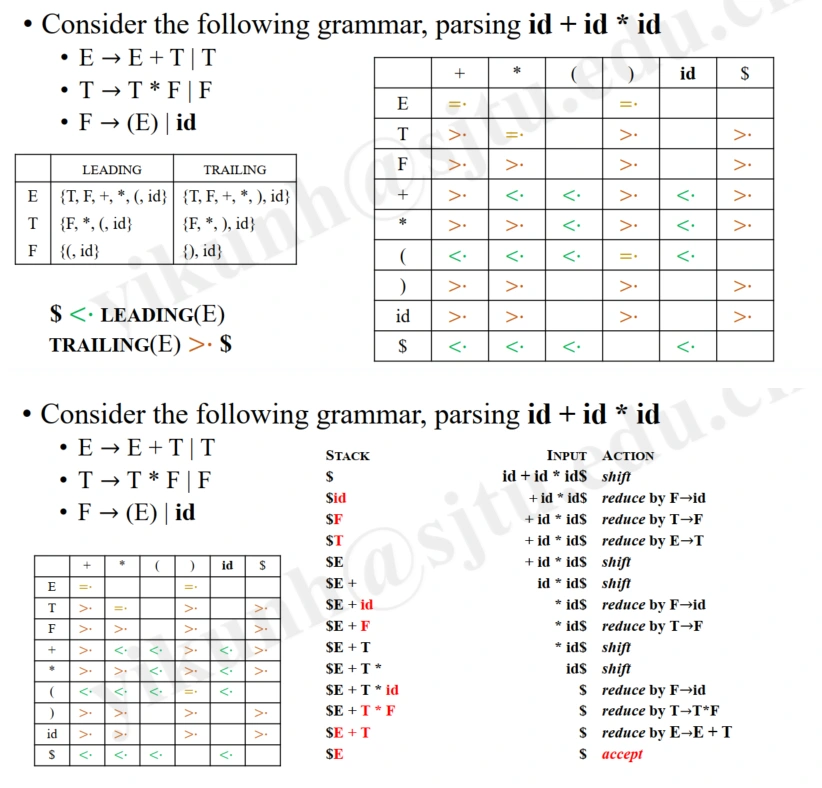
Precedence Table
-
Steps:
-
for each production \(\mathbf{A} \rightarrow \mathbf{X_1 X_2 \dots X_k}\):
-
for each \(\mathbf{X_i}\)
-
if \(\mathbf{X_i} \in \mathbf{V_t}\) and \(\mathbf{X_{i+1}} \in \mathbf{V_t}\), then \(\mathbf{X_i} =· \mathbf{X_{i+1}}\)
-
if \(\mathbf{X_i} \in \mathbf{V_t}\) and \(\mathbf{X_{i+2}} \in \mathbf{V_t}\) and \(\mathbf{X_{i+1}} \in \mathbf{V_n}\), then \(\mathbf{X_i} =· \mathbf{X_{i+2}}\)
-
if \(\mathbf{X_i} \in \mathbf{V_t}\) and \(\mathbf{X_{i+1}} \in \mathbf{V_n}\), then \(\mathbf{X_i} <· \mathbf{LEADING(X_{i+1})}\)
-
if \(\mathbf{X_i} \in \mathbf{V_n}\) and \(\mathbf{X_{i+1}} \in \mathbf{V_t}\), then \(\mathbf{X_i} =· \mathbf{X_{i+1}}\) and \(\mathbf{TRAILING(X_i)} >· \mathbf{X_{i+1}}\)
-
for the Start Symbol \(\mathbf{S}\):
-
\(\$ <· \mathbf{LEADING(S)}\)
-
\(\mathbf{TRAILING(S)} >· \$\)
-
-
-
Example:
OPP: Some More
-
Unary Minus vs. Binary Minus (一元负号与二元负号)
-
Leave It to Scanners (留给扫描器)
-
return two different tokens for the two (返回两个不同的 tokens)
-
lookahead is required (需要向前看)
-
-
OPPs are not used often in practice (运算符优先级在实践中不常用)
-
limited scenarios and applications (有限的场景和应用)
-
but, simple -> part of a complex parsing system (但简单,是复杂解析系统的一部分)
-
LR Parsing
-
What:
-
left-to-right scanning
-
rightmost derivation in reverse
-
-
Why
-
can recognize virtually all programming languages of context-free grammars (几乎可以识别所有上下文无关文法的编程语言)
-
is the most general non-backtracking shift-reduce parsing method known (已知的最通用的非回溯移位归约解析方法)
- yet is still efficient (仍然高效)
-
can detect a syntax error as soon as possible (尽快检测语法错误)
-
is a proper superset of the predictive parsing (是预测解析的适当超集)
-
LR(0) Parsing
Items and the LR(0) Automaton
-
Problem: when to shift and when to reduce?
- how to decide whether that on the top of the stack is a handle? (如何判断栈顶的句柄?)
-
LR(0) Items: a production with a dot at some position in its body (LR(0) 项目:在其主体的某个位置有一个点的产生式)
-
prefixes of a valid production, indicating how much we have seen at the point (有效产生式的前缀,指示我们在该点上已经看到多少)
-
e.g. \(\mathbf{A} \rightarrow \mathbf{XYZ}\) yields four items(例如 \(\mathbf{A} \rightarrow \mathbf{XYZ}\) 产生四个项):
-
\(\mathbf{A} \rightarrow \cdot \mathbf{XYZ}\): hope to see \(\mathbf{XYZ}\) next on the input
-
\(\mathbf{A} \rightarrow \mathbf{X} \cdot \mathbf{YZ}\): hope to see \(\mathbf{YZ}\) next on the input
-
\(\mathbf{A} \rightarrow \mathbf{XY} \cdot \mathbf{Z}\): hope to see \(\mathbf{Z}\) next on the input
-
\(\mathbf{A} \rightarrow \mathbf{XYZ} \cdot\): hope to see nothing next on the input
-
-
kind of state + transition → automaton
-
-
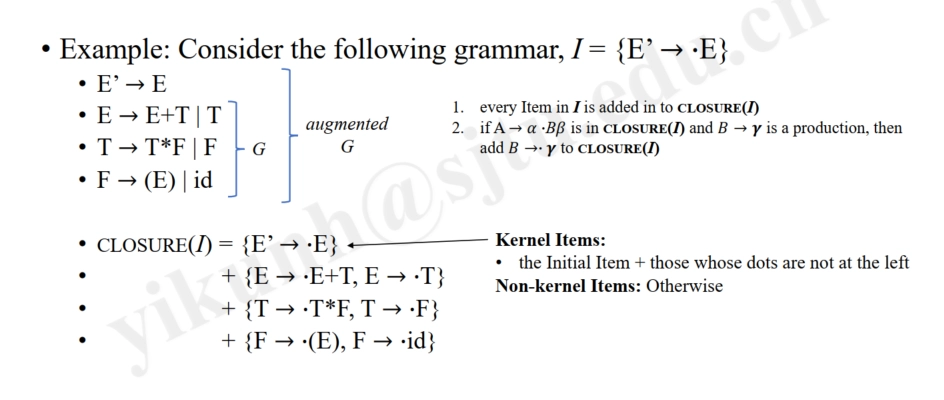
Kernel and Non-Kernel Items
-
Kernel Items: the Initial Item + those whose dots are not at the left
-
Non-Kernel Items: Otherwise
-
-
LR(0) Automaton: CLOSURE + GOTO
-
CLOSURE: set of Items (项集的闭包)
-
GOTO: the Transition Function (转换函数)
-
CLOSURE and GOTO
-
\(\mathbf{CLOSURE(I)}\):
-
\(\mathbf{I}\): a set of Items for a grammar \(\mathbf{G}\)(文法 \(\mathbf{G}\) 的项集)
-
construct by two rules:
-
every Item in \(\mathbf{I}\) is added in to \(\mathbf{CLOSURE(I)}\) (\(\mathbf{I}\) 中的每个项目都添加到 \(\mathbf{CLOSURE(I)}\) 中)
-
if \(\mathbf{A} \rightarrow \mathbf{\alpha} \cdot \mathbf{B} \mathbf{\beta}\) is in \(\mathbf{CLOSURE(I)}\) and \(\mathbf{B} \rightarrow \mathbf{\gamma}\) is a production of \(\mathbf{G}\), then add \(\mathbf{B} \rightarrow \cdot \mathbf{γ}\) to \(\mathbf{CLOSURE(I)}\) (如果 \(\mathbf{A} \rightarrow \mathbf{\alpha} \cdot \mathbf{B} \mathbf{\beta}\) 在 \(\mathbf{CLOSURE(I)}\) 中,并且 \(\mathbf{B} \rightarrow \mathbf{\gamma}\) 是 \(\mathbf{G}\) 的一个产生式,则将 \(\mathbf{B} \rightarrow \cdot \mathbf{γ}\) 添加到 \(\mathbf{CLOSURE(I)}\) 中)
-
-
Example:
-
-
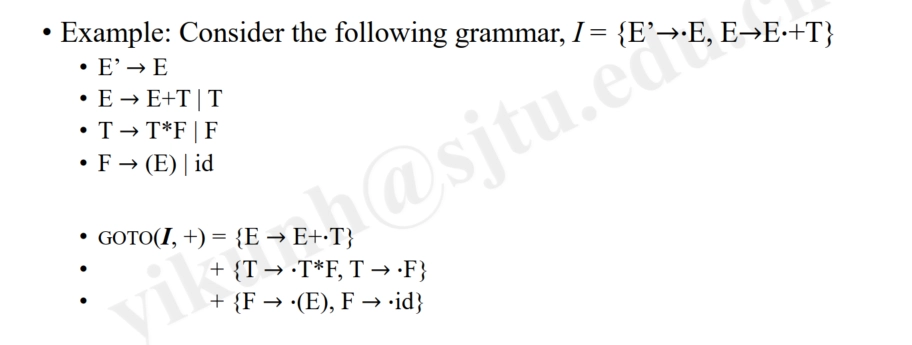
\(\mathbf{GOTO(I, X)}\):
-
\(\mathbf{I}\): a set of Items for a grammar \(\mathbf{G}\) (文法 \(\mathbf{G}\) 的项集)
-
\(\mathbf{X}\): a grammar symbol (文法符号)
-
the closure of the set of items [\(\mathbf{A} \rightarrow \mathbf{\alpha X} \cdot \mathbf{\beta}\)] such that [\(\mathbf{A} \rightarrow \mathbf{\alpha} \cdot \mathbf{X} \mathbf{\beta}\)] is in \(\mathbf{I}\) (\(\mathbf{GOTO(I, X)}\) 是 \(\mathbf{I}\) 中所有形如[\(\mathbf{A} \rightarrow \mathbf{\alpha} \cdot \mathbf{X \beta}\)]的项所对应的项[\(\mathbf{A} \rightarrow \mathbf{\alpha X} \cdot \mathbf{\beta}\)]的集合的闭包)
- the transition from the state for \(\mathbf{I}\) under input \(\mathbf{X}\) (在输入 \(\mathbf{X}\) 下,\(\mathbf{I}\) 的状态转换)
-
construct by
-
for each Item \(\mathbf{A} \rightarrow \mathbf{\alpha} \cdot \mathbf{X} \mathbf{\beta}\) in \(\mathbf{I}\)
-
then every Item in \(\mathbf{CLOSURE(A \rightarrow \alpha X \cdot \beta)}\) is added to \(\mathbf{GOTO(I, X)}\)
-
-
Example:
-
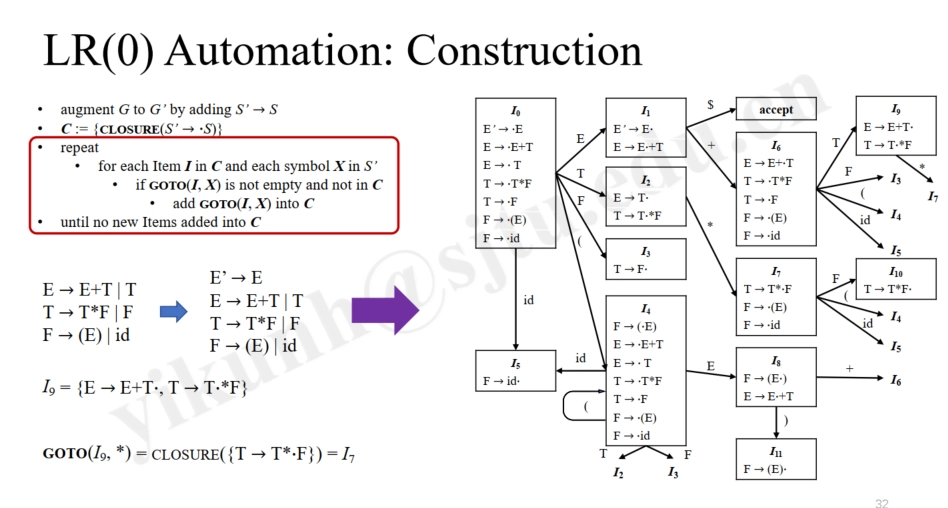
Automaton Construction
-
INPUT: a grammar \(\mathbf{G}\)
-
OUTPUT: a LR(0) automaton
-
Construction:
-
augment \(\mathbf{G}\) to \(\mathbf{G'}\) by adding a new start symbol \(\mathbf{S'}\) and production \(\mathbf{S'} \rightarrow \mathbf{S}\) (通过添加新的起始符号 \(\mathbf{S'}\) 和产生式 \(\mathbf{S'} \rightarrow \mathbf{S}\) 扩展文法 \(\mathbf{G}\) 至 \(\mathbf{G'}\))
-
\(\mathbf{C}\):= {\(\mathbf{CLOSURE(S' \rightarrow \cdot S)}\)} (先求 \(\mathbf{CLOSURE(S' \rightarrow \cdot S)}\),作为闭包的集合 \(\mathbf{C}\) 中的第一个闭包)
-
repeat:
-
for each Item \(\mathbf{I}\) in \(\mathbf{C}\) and each grammar symbol \(\mathbf{X}\) in \(\mathbf{G'}\) (对 \(\mathbf{C}\) 中每个项目 \(\mathbf{I}\) 和 \(\mathbf{G'}\) 中的每个文法符号 \(\mathbf{X}\))
-
if \(\mathbf{GOTO(I, X)}\) is not empty and not in \(\mathbf{C}\) (如果 \(\mathbf{GOTO(I, X)}\) 不为空且不在 \(\mathbf{C}\) 中,注意 \(\mathbf{GOTO(I, X)}\) 是项集 \(\mathbf{I}\) 在输入符号 \(\mathbf{X}\) 下的转换的闭包)
- add \(\mathbf{GOTO(I, X)}\) to \(\mathbf{C}\)
-
-
-
until no new Items are added to \(\mathbf{C}\)
-
-
Example:
Parsing Table Construction
-
LR(0) Parsing Table \(\mathbb{T}\):
-
Rows: states
-
Columns: grammar symbols
-
terminals for \(\mathbf{SHIFT}\) and \(\mathbf{REDUCE}\) actions
-
non-terminals for \(\mathbf{GOTO}\) actions
-
-
Construction: each edge \(\mathbf{X}\): \((s_m, s_n)\) (对于每条边 \(\mathbf{X}\),\((s_m, s_n)\) 为其起始和终止状态,X 为文法符号)
-
if \(\mathbf{X}\) is a terminal \(\mathbf{a}\), then \(\mathbb{T}[s_m, a] = \mathbf{SHIFT}\ n\) (记作 s n)
-
if \(\mathbf{X}\) is a non-terminal \(\mathbf{A}\), then \(\mathbb{T}[s_m, A] = \mathbf{GOTO}\ n\) (记作 n)
-
if \(\mathbf{A} \rightarrow \mathbf{\beta} \cdot\) is in \(s_m\), then for each terminal \(\mathbf{a}\), \(\mathbb{T}[s_m, a] = \mathbf{REDUCE}\ \mathbf{A} \rightarrow \mathbf{\beta}\) (记作 r n,其中 n 是产生式的编号,用罗马数字表示)
-
if \(\mathbf{S'} \rightarrow \mathbf{S} \cdot\) is in \(s_m\), then for each terminal \(\mathbf{a}\), \(\mathbb{T}[s_m, a] = \mathbf{ACCEPT}\) (记作 a/acc)
-
-
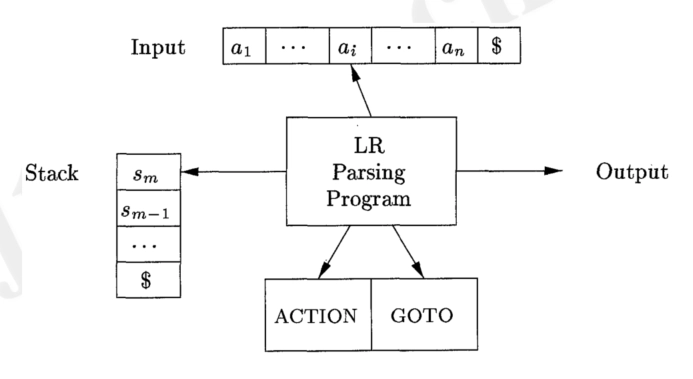
-
-
Example:
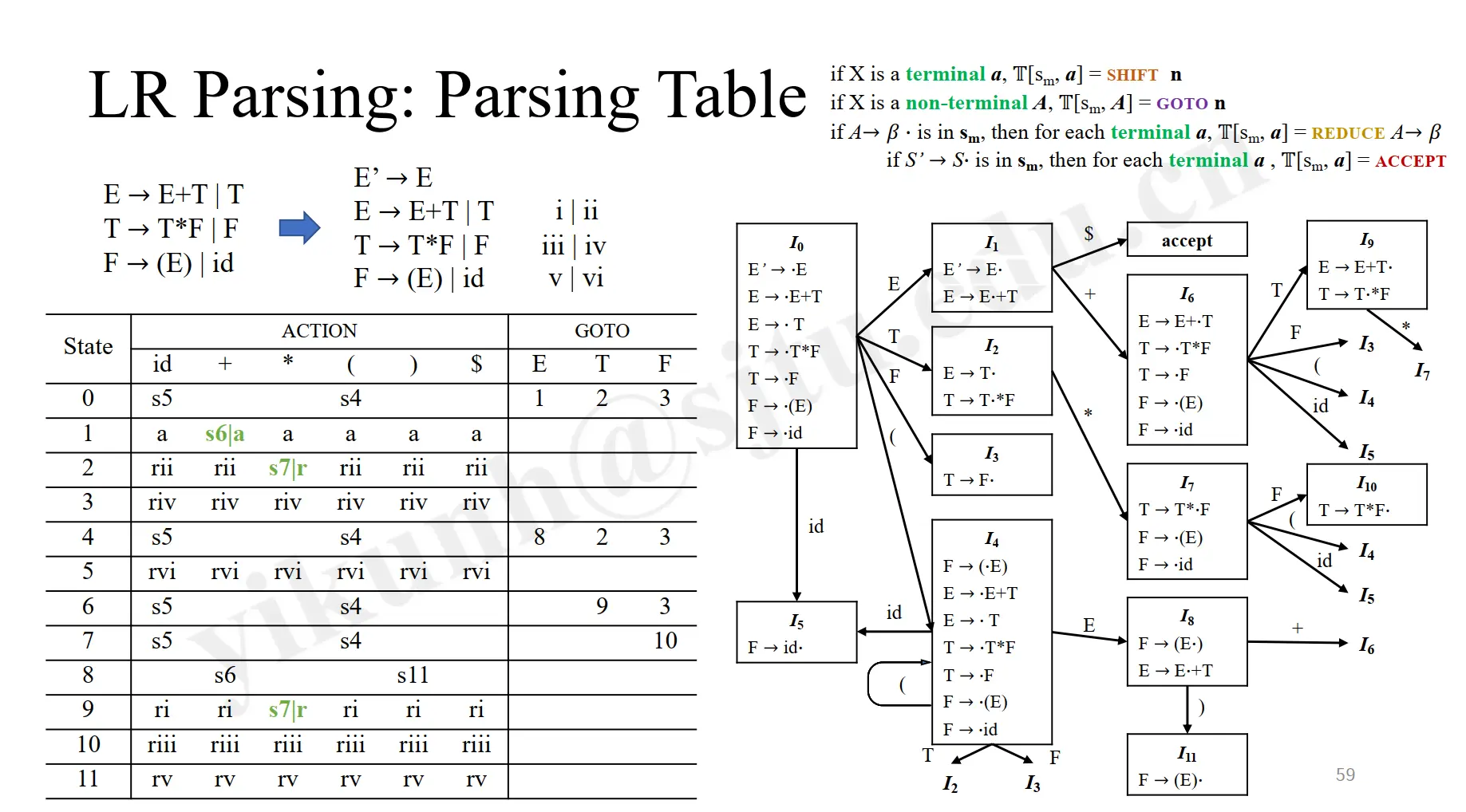 > 注:在上面的例子中,状态 1、2、9 均存在移进-归约冲突,因此不属于 LR(0)文法。
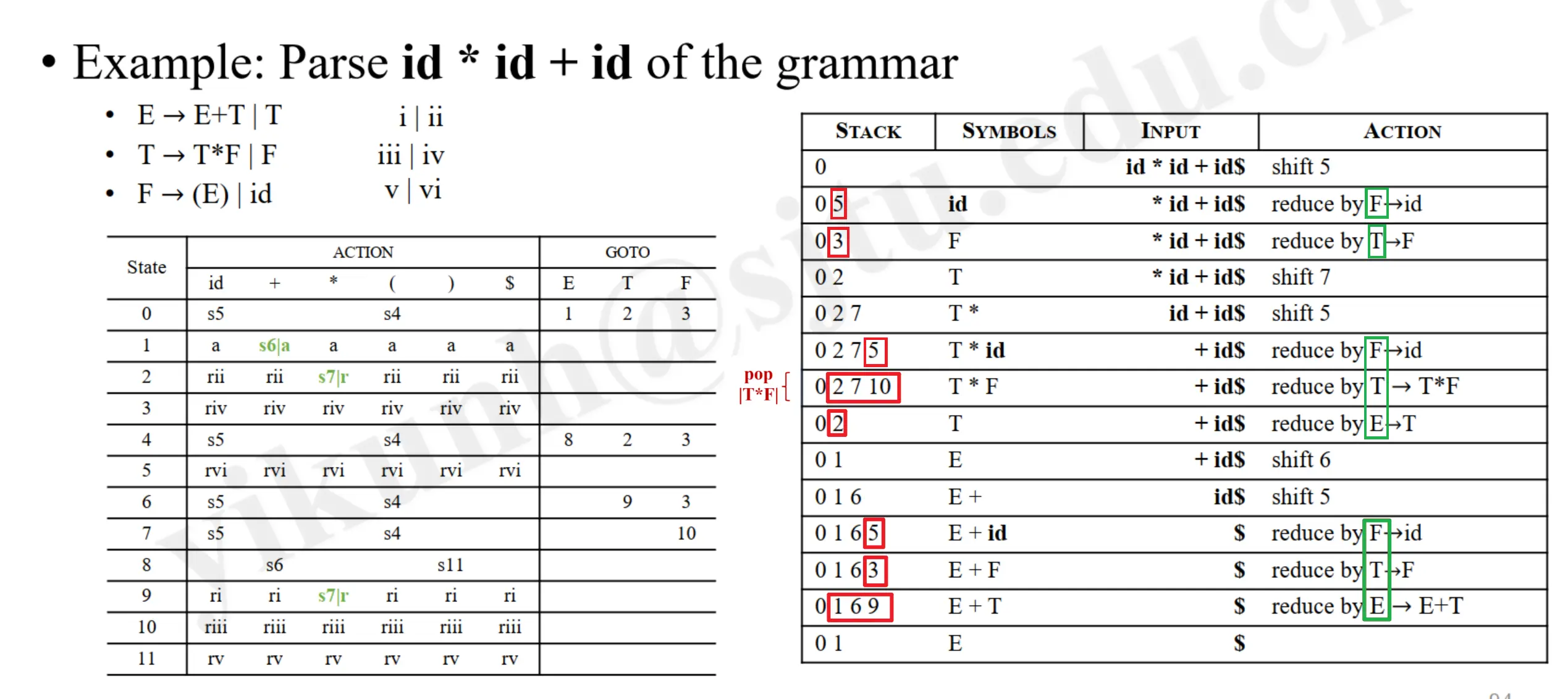
Alogrithm and Implementation (算法与实现)
-
INPUT: an input string \(\mathbf{\omega}\) and an LR-parsing table \(\mathbb{T}\) for a grammar \(\mathbf{G}\)
-
OUTPUT: if \(\mathbf{\omega} \in \mathbf{L(G)}\), the reduction steps of a bottom-up parse for \(\mathbf{\omega}\)
-
STEPS:
let a be the first symbol of 𝜔$ //设a是输入字符串𝜔$的第一个符号 push state 0 onto the stack //将状态0推入栈中 while (1) { let s be the state on top of the stack //设s是栈顶的状态 if (ACTION[s, a] = shift t) { //如果ACTION[s, a] = shift t push t onto the stack //将t推入栈中 let a be the next input symbol //设a是下一个输入符号 } else if (ACTION[s, a] = reduce A→𝛽) { //如果ACTION[s, a] = reduce A→𝛽 pop |𝛽| symbols off the stack //从栈中弹出|𝛽|(𝛽包含的符号数)个状态 let t be the top of the stack now //设t是栈顶的状态 push GOTO[t, A] onto the stack //将GOTO[t, A]推入栈中 } else if (ACTION[s, a] = accept) break //如果ACTION[s, a] = accept,则结束 else call error-handling routine } -
Example:
LR(0) Conflicts
-
Reduce-Reduce Conflicts:
-
state has two reduce items
-
e.g. \(\mathbf{A} \rightarrow \mathbf{\alpha} \cdot\) and \(\mathbf{B} \rightarrow \mathbf{\beta} \cdot\)
-
-
Shift-Reduce Conflicts:
-
state has a reduce item and a shift item
-
e.g. \(\mathbf{A} \rightarrow \mathbf{\alpha} \cdot \mathbf{k \gamma}\) and \(\mathbf{B} \rightarrow \mathbf{\beta} \cdot\)
-
-
To avoid conflicts: SLR(1) Parsing
SLR(1) Parsing
Parsing Table Construction
-
LR(0) Parsing Table \(\mathbb{T}\) \(\Rightarrow\) SLR(1) Parsing Table \(\mathbb{T}\)
-
Rows: states
-
Columns: grammar symbols
-
terminals for \(\mathbf{SHIFT}\) and \(\mathbf{REDUCE}\) actions
-
non-terminals for \(\mathbf{GOTO}\) actions
-
-
Construction: each edge \(\mathbf{X}\): \((s_m, s_n)\)
-
if \(\mathbf{X}\) is a terminal \(\mathbf{a}\), then \(\mathbb{T}[s_m, a] = \mathbf{SHIFT}\ n\)
-
if \(\mathbf{X}\) is a non-terminal \(\mathbf{A}\), then \(\mathbb{T}[s_m, A] = \mathbf{GOTO}\ n\)
-
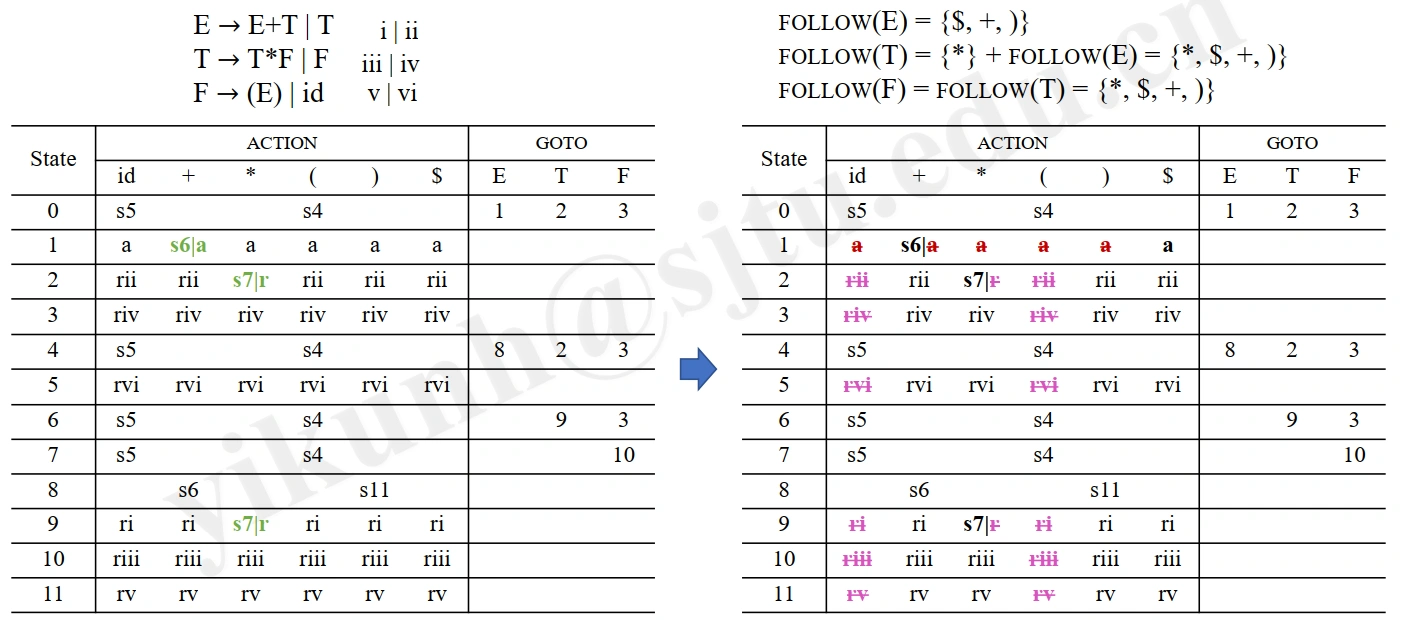
if \(\mathbf{A} \rightarrow \mathbf{\beta} \cdot\) is in \(s_m\), then for each terminal \(\mathbf{a} \in \mathbf{FOLLOW(A)}\), \(\mathbb{T}[s_m, a] = \mathbf{REDUCE}\ \mathbf{A} \rightarrow \mathbf{\beta}\) (只对 \(\mathbf{FOLLOW(A)}\) 中的终结符进行归约)
-
if \(\mathbf{S'} \rightarrow \mathbf{S} \cdot\) is in \(s_m\), then \(\mathbb{T}[s_m, \$] = \mathbf{ACCEPT}\) (只对$进行归约)
-
-
-
Example:
SLR(1) Conflicts
-
Reduce-Reduce Conflicts:
-
state has two reduce items
-
e.g. \(\mathbf{A} \rightarrow \mathbf{\alpha} \cdot\) and \(\mathbf{B} \rightarrow \mathbf{\beta} \cdot\)
- if \(\mathbf{FOLLOW(A)} \cap \mathbf{FOLLOW(B)} = \varnothing\), safe for SLR(1) (如果 \(\mathbf{FOLLOW(A)} \cap \mathbf{FOLLOW(B)} = \varnothing\),则 SLR(1)安全)
-
-
Shift-Reduce Conflicts:
-
state has a reduce item and a shift item
-
e.g. \(\mathbf{A} \rightarrow \mathbf{\alpha} \cdot \mathbf{k \gamma}\) and \(\mathbf{B} \rightarrow \mathbf{\beta} \cdot\)
- if \(\mathbf{k} \notin \mathbf{FOLLOW(B)}\), safe for SLR(1) (如果 \(\mathbf{k} \notin \mathbf{FOLLOW(B)}\),则 SLR(1)安全)
-
LR(1) Parsing
-
How: check the immediate following symbols of non-terminals for reduction (检查非终结符的直接后续符号以进行归约)
-
LR(1) Item = [LR(0) Item, Following Symbol]
-
e.g. \([\mathbf{A} \rightarrow \mathbf{XY} \cdot \mathbf{Z}, \mathbf{a}]\)
-
where \(\mathbf{a}\) is the following terminal symbol of \(\mathbf{A}\) (\(\mathbf{a}\) 是 \(\mathbf{A}\) 的后续终结符)
-
when \(\mathbf{Z}\) is not empty, the same as LR(0) Item (当 \(\mathbf{Z}\) 不为空时,与 LR(0)项相同)
-
otherwise, \(\mathbf{A} \rightarrow \mathbf{XY} \cdot \mathbf{Z}\) is applied only when the next input symbol is \(\mathbf{a}\) (否则,只有在下一个输入符号为 \(\mathbf{a}\) 时才应用 \(\mathbf{A} \rightarrow \mathbf{XY} \cdot \mathbf{Z}\))
- instead of SLR(1)'s ALL \(\mathbf{A}\)'s following symbols, let along LR(0)'s ALL terminal symbols (而不是 SLR(1)的所有 \(\mathbf{A}\) 的后续符号,甚至 LR(0)的所有终结符)
-
LR(1)'s CLOSURE and GOTO
-
LR(1)'s \(\mathbf{CLOSURE(I)}\)
-
every Item in \(\mathbf{I}\) is added in to \(\mathbf{CLOSURE(I)}\)
-
repeat:
-
if \([\mathbf{A} \rightarrow \mathbf{\alpha} \cdot \mathbf{B} \mathbf{\beta}, \mathbf{a}]\) is in \(\mathbf{CLOSURE(I)}\) and \(\mathbf{B} \rightarrow \mathbf{\gamma}\) is a production of \(\mathbf{G}\), then for each terminal \(\mathbf{b}\) in \(\mathbf{FIRST(\beta a)}\), add \([\mathbf{B} \rightarrow \cdot \mathbf{\gamma}, \mathbf{b}]\) into \(\mathbf{CLOSURE(I)}\)
-
until no more new Items can be added into \(\mathbf{CLOSURE(I)}\)
-
-
only reduce \(\mathbf{B}\) when it is followed by that in \(\mathbf{FIRST(\beta a)}\) (仅在后面跟着 \(\mathbf{FIRST(\beta a)}\) 中的项时才归约 \(\mathbf{B}\))
-
-
LR(1)'s \(\mathbf{GOTO(I, B)}\)
-
if \([\mathbf{A} \rightarrow \mathbf{\alpha} \cdot \mathbf{B} \mathbf{\beta}, \mathbf{a}]\) in \(\mathbf{I}\)
-
then every Item in \(\mathbf{CLOSURE(\{[\mathbf{A} \rightarrow \mathbf{\alpha} \mathbf{B} \cdot \mathbf{\beta}, \mathbf{a}]\})}\) is in \(\mathbf{GOTO(I, B)}\)
-
\(\mathbf{GOTO(I, B)} \supseteq \mathbf{CLOSURE(\{[\mathbf{A} \rightarrow \mathbf{\alpha} \mathbf{B} \cdot \mathbf{\beta}, \mathbf{a}]\})}\)
- [\(\mathbf{A} \rightarrow \mathbf{\alpha} \mathbf{B} \cdot \mathbf{\beta}, \mathbf{a}\)]: Kernel Item
-
Those of Kernel Items inherited from the previous state (从前一个状态继承的内核项)
-
-
-
Example:
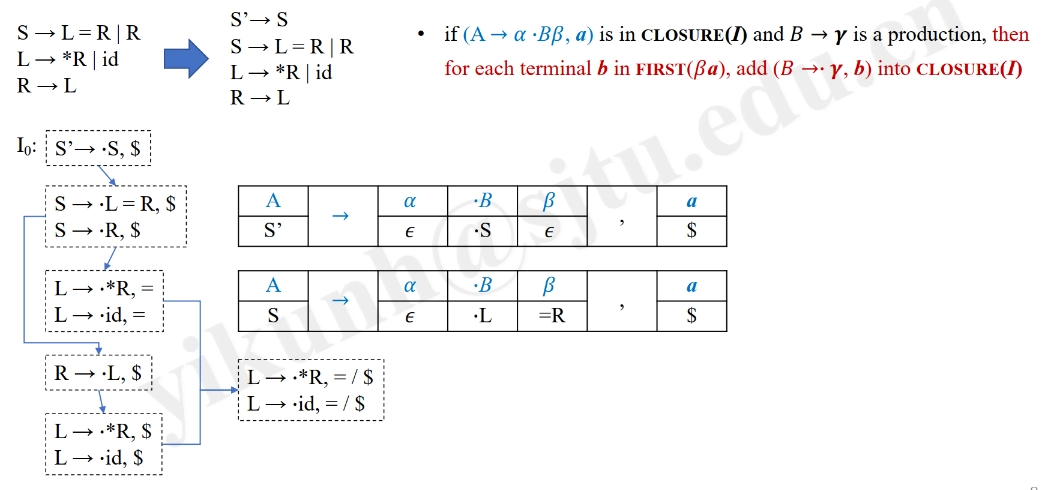
Automaton Construction
-
INPUT: a grammar \(\mathbf{G}\)
-
OUTPUT: a LR(1) automaton
-
Construction:
-
augment \(\mathbf{G}\) to \(\mathbf{G'}\) by adding a new start symbol \(\mathbf{S'}\) and production \(\mathbf{S'} \rightarrow \mathbf{S}\) (扩展文法)
-
\(\mathbf{C}\):= {\(\mathbf{CLOSURE({[S' \rightarrow \cdot S, \$]})}\)} (初始化项集 C)
-
repeat:
-
for each Item \(\mathbf{I}\) in \(\mathbf{C}\) and each grammar symbol \(\mathbf{X}\) in \(\mathbf{G'}\)
-
if \(\mathbf{GOTO(I, X)}\) is not empty and not in \(\mathbf{C}\)
- add \(\mathbf{GOTO(I, X)}\) to \(\mathbf{C}\)
-
-
-
until no new Items are added to \(\mathbf{C}\)
-
-
Example:
-
Example:
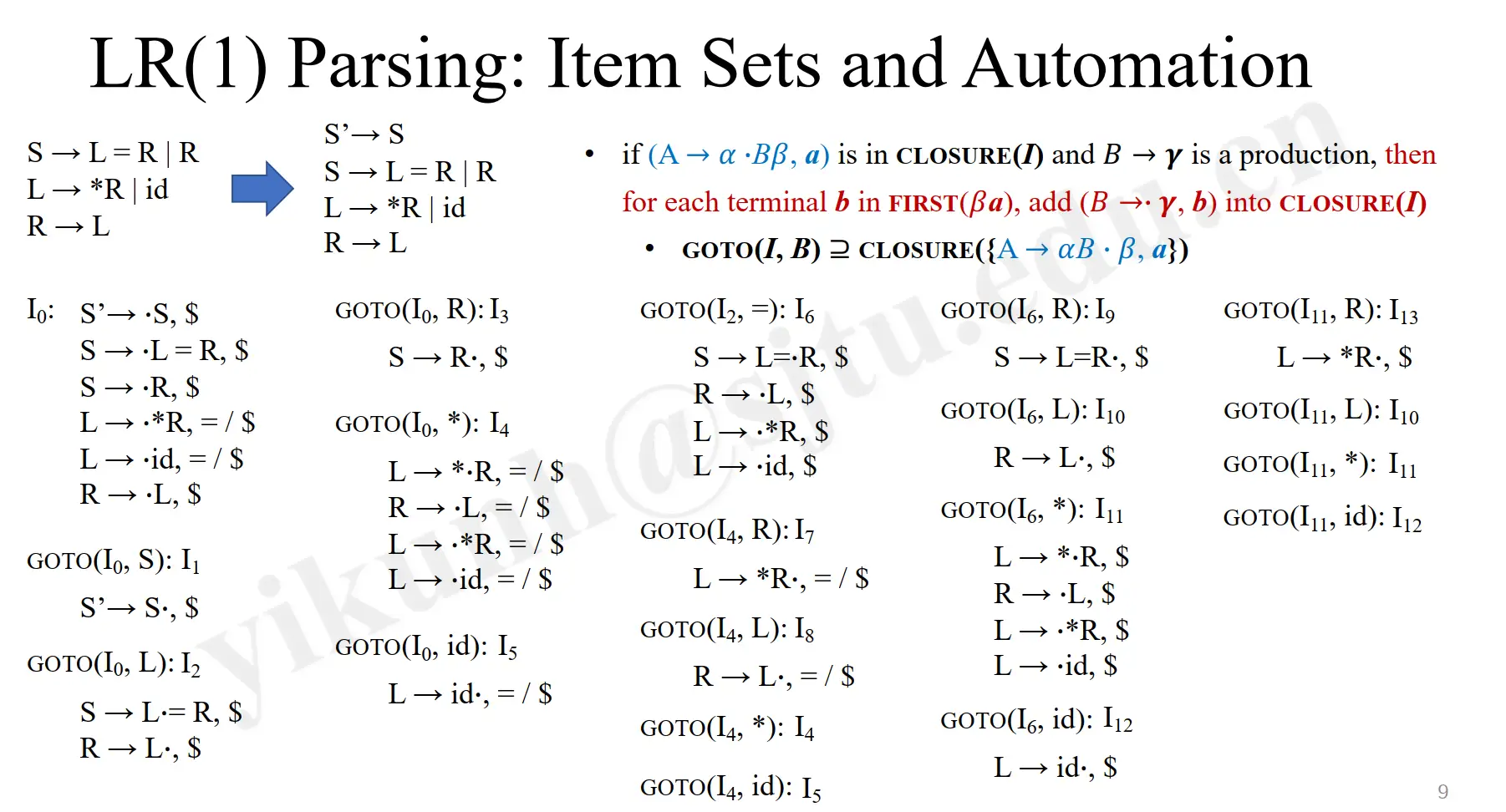
-
Exercise:
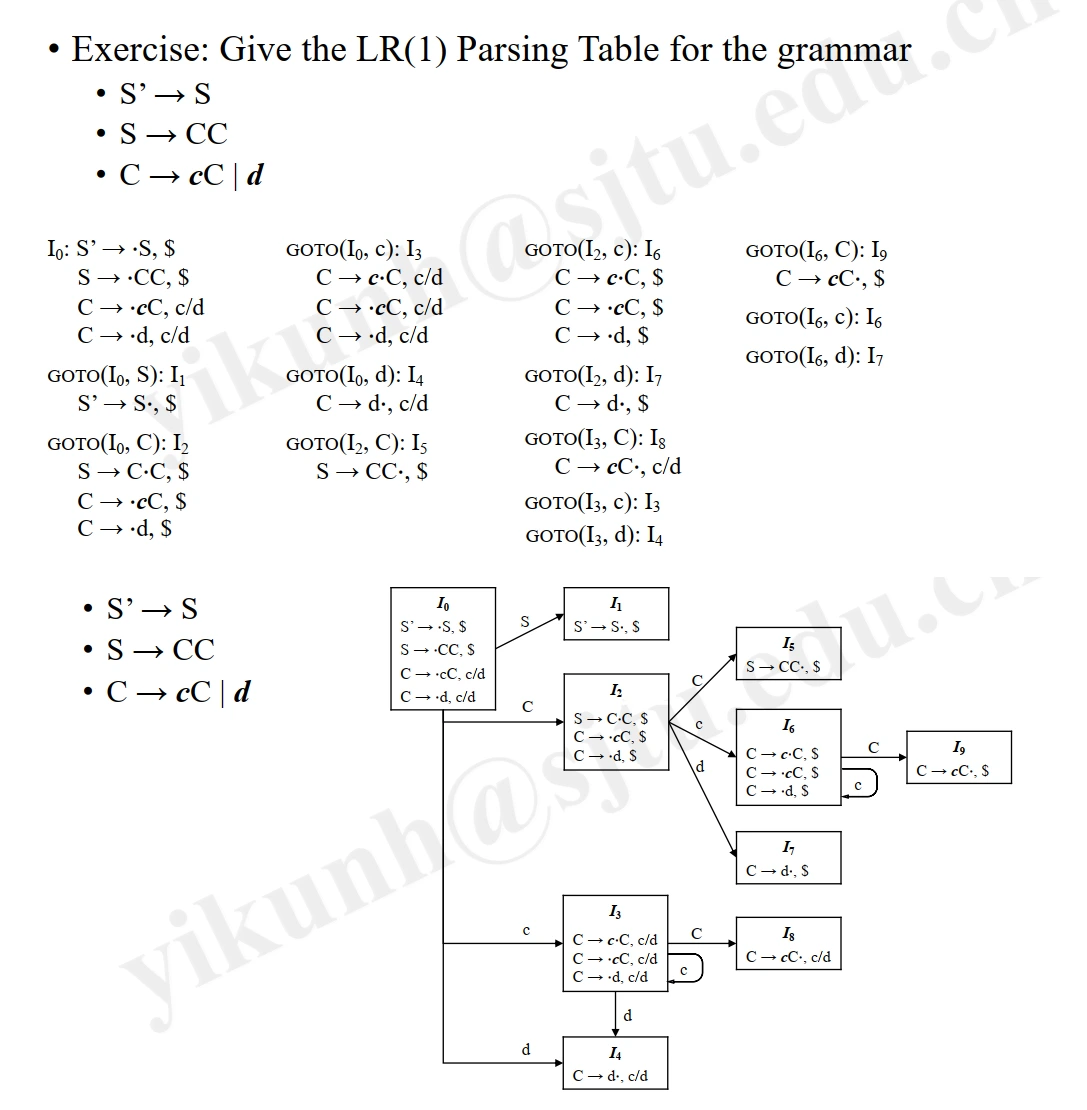
-
Parsing Table Construction
-
LR(1) Parsing Table \(\mathbb{T}\):
-
Rows: states
-
Columns: grammar symbols
-
terminals for \(\mathbf{SHIFT}\) and \(\mathbf{REDUCE}\) actions
-
non-terminals for \(\mathbf{GOTO}\) actions
-
-
Construction: each edge \(\mathbf{X}\): \((s_m, s_n)\)
-
if \(\mathbf{X}\) is a terminal \(\mathbf{a}\), then \(\mathbb{T}[s_m, a] = \mathbf{SHIFT}\ n\)
-
if \(\mathbf{X}\) is a non-terminal \(\mathbf{A}\), then \(\mathbb{T}[s_m, A] = \mathbf{GOTO}\ n\)
-
if \([\mathbf{A} \rightarrow \mathbf{\beta} \cdot, \mathbf{a}]\) (the kernel) is in \(s_m\), then \(\mathbb{T}[s_m, a] = \mathbf{REDUCE}\ \mathbf{A} \rightarrow \mathbf{\beta}\)
-
if \([\mathbf{S'} \rightarrow \mathbf{S} \cdot, \$]\) is in \(s_m\), then \(\mathbb{T}[s_m, \$] = \mathbf{ACCEPT}\)
-
-
-
Example:
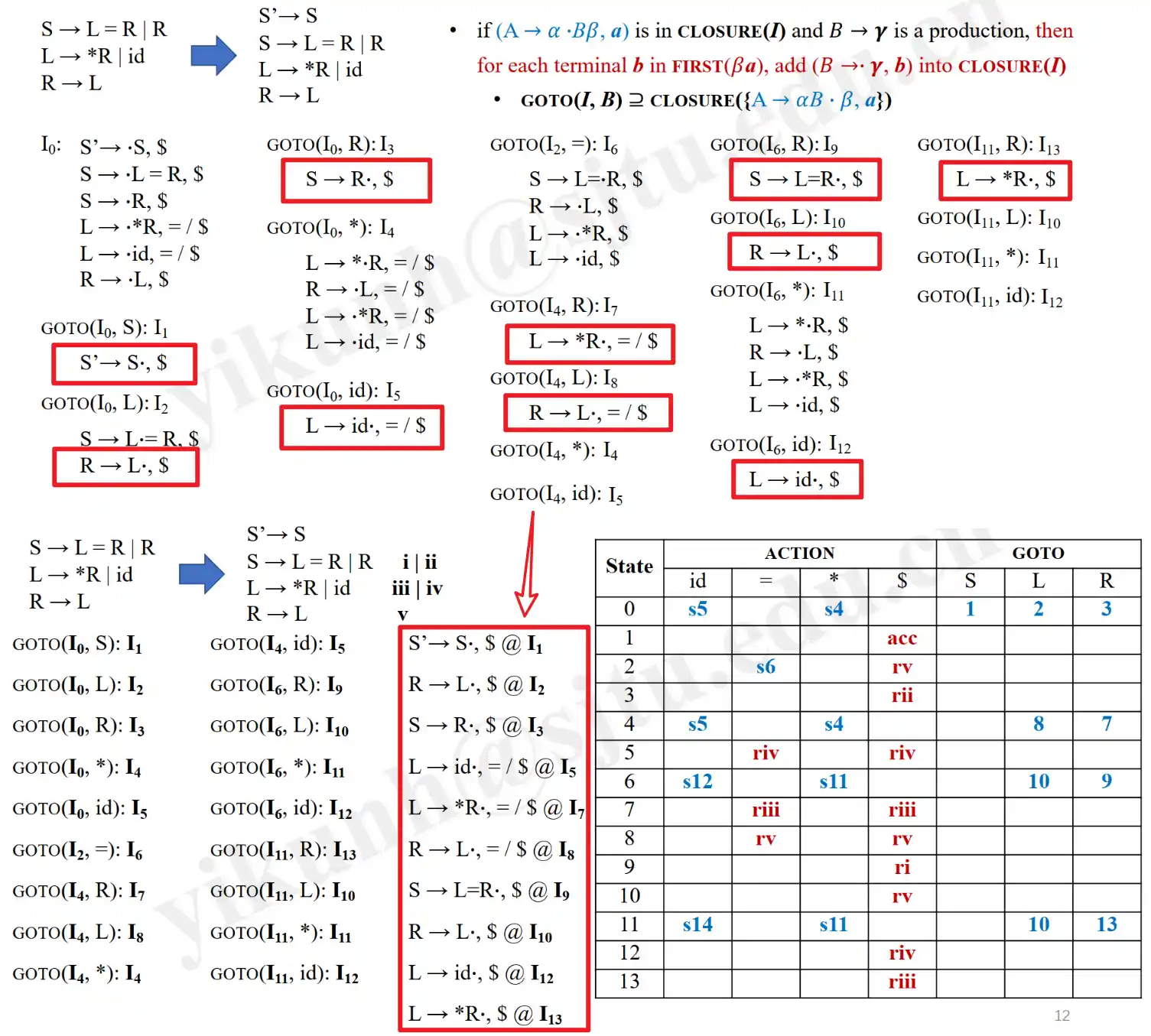 > 注:上表中 \([11, id]\) 应为 \(s12\),即 \(\mathbb{T}[11, id] = s12\)。
LALR(1) Parsing
-
What: L ook A head LR(1)
-
Why: smaller parsing table than LR(1) for practice(比 LR(1)小的解析表)
-
equal to SLR(1) in state number (与 SLR(1)状态数相等)
- e.g. In C, serveral hundred for SLR(1), serverals of thousands for LR(1)
-
more powerful than SLR(1) in processing more grammars (比 SLR(1)更强大,能处理更多文法)
-
-
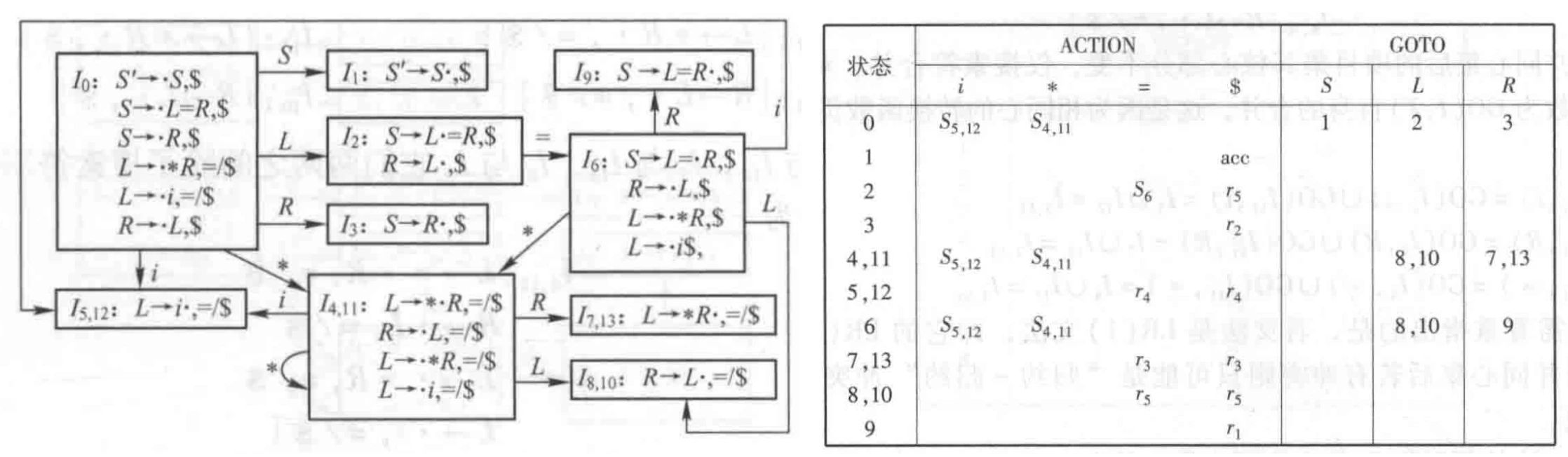
How: combine Items with the same Production Set in LR(1) (将 LR(1)中具有相同产生式集的项(同心集)组合在一起)
- e.g. \([\mathbf{A} \rightarrow \mathbf{\alpha} \cdot, \mathbf{a}]\) and \([\mathbf{A} \rightarrow \mathbf{\alpha} \cdot, \mathbf{b}]\) are combined into one state
-
Compared to LR(1):
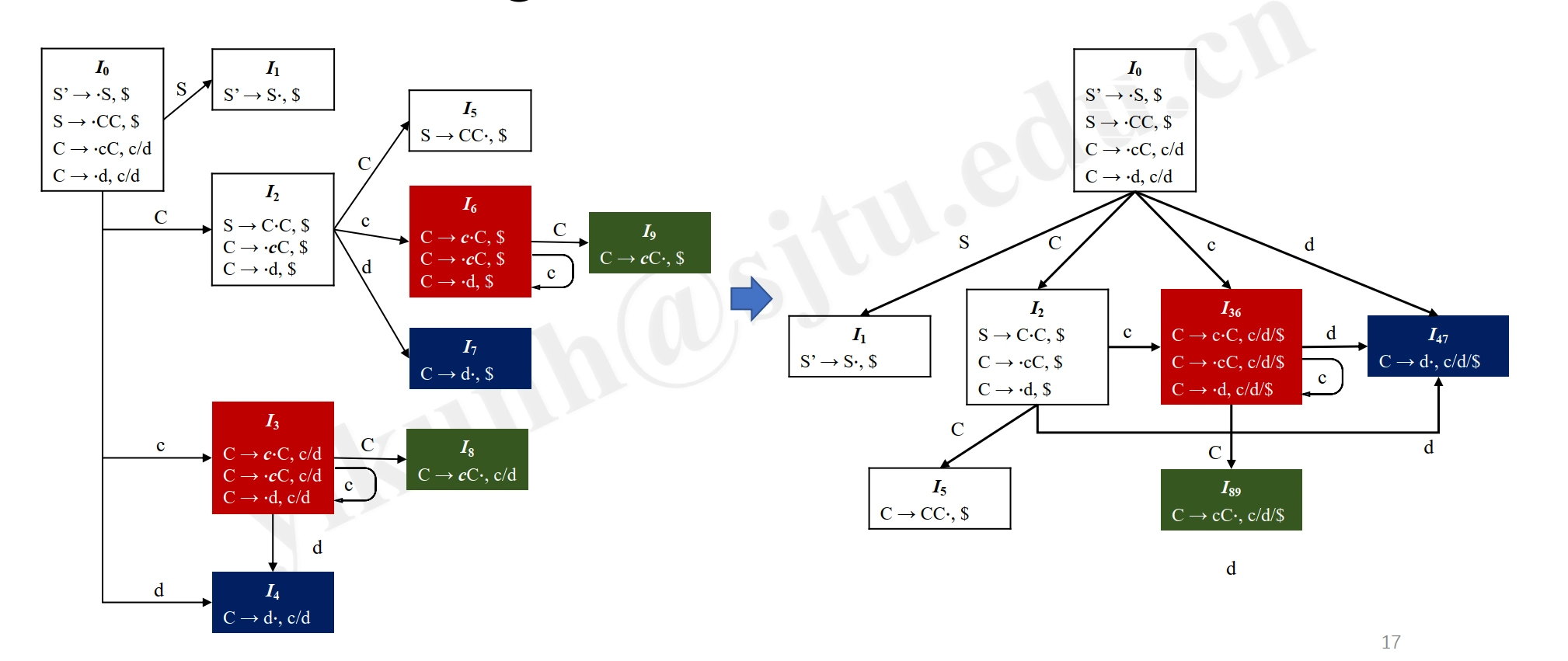
Automaton Construction
-
INPUT: a grammar \(\mathbf{G}\)
-
OUTPUT: a LALR(1) automaton
-
Construction:
-
Construct LR(0) items as LALR(1) items' cores for the grammar \(\mathbf{G'}\),then remove the non-kernel items (为文法 \(\mathbf{G'}\) 构造 LR(0)项作为 LALR(1)项的核心,然后删除非核心项)
-
For each kernal items \(\mathbf{K}\) in \(\mathbf{I_i}\) and each grammar symbol \(\mathbf{X}\) in \(\mathbf{G'}\), calculate the lookahead symbols' INIT and PROPAGATION. (对于每个项集 \(\mathbf{I_i}\) 中的核心项 \(\mathbf{K}\) 和文法符号 \(\mathbf{X}\),计算前瞻符号的初始值和传播)
-
For each item \((\mathbf{A} \rightarrow \mathbf{\alpha} \cdot \mathbf{\beta})\) in \(\mathbf{K}\)
-
\(\mathbf{J} := \{\mathbf{CLOSURE({[A \rightarrow \alpha \cdot \beta, \#]})}\}\) (初始化 \(\mathbf{J}\))
-
if \([\mathbf{B \rightarrow \gamma \cdot X \delta, a}]\) in \(\mathbf{J}\) and \(\mathbf{a \neq} \#\), then \(\mathbf{B \rightarrow \gamma X \cdot \delta}\) in \(\mathbf{GOTO(I_i, X)}\) has a SELF-generated lookahead symbol \(\mathbf{a}\) (\(\mathbf{J}\) 中的项若出现不为#的前瞻符号,则它是自发生成的)
-
if \([\mathbf{B \rightarrow \gamma \cdot X \delta,} \#]\) in \(\mathbf{J}\), then lookahead symbols are propagated from \(\mathbf{A \rightarrow \alpha \cdot \beta}\) to \(\mathbf{B \rightarrow \gamma X \cdot \delta}\) in \(\mathbf{GOTO(I_i, X)}\). (\(\mathbf{J}\) 中的项若出现#的前瞻符号,则该项会传播前瞻符号)
-
-
Specifically, \(\mathbf{\$}\) in \(\mathbf{[S' \rightarrow S \cdot, \$]}\) is SELF-generated.
-
-
Construct the \(\mathbf{FROM-TO}\) table base on \(\mathbf{GOTO}\) for the kernel items to show the propagation of lookahead symbols (为核心项构建 \(\mathbf{FROM-TO}\) 表,以显示前瞻符号的传播)
- in step 2, we calculate propagated relationships.
-
Propagate the lookahead symbols according to the \(\mathbf{FROM-TO}\) relationships until the fixed point achieved (根据 \(\mathbf{FROM-TO}\) 关系传播前瞻符号,直到达到不变点)
- in step 2, we calculate self-generated lookahead symbols.
-
-
Example:
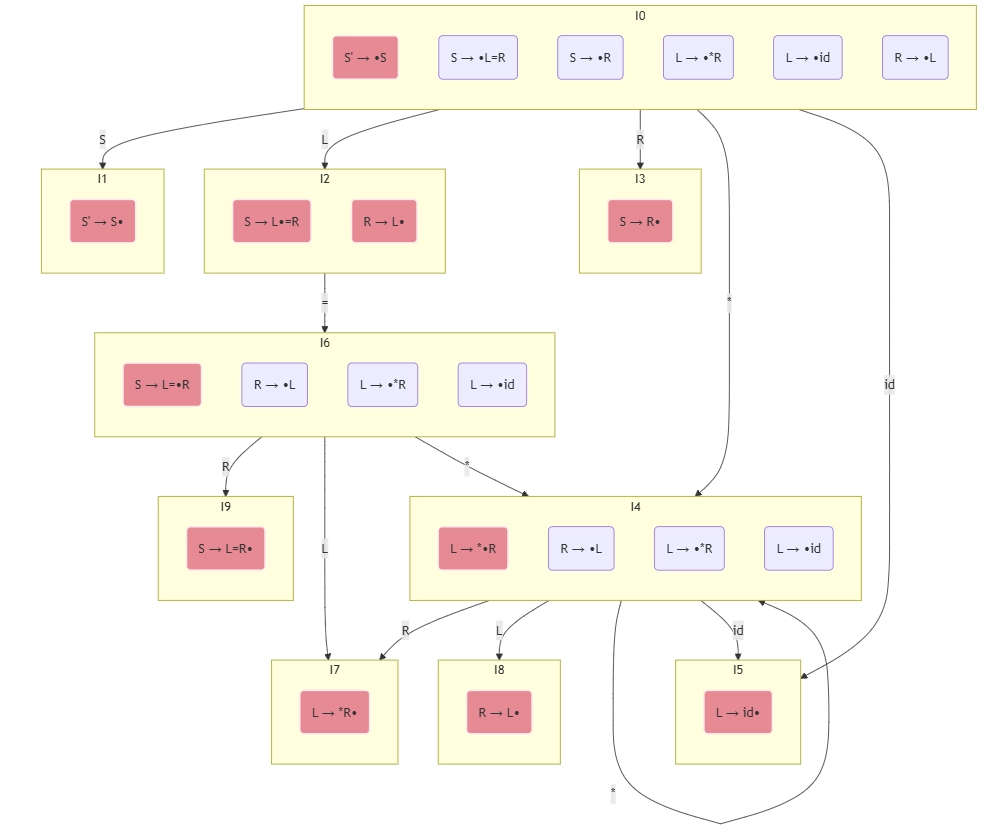
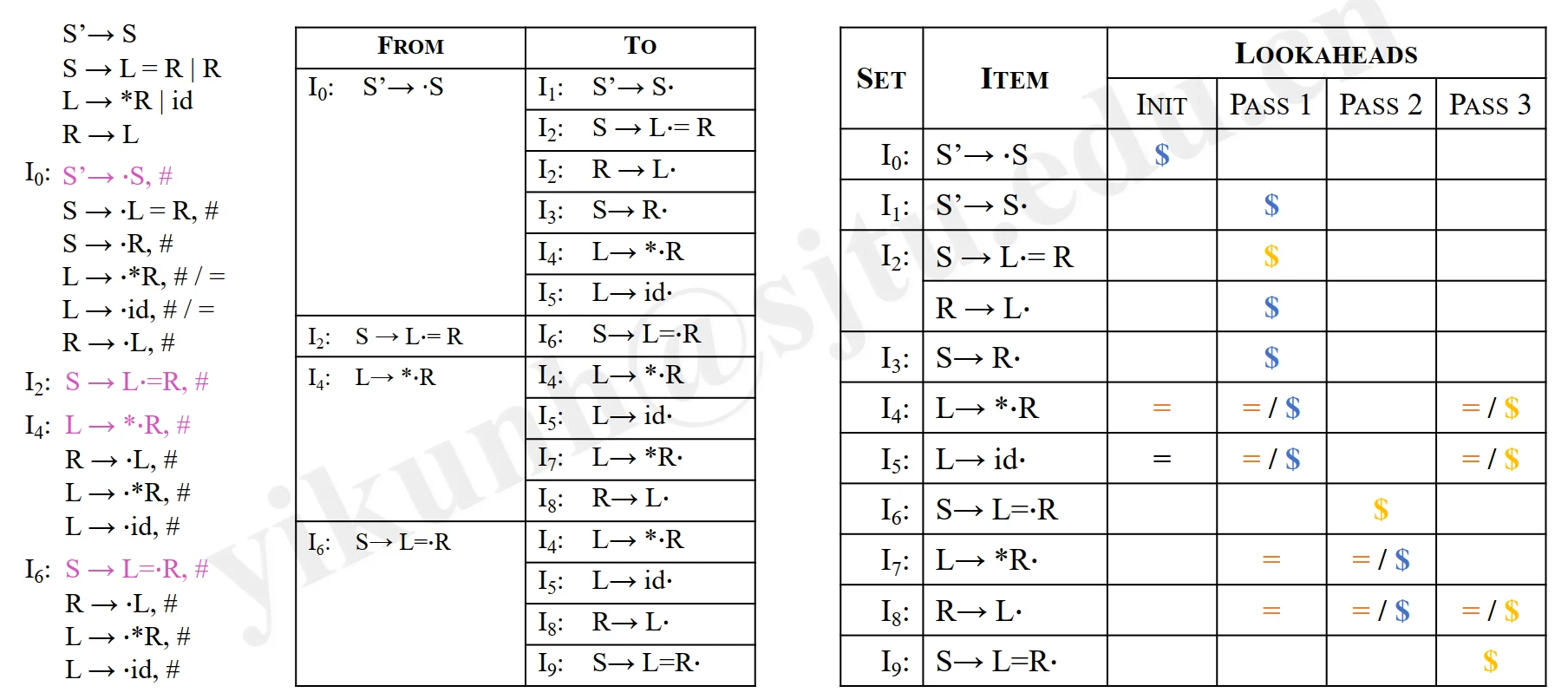 > 注:上右表中,前瞻符号在传播时,每一行的前瞻符号可以向右填满右侧列,最右一列是最终结果
Parsing Table Construction
-
the same as LR(1) method
-
LALR(1) Parsing Table \(\mathbb{T}\):
-
Rows: states
-
Columns: grammar symbols
-
terminals for \(\mathbf{SHIFT}\) and \(\mathbf{REDUCE}\) actions
-
non-terminals for \(\mathbf{GOTO}\) actions
-
-
Construction: each edge \(\mathbf{X}\): \((s_m, s_n)\)
-
if \(\mathbf{X}\) is a terminal \(\mathbf{a}\), then \(\mathbb{T}[s_m, a] = \mathbf{SHIFT}\ n\)
-
if \(\mathbf{X}\) is a non-terminal \(\mathbf{A}\), then \(\mathbb{T}[s_m, A] = \mathbf{GOTO}\ n\)
-
if \([\mathbf{A} \rightarrow \mathbf{\beta} \cdot, \mathbf{a}]\) (the kernel) is in \(s_m\), then \(\mathbb{T}[s_m, a] = \mathbf{REDUCE}\ \mathbf{A} \rightarrow \mathbf{\beta}\)
-
if \([\mathbf{S'} \rightarrow \mathbf{S} \cdot, \$]\) is in \(s_m\), then \(\mathbb{T}[s_m, \$] = \mathbf{ACCEPT}\)
-
-
-
Example:
Capabilities vs. Conflicts
-
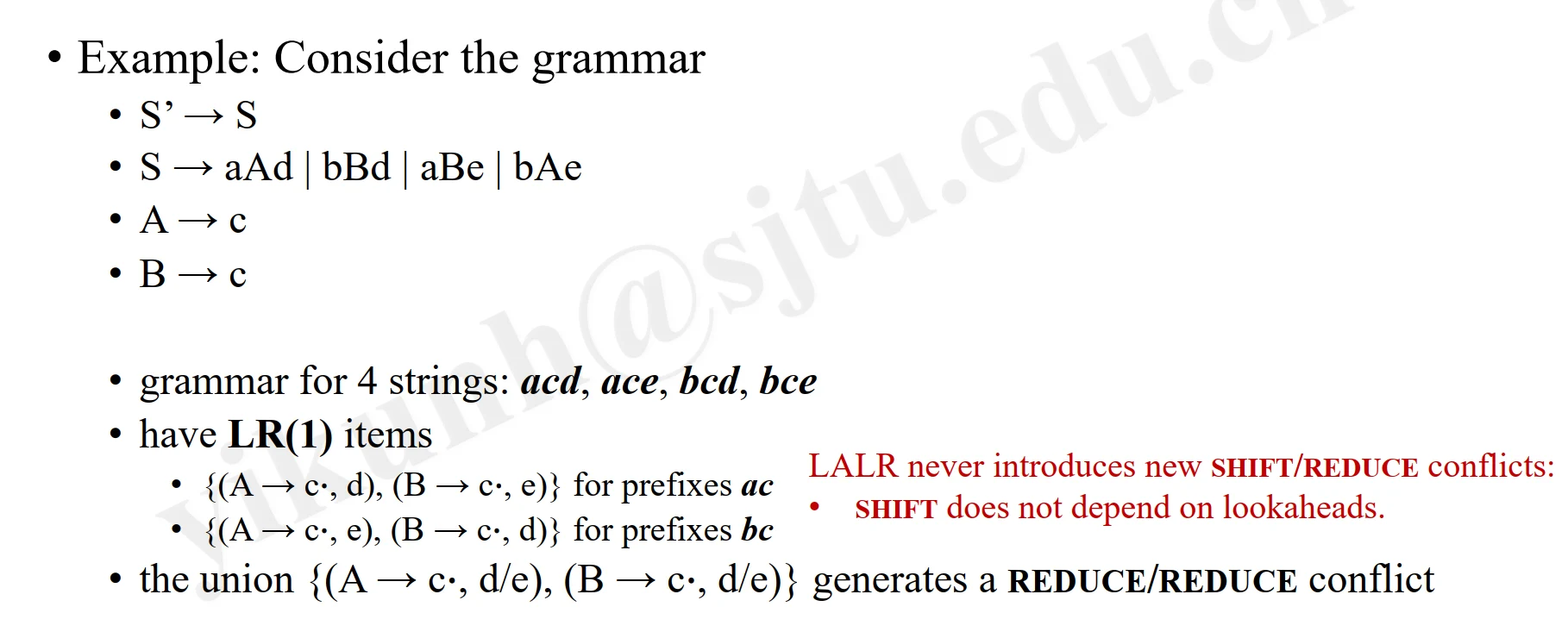
LALR never introduces new SHIFT-REDUCE conflicts:
- SHIFT does not depend on lookaheads
-
Example:
Summary
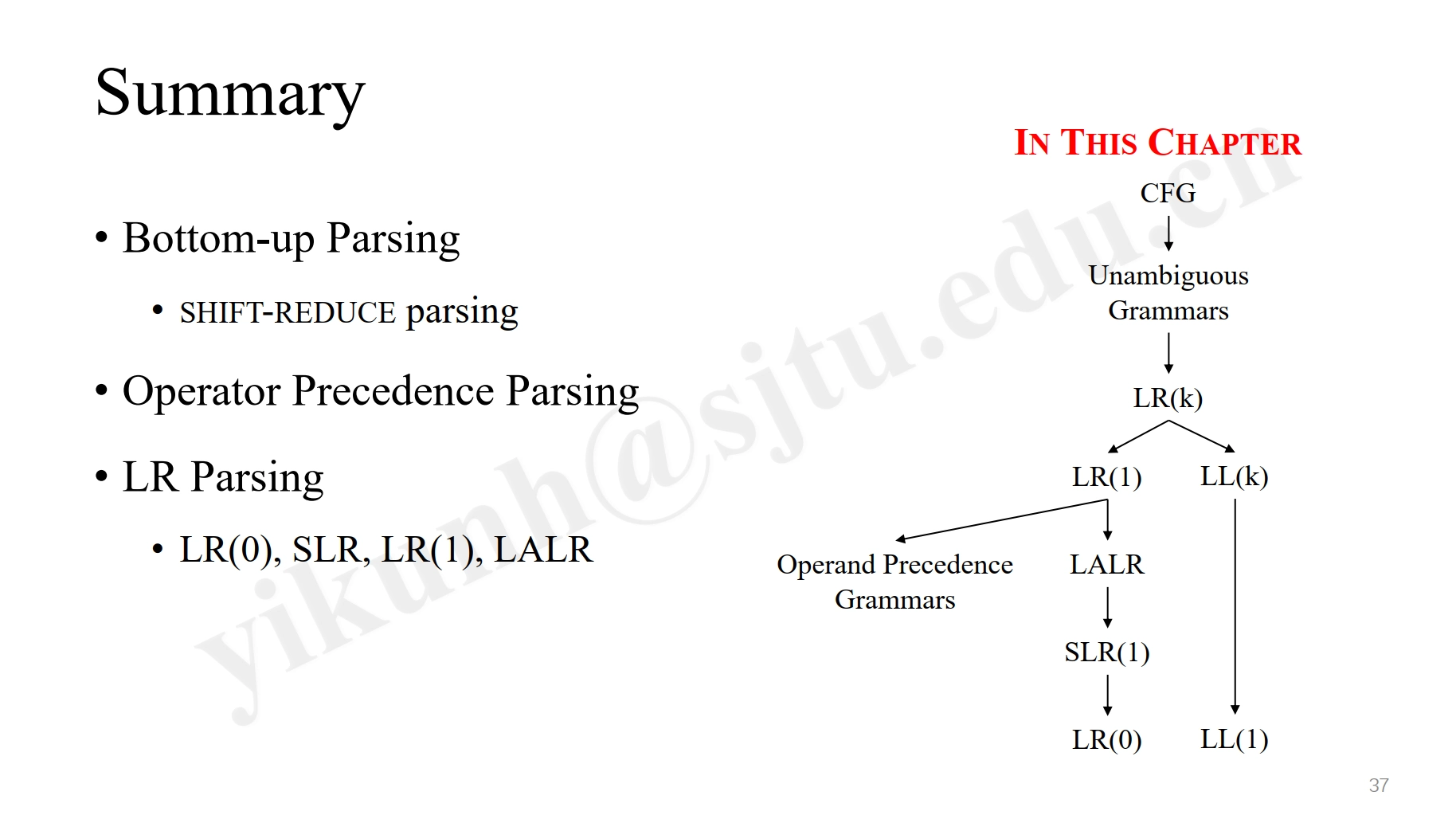
-
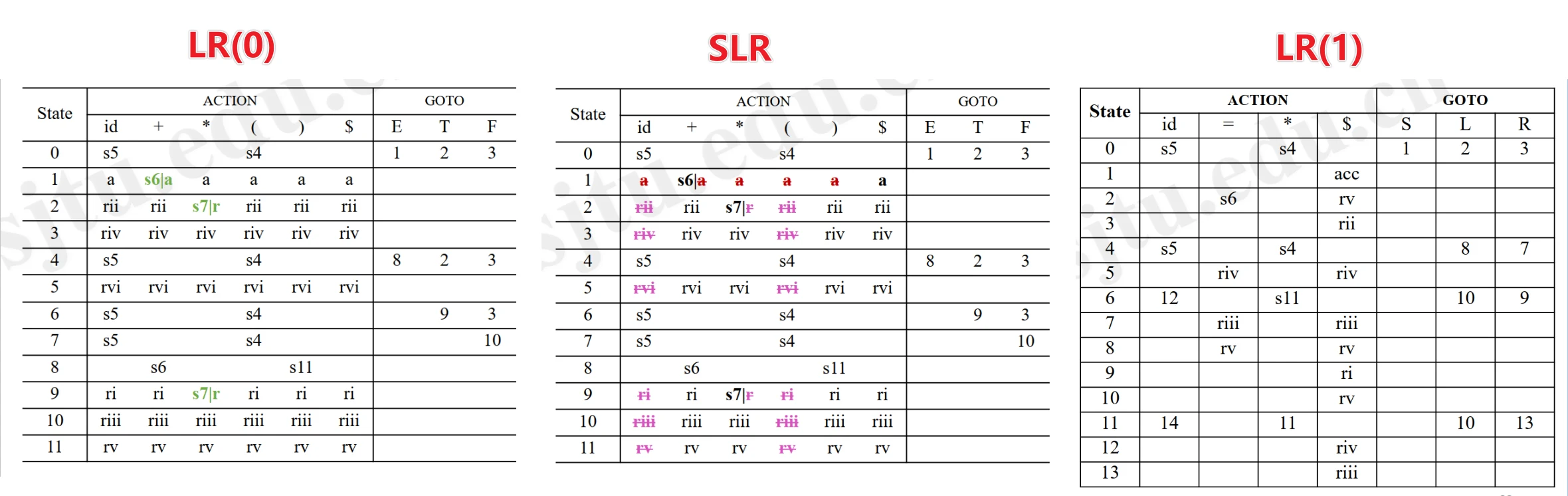
LR(0), SLR(1), LR(1), LALR(1)
-
all working in SHIFT-REDUCE mode
-
only different in Parsing Tables
-
-
Parsing Tables - Capabilities
-
LR(0) < SLR(1) < LALR(1) < LR(1)
-
LR(0): Items
-
SLR(1): Items with FOLLOW
-
LALR(1): Items Combined from SLR(1) and LR(1)
-
LR(1): Items with Subset of FOLLOW
-
Using Ambiguous Grammars
-
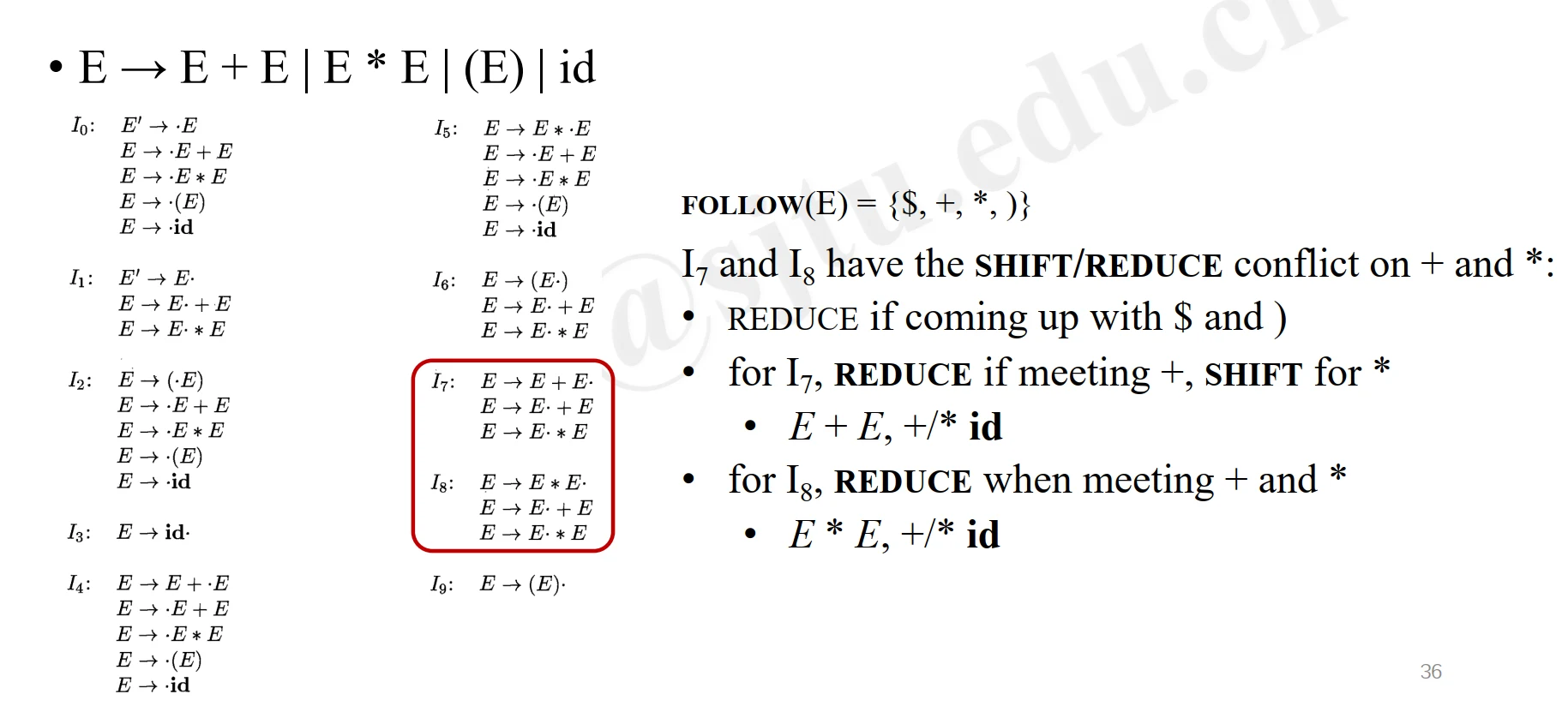
In Theory: grammar for LR parsing tables should be unambiguous (在理论上:LR 解析表的文法应该是无歧义的)
-
For ambiguous grammars:
-
there will be conflicts
-
add new information/restrictions to resolve ambiguity (添加新信息/限制以解决歧义)
-
precedence, associativity, etc.
-
get LR tables without conflicts
-
-
-
Why embracing ambiguous grammars?
-
some are much natural, the unambiguous one can be very complex (有些是非常自然的,无歧义的可能非常复杂)
-
isolate common syntactic constructs for special-case optimizations (隔离常见的语法结构以进行特殊情况优化)
-
-
Example:
Summary