Ch1 Intro
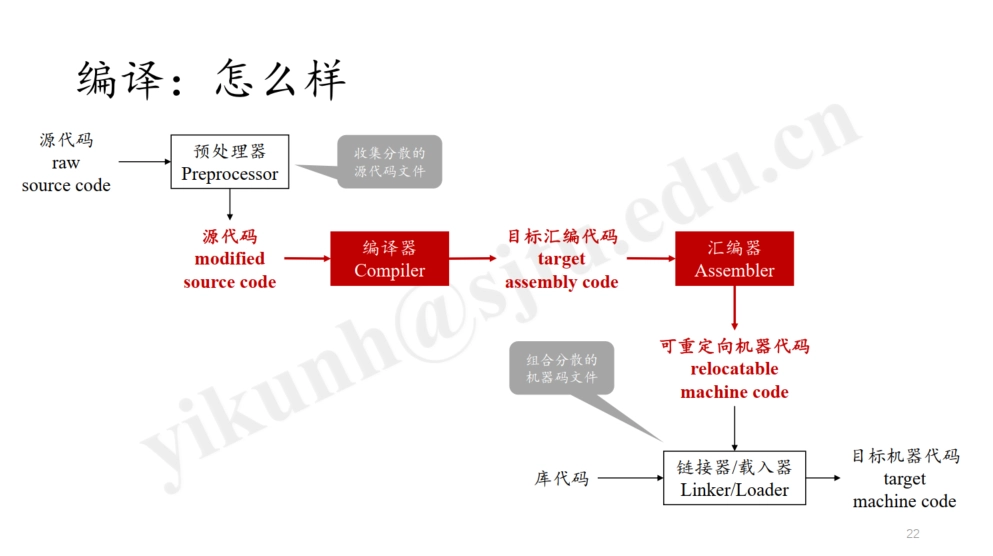
编译流程
-
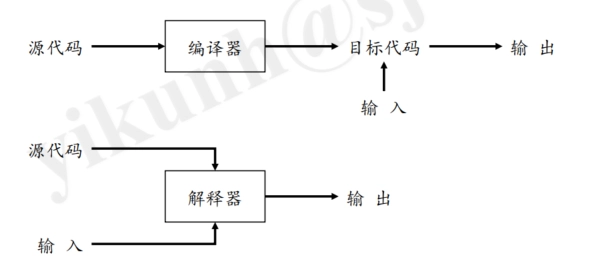
解释器 vs. 编译器 (Interpreter vs. Compiler)
-
解释器方便错误诊断 (Error Diagnosis)
-
编译器得到的代码更加高效
-
编译器
-
Ch1 Intro
-
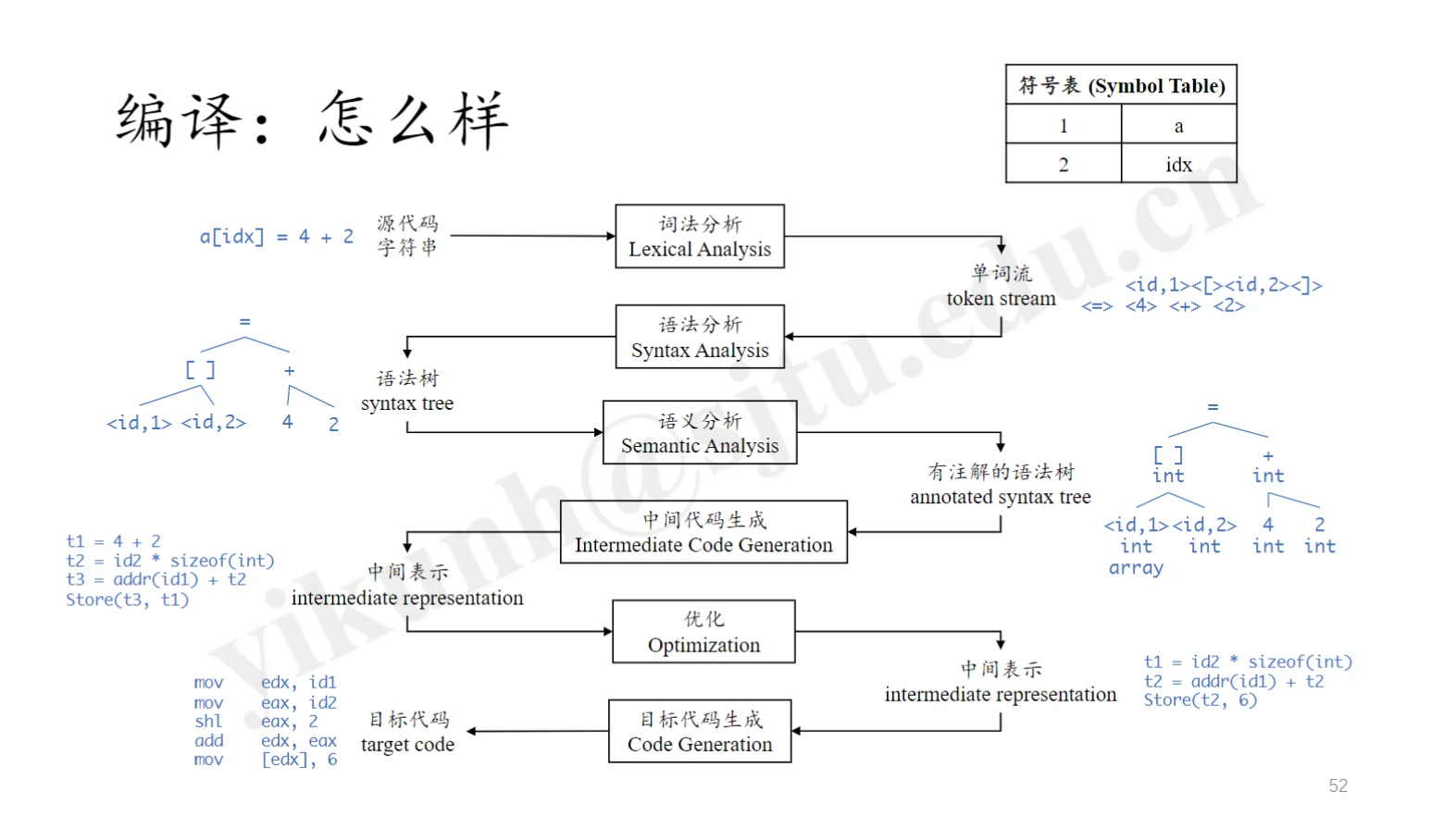
编译流程
- 编译器
-
词法分析:Lexical Analysis
-
语法分析:Syntax Analysis
-
词法分析 vs. 语法分析
-
语义分析:Semantic Analysis
-
中间代码生成:Intermediate Code Generation
-
优化:Optimization
-
目标代码生成:Target Code Generation
-
词法分析:Lexical Analysis
-
Lexical Analysis: Scanning (词法分析:扫描)
-
Lexical Analyzer: Scanner (词法分析器:扫描器)
-
Recognize Words (Lexemes) -> Tokens & Symbol Table (识别单词(词素)-> 生成标记和符号表)
-
Token:
-
token-name: id, number, keywords, operators, etc. (标记名:标识符、数字、关键字、运算符等)
-
attribute-value: a pointer to the symbol table (属性值:指向符号表的指针)
-
-
语法分析:Syntax Analysis
-
Syntax Analysis: Parsing (语法分析:解析)
-
Syntax Analyzer: Parser (语法分析器:解析器)
-
Produce the Grammatical Structure (生成语法结构)
-
The Relationships among Tokens (标记之间的关系)
-
Tree-like Intermediate Representation (树状中间表示)
-
-
Parse Tree (解析树)
- Parser generates the Parse Tree, from which produces the Syntax Tree (解析器生成解析树,从中生成语法树)
-
Syntax Tree: Simplified Parse Tree (语法树:简化的解析树)
-
Interior Node: Operation (内部节点:操作)
-
Children: Arguments of the Operation (子节点:操作的参数)
-
-
词法分析 vs. 语法分析
-
做着相似的事情:处理字符串
-
词法分析 (Scanning):拆分字符串成 Lexemes,并抽象成 Tokens
-
语法分析 (Parsing):整理 Tokens 的逻辑关系
语义分析:Semantic Analysis
-
Semantic Analysis (语义分析)
-
computing additional info needed for compilation (计算编译所需的附加信息)
- which is not regarded as syntax (这些信息不被视为语法)
-
checking source code semantic consistency with the language definition (检查源代码与语言定义的语义一致性)
- Type Checking (类型检查)
-
中间代码生成:Intermediate Code Generation
-
Intermediate Code Generation (中间代码生成)
-
Intermediate Representations (IR), e.g., Syntax Tree, etc. (中间表示,例如语法树等)
-
Low-level or Machine-like IR (低级或类似机器的中间表示)
-
LLVM-IR (LLVM, Clang), Gimple (GCC), etc. (LLVM-IR(LLVM,Clang),Gimple(GCC)等)
-
Three-address Code, with at Most Three Operands per Instruction (三地址码,每条指令最多三个操作数)
-
Static Single Assignment (SSA) (静态单赋值)
- Every variable is only assigned (defined) once and defined before used. (每个变量只能被赋值(定义)一次,并且在使用前必须定义。)
-
-
优化:Optimization
-
Optimization (优化)
-
Improve the IR for Better Target Code (改进中间表示以生成更好的目标代码)
-
Better: Faster, Smaller, Greener (更好:更快、更小、更环保)
-
目标代码生成:Target Code Generation
-
Target Code Generation (目标代码生成)
-
Instruction Selection (指令选择)
-
RISC vs. CISC
-
RISC: Reduced Instruction Set Computer (精简指令集计算机)
-
CISC: Complex Instruction Set Computer (复杂指令集计算机)
-
-
Intel Manual: > 6000 Pages (英特尔手册:超过 6000 页)
-
-
Register Allocation (寄存器分配)
- Graph Coloring Problem (图着色问题)
-
Evaluation Order (计算顺序)
-
Arrange the Computation Order for Less Register Occupation (安排计算顺序以减少寄存器占用)
-
NPC (Non-Polynomial Complete) Problem (非多项式完全问题)
-
-