树
树的定义
-
相关概念
-
结点
-
根结点:起始结点,没有父结点
-
叶结点:没有子结点(度为 0)
-
子结点:结点的下一层结点
-
父结点:结点的上一层结点
-
兄弟结点:同一父结点的结点
-
祖先结点:从根到该结点路径上的所有结点
-
子孙结点:某个结点的所有下层结点
-
-
度:直接子结点的数量
- 树的度:由度最大的结点决定
-
层次/深度:结点在树的层数
-
根结点在第 1 层
-
高度:树的结点中的最大层次
-
-
有序树与无序树
-
有序树:子树从左到右有顺序,即区分左右子树
-
无序树:不区分左右子树
-
-
森林:若干互不相交的树的集合
-
-
树的抽象类
#ifndef TREE_H
#define TREE_H
#include <bits/stdc++.h>
using namespace std;

template <class elemType>
class tree
{
public:
    virtual ~tree() {}
    virtual void clear() = 0;
    virtual bool isEmpty() const = 0;
    virtual elemType Root(elemType flag) const = 0;
    virtual elemType parent(elemType x, elemType flag) const = 0;
    virtual elemType child(elemType x, int i, elemType flag) const = 0;
    virtual void remove(elemType x, int i) = 0;
    virtual void traverse() const = 0;
};

#endif
二叉树
二叉树的定义
-
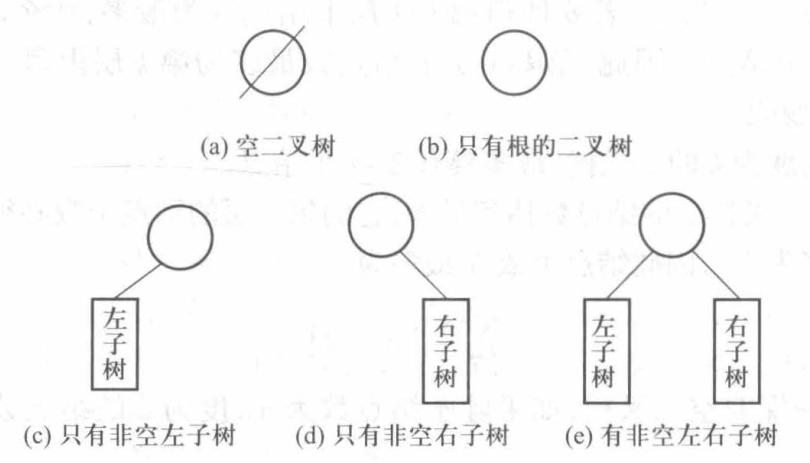
有序树,必须严格区分左右子树
-
任意结点的子结点数不超 2
-
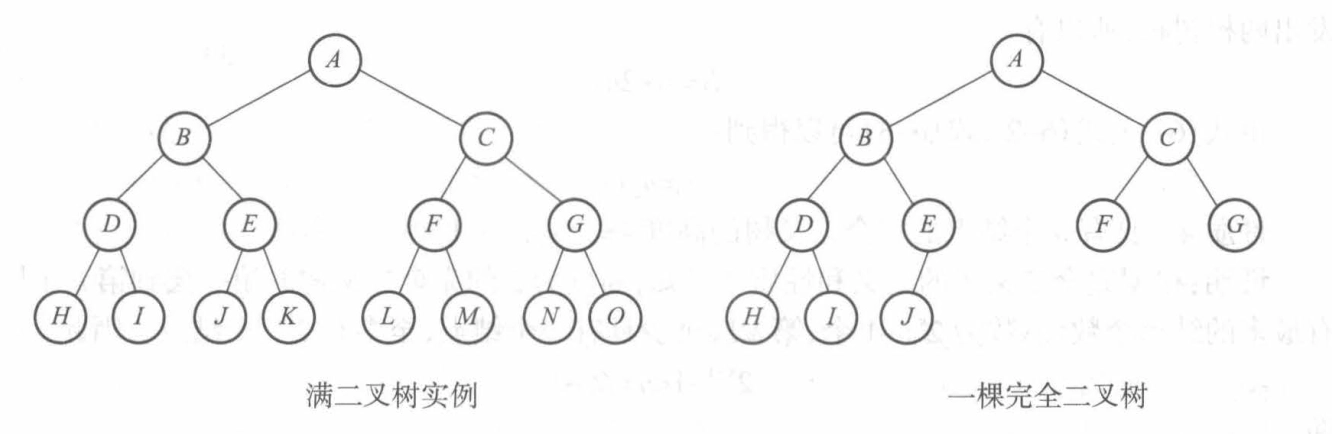
满二叉树/完美树:任意一层的结点个数都达到最大值
- 高度为 \(k\) 并具有 \(2k-1\) 个结点的二叉树
-
完全二叉树:满二叉树最底层从右向左依次移除若干结点
-
满二叉树一定是完全二叉树
-
完全二叉树不一定是满二叉树
-
二叉树的常用性质
-
非空二叉树的第 \(i\) 层上最多有 \(2i-1\) 个结点(\(i≥1\))
-
高度为 \(k\) 的二叉树,最多具有 \(2^k-1\) 个结点(对满二叉树进行 \(2\) 的等比数列求和)
-
如果叶子结点数为 \(n_0\),度数为 \(2\) 的结点数为 \(n_2\),则有:\(n_0=n_2+1\)
-
具有 \(n\) 个结点的完全二叉树的高度 \(k = \lfloor \log_2 n \rfloor + 1\)
-
对一棵有 \(n\) 个结点的完全二叉树按层自上而下编号,每一层自左至右依次编号,若树的根结点编号为 \(1\),则对一个编号为 \(i\) 的结点
-
若 \(i=1\),则该结点是根结点,否则父结点编号为 \(\lfloor i/2 \rfloor\)
-
若 \(2i > n\),则该结点是叶结点,否则左儿子编号为 \(2i\)
-
若 \(2i+1 > n\),则该结点是叶结点,否则右儿子编号为 \(2i+1\)
-
二叉树的基本运算
-
遍历
-
前序遍历/先根遍历
- 顺序:根-左-右
-
中序遍历/中根遍历
- 顺序:左-根-右
-
后序遍历/后根遍历
- 顺序:左-右-根
-
层次遍历
- 顺序:从根到叶,从左到右
-
-
由二叉树的前序遍历和中序遍历/后序遍历和中序遍历可以唯一确定一棵二叉树
-
前序遍历和中序遍历
-
前序遍历的第一个结点为根结点
-
在中序遍历中找到根结点,将中序遍历分为左子树和右子树
-
对左子树和右子树递归进行前序遍历和中序遍历
-
-
后序遍历和中序遍历
-
后序遍历的最后一个结点为根结点
-
在中序遍历中找到根结点,将中序遍历分为左子树和右子树
-
对左子树和右子树递归进行后序遍历和中序遍历
-
-
-
二叉树的抽象类
#ifndef BTREE_H
#define BTREE_H
#include <bits/stdc++.h>
using namespace std;

template <class elemType>
class bTree
{
public:
    virtual ~bTree() {}
    virtual void clear() = 0;
    virtual bool isEmpty() const = 0;
    virtual elemType Root(elemType flag) const = 0;
    virtual elemType parent(elemType x, elemType flag) const = 0;
    virtual elemType lchild(elemType x, elemType flag) const = 0;
    virtual elemType rchild(elemType x, elemType flag) const = 0;
    virtual void delLeft(elemType x) = 0;
    virtual void delRight(elemType x) = 0;
    virtual void preOrder() const = 0;
    virtual void midOrder() const = 0;
    virtual void postOrder() const = 0;
    virtual void levelOrder() const = 0;
};

#endif
二叉树的顺序实现
-
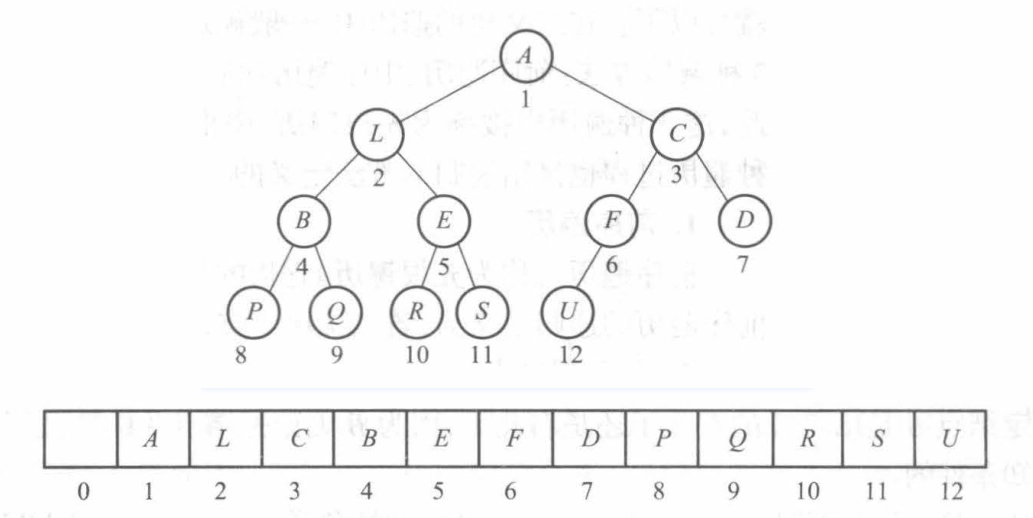
使用数组存储
-
根结点下标为 \(1\)
-
若某个结点下标为 \(i\)
-
左子树下标为 \(2i\)
-
右子树下标为 \(2i+1\)
-
-
二叉树的链接实现
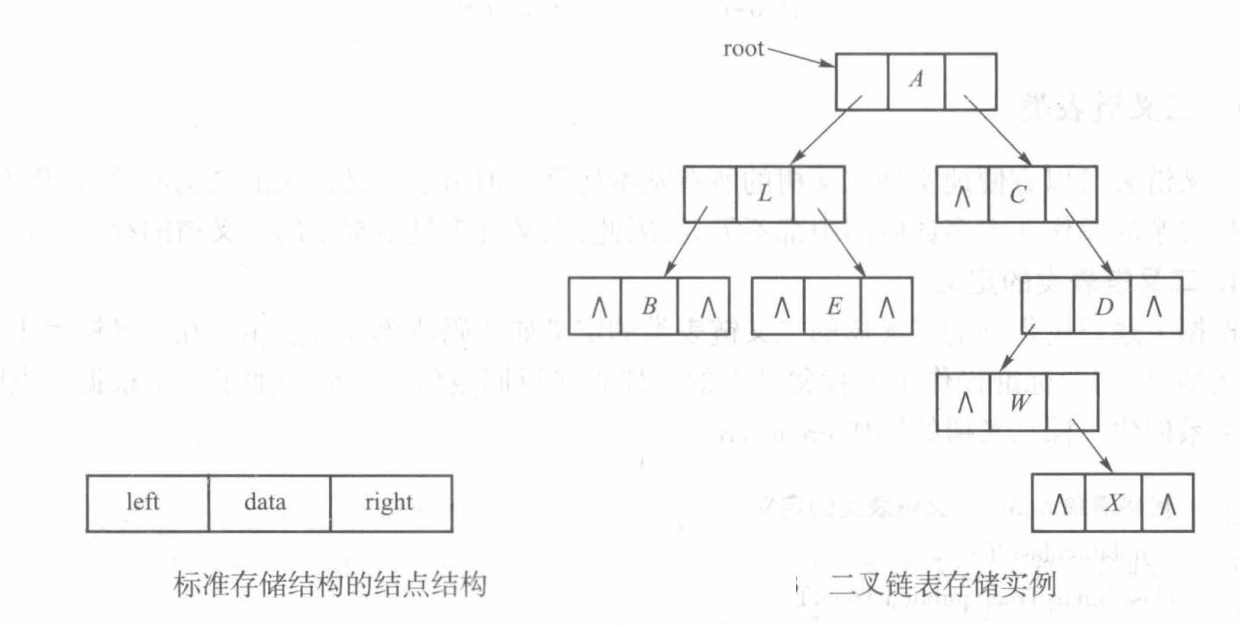
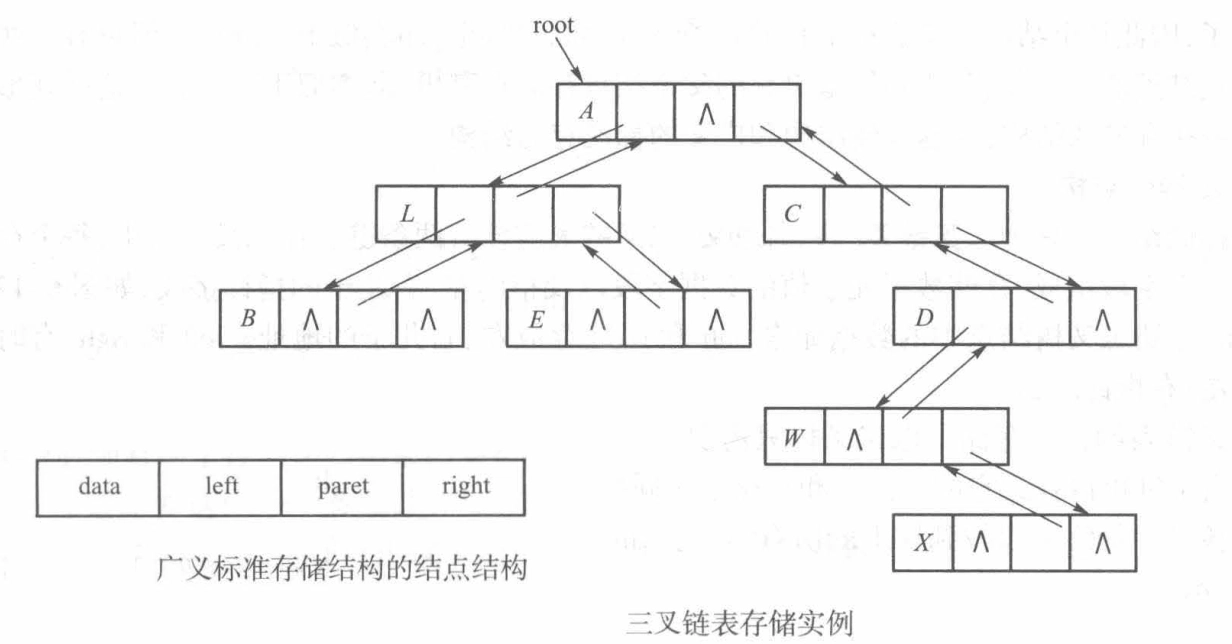
#include "6-2-bTree.h"

template <class T>
class binaryTree : public bTree<T>
{
    friend void printTree(const binaryTree<T> &t, T flag);
    private:
        struct Node
        {
            T data;
            Node *left, *right;
            Node():left(NULL), right(NULL) {}
            Node(T item, Node *L = NULL, Node *R = NULL):data(item), left(L), right(R) {}
            ~Node() {}
        };
        Node *root;

    public:
        binaryTree():root(NULL) {}
        binaryTree(const T &value) {root = new Node(value);}
        ~binaryTree() {clear();}

        void clear();
        bool isEmpty() const {return root == NULL;}
        T Root(T flag) const;
        T lchild(T x, T flag) const;
        T rchild(T x, T flag) const;
        void delLeft(T x);
        void delRight(T x);
        void preOrder() const;
        void midOrder() const;
        void postOrder() const;
        void levelOrder() const;
        void createTree(T flag);
        T parent(T x, T flag) const {return flag;}
        int height() const {return height(root);}
        int size() const {return size(root);}

    private:
        Node* find(T x, Node *t) const;
        void clear(Node *&t);
        void preOrder(Node *t) const;
        void midOrder(Node *t) const;
        void postOrder(Node *t) const;
        int height(Node *t) const;
        int size(Node *t) const;
};

template <class T>
void binaryTree<T>::clear()
{
    if (root != NULL)
        clear(root);
    root = NULL;
}

template <class T>
void binaryTree<T>::clear(Node *&t)
{
    if (t == NULL) return;
    clear(t->left);
    clear(t->right);
    delete t;
    t = NULL;
}

template <class T>
T binaryTree<T>::Root(T flag) const
{
    if (root == NULL) return flag;
    else return root->data;
}

template <class T>
binaryTree<T>::Node* binaryTree<T>::find(T x, binaryTree<T>::Node *t) const
{
    Node *tmp;
    if (t == NULL) return NULL;
    if (t->data == x) return t;
    if ((tmp = find(x, t->left)) != NULL) return tmp;
    else return find(x, t->right);
}

template <class T>
T binaryTree<T>::lchild(T x, T flag) const
{
    Node *tmp = find(x, root);
    if (tmp == NULL || tmp->left == NULL) return flag;
    return tmp->left->data;
}

template <class T>
T binaryTree<T>::rchild(T x, T flag) const
{
    Node *tmp = find(x, root);
    if (tmp == NULL || tmp->right == NULL) return flag;
    return tmp->right->data;
}

template <class T>
void binaryTree<T>::delLeft(T x)
{
    Node *tmp = find(x, root);
    if (tmp == NULL || tmp->left == NULL) return;
    clear(tmp->left);
}

template <class T>
void binaryTree<T>::delRight(T x)
{
    Node *tmp = find(x, root);
    if (tmp == NULL || tmp->right == NULL) return;
    clear(tmp->right);
}

template <class T>
void binaryTree<T>::createTree(T flag)
{
    queue<Node*> q;
    Node *tmp;
    T x, ldata, rdata;
    cout << "\n Input root node: ";
    cin >> x;
    root = new Node(x);
    q.push(root);
    while (!q.empty())
    {
        tmp = q.front();
        q.pop();
        cout << "Input " << tmp->data << "'s two children(" << flag << " as NULL): ";
        cin >> ldata >> rdata;
        if (ldata != flag) q.push(tmp->left = new Node(ldata));
        if (rdata != flag) q.push(tmp->right = new Node(rdata));
    }

    cout << "Create completed!" << endl;
}

template <class T>
void printTree(const binaryTree<T> &t, T flag)
{
    queue <T> q;
    q.push(t.Root(flag));
    cout << endl;
    while (!q.empty())
    {
        T tmp = q.front();
        q.pop();
        if (tmp == flag) continue;
        cout << tmp << ' ' <<t.lchild(tmp, flag) << ' ' << t.rchild(tmp, flag) << endl;
        if (t.lchild(tmp, flag) != flag) q.push(t.lchild(tmp, flag));
        if (t.rchild(tmp, flag) != flag) q.push(t.rchild(tmp, flag));
    }
}

template <class T>
int binaryTree<T>::height(Node *t) const
{
    if (t == NULL) return 0;
    int lt = height(t->left), rt = height(t->right);
    return 1 + ((lt > rt) ? lt : rt);
}

template <class T>
int binaryTree<T>::size(Node *t) const
{
    if (t == NULL) return 0;
    return 1 + size(t->left) + size(t->right);
}

template <class T>
void binaryTree<T>::preOrder() const
{
    if (root != NULL) preOrder(root);
}
// 递归实现
template <class T>
void binaryTree<T>::preOrder(Node *t) const
{
    if (t == NULL) return;
    cout << t->data << ' ';
    preOrder(t->left);
    preOrder(t->right);
}
// 非递归实现
template <class T>
void BinaryTree<T>::preOrder () const
{
    Stack<Node*> s;
    Node *current;
    s.push(root);
    while (!s.isEmpty())
    {
        current = s.pop();
        cout << current->data << ' ';
        if (current->right != NULL) s.push(current->right);
        if (current->left != NULL) s.push(current->left);
    }
}

template <class T>
void binaryTree<T>::midOrder() const
{
    if (root != NULL) midOrder(root);
}
// 递归实现
template <class T>
void binaryTree<T>::midOrder(Node *t) const
{
    if (t == NULL) return;
    midOrder(t->left);
    cout << t->data << ' ';
    midOrder(t->right);
}
// 非递归实现
template <class T>
void BinaryTree<T>::midOrder () const
{
    struct StNode
    {
        Node *node;
        int TimesPop;
        StNode(Node *N = NULL):node(N), TimesPop(0) {}
    };
    Stack<StNode> s;
    StNode current(root);
    s.push(current);
    while (!s.isEmpty())
    {
        current = s.pop();
        if (++current.TimesPop == 2)
        {
            cout << current.node->data << ' ';
            if (current.node->right != NULL)
                s.push(StNode(current.node->right));
        }
        else
        {
            s.push(current);
            if (current.node->left != NULL)
                s.push(StNode(current.node->left));
        }
    }
}

template <class T>
void binaryTree<T>::postOrder() const
{
    if (root != NULL) postOrder(root);
}
// 递归实现
template <class T>
void binaryTree<T>::postOrder(Node *t) const
{
    if (t == NULL) return;
    postOrder(t->left);
    postOrder(t->right);
    cout << t->data << ' ';
}
// 非递归实现
template <class T>
void BinaryTree<T>::postOrder () const
{
    struct StNode
    {
        Node *node;
        int TimesPop;
        StNode(Node *N = NULL):node(N), TimesPop(0) {}
    };
    Stack<StNode> s;
    StNode current(root);
    s.push(current);
    while (!s.isEmpty())
    {
        current = s.pop();
        if (++current.TimesPop == 3)
        {
            cout << current.node->data << ' ';
            continue;
        }
        s.push(current);
        if (current.TimesPop == 1)
        {
            if (current.node->left != NULL)
                s.push(StNode(current.node->left));
        }
        else
        {
            if (current.node->right != NULL)
                s.push(StNode(current.node->right));
        }
    }
}

template <class T>
void binaryTree<T>::levelOrder() const
{
    queue<Node*> q;
    Node *tmp;
    if (root != NULL) q.push(root);
    while (!q.empty())
    {
        tmp = q.front();
        q.pop();
        cout << tmp->data << ' ';
        if (tmp->left != NULL) q.push(tmp->left);
        if (tmp->right != NULL) q.push(tmp->right);
    }
}
二叉树的应用
- 计算表达式
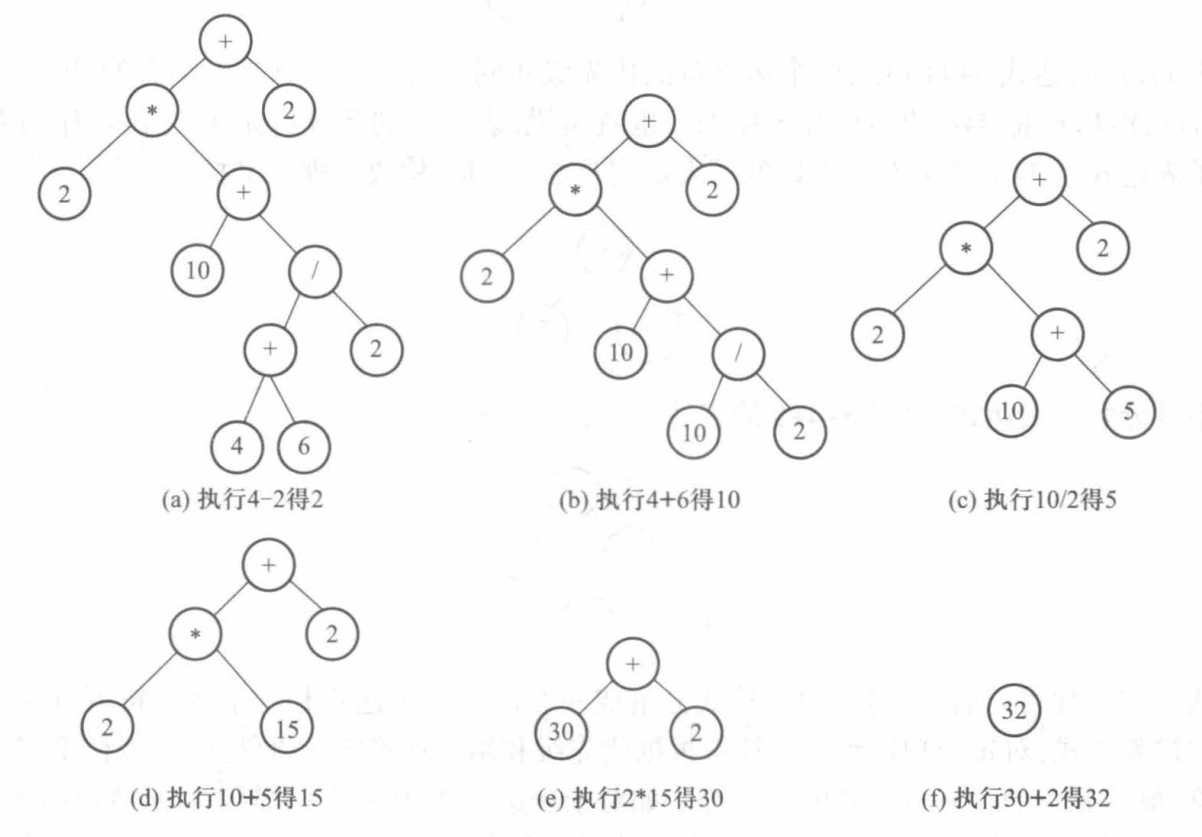
哈夫曼树和哈夫曼编码
前缀编码
-
无二义性
-
每个字符的编码与其它字符编码的前缀不同
哈夫曼编码
-
目的:根据数据的出现频率进行不同长度的编码,从而节省空间。
-
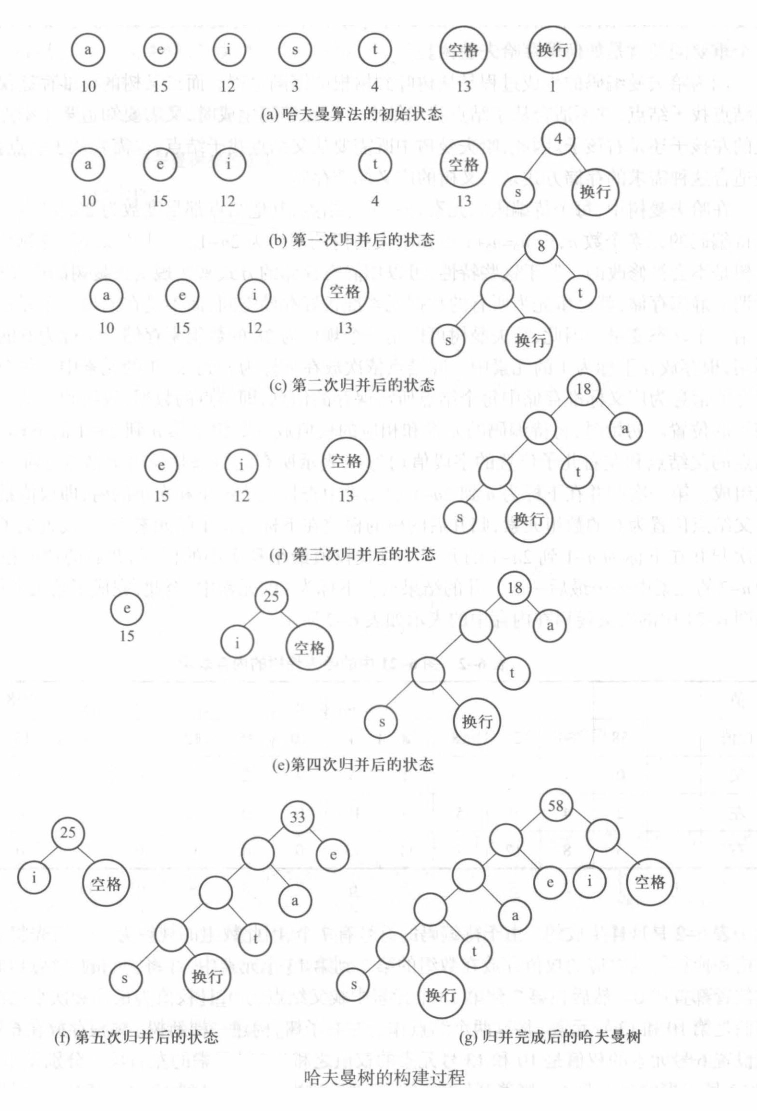
哈夫曼树:哈夫曼树是一棵最小代价的二叉树,在这棵树上,所有的字符都包含在叶结点上。要使得整棵树的代价最小,显然权值大的叶子应当尽量靠近树根,权值小的叶子可以适当离树根远一些。
-
构建方法:从当前集合中选取并去除权值最小、次最小的两个结点,以这两个结点作为内部结点 \(b_i\) 的左右儿子,\(b_i\) 的权值为其左右儿子权值之和并加入其中。这样,在集合 A 中,结点个数便减少了一个。这样,在经过了 \(n-1\) 次循环之后,集合 A 中只剩下了一个结点,这个结点就是根结点。
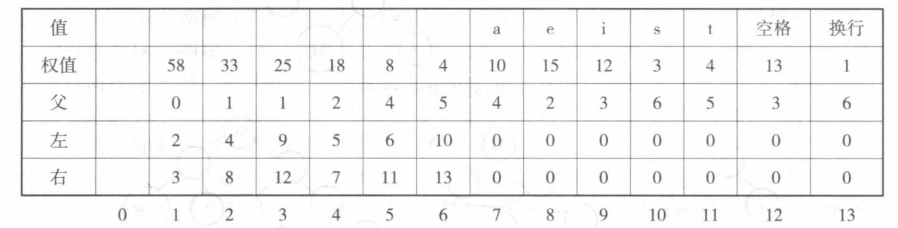
哈夫曼树类的实现
-
二叉树的广义标准存储
-
每个结点包含以下字段
-
数据
-
数据
-
权值
-
-
父结点指针
-
左、右子结点指针
-
-
#include <bits/stdc++.h>
using namespace std;

template <class T>
class hfTree
{
    private:
        struct Node
        {
            T data;
            int weight;
            int parent, left, right;
        };
        Node *elem;
        int length;

    public:
        struct hfCode
        {
            T data;
            string code;
        };
        hfTree(const T *v, const int *w, int size);
        void getCode(hfCode result[]);
        ~hfTree() {delete [] elem; }
};

template <class T>
hfTree<T>::hfTree(const T *v, const int *w, int size)
{
    const int MAX_INT = 32767;
    int min1, min2;
    int x, y;

    length = 2 * size;
    elem = new Node[length];

    for (int i = size; i < length; i++)
    {
        elem[i].weight = w[i - size];
        elem[i].data = v[i - size];
        elem[i].parent = elem[i].left = elem[i].right = 0;
    }

    for (int i = size - 1; i > 0; i--)
    {
        min1 = min2 = MAX_INT;
        x = y = 0;

        for (int j = i + 1; j < length; j++)
        {
            if (elem[j].parent == 0)
            {
                if (elem[j].weight < min1)
                {
                    min2 = min1;
                    min1 = elem[j].weight;
                    y = x;
                    x = j;
                }
                else if (elem[j].weight < min2)
                {
                    min2 = elem[j].weight;
                    y = j;
                }
            }
        }

        elem[i].weight = min1 + min2;
        elem[i].left = x;
        elem[i].right = y;
        elem[i].parent = 0;
        elem[x].parent = elem[y].parent = i;
    }
}

template <class T>
void hfTree<T>::getCode(hfCode result[])
{
    int size = length / 2;
    int p, s;
    string str = "";
    for (int i = size; i < length; i++)
    {
        result[i - size].data = elem[i].data;
        result[i - size].code = "";
        p = elem[i].parent;
        s = i;
        while (p)
        {
            if (elem[p].left == s) str += '0';
            else str += '1';
            s = p;
            p = elem[p].parent;
        }
        for (int j = str.size() - 1; j >= 0; j--)  result[i - size].code += str[j];
        str = "";
    }
}

int main()
{
    char ch[] = {"aeistdn"};
    int w[] = {10, 15, 12, 3, 4, 13, 1};
    hfTree<char> tree(ch, w, 7);
    hfTree<char>::hfCode result[7];
    tree.getCode(result);
    for (int i = 0; i < 7; i++)
    {
        cout << result[i].data << ' ' << result[i].code << endl;
    }
    return 0;
}
树和森林
树的存储实现
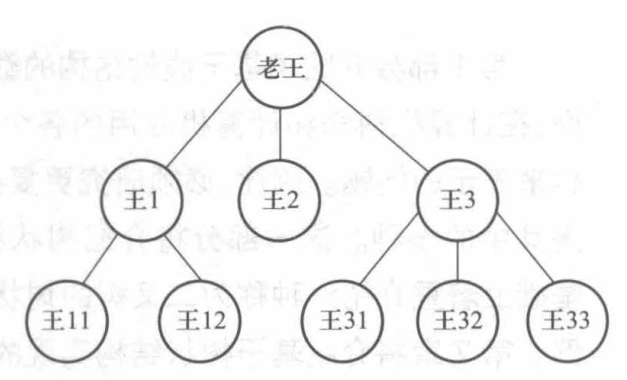
-
孩子链表示法
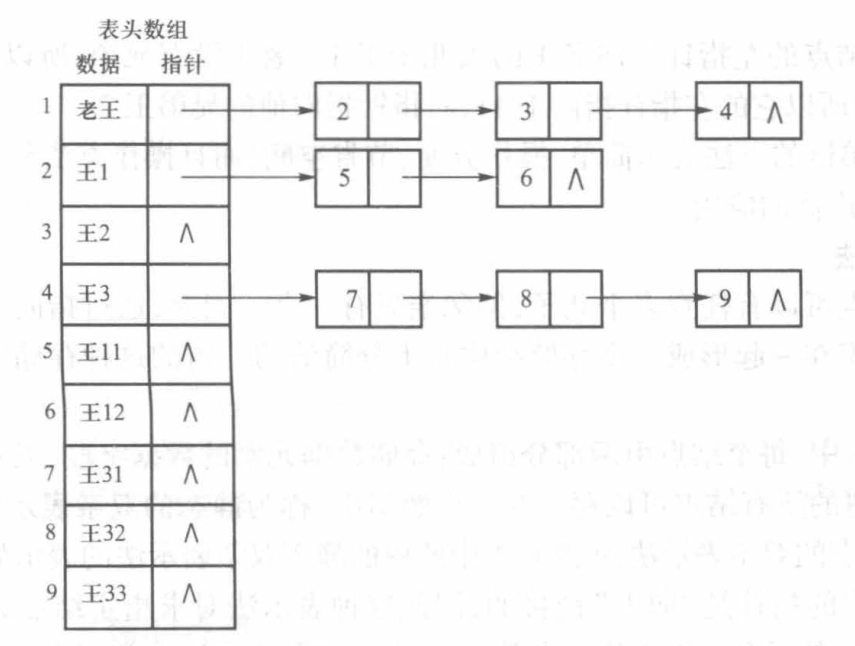
-
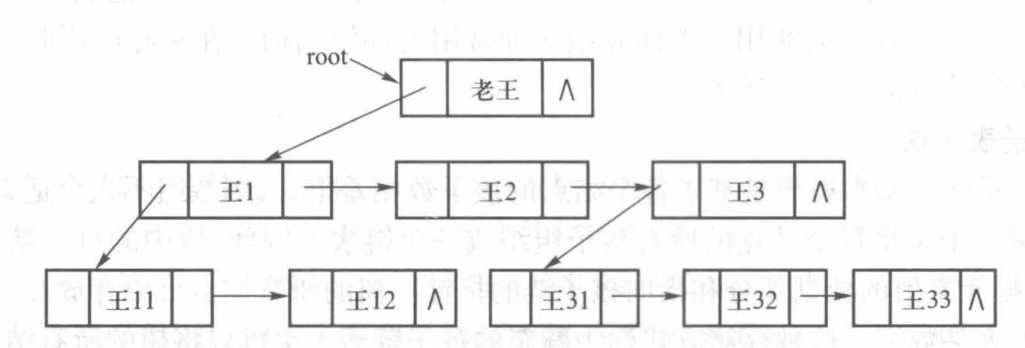
孩子兄弟链表示法
-
把树表示成一棵二叉树
-
左指针:第一个子结点
-
右指针:兄弟结点
-
-
前序遍历与二叉树相同
-
后序遍历与二叉树的中序遍历相同
-
-
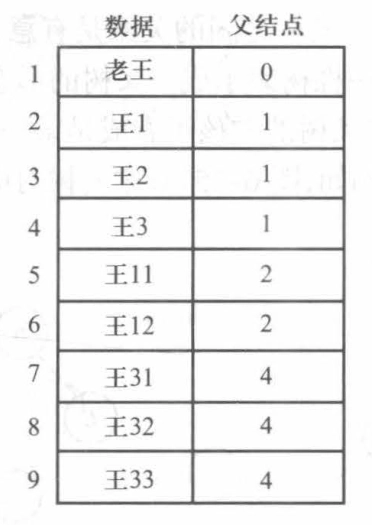
双亲表示法
树的遍历
-
前序遍历
-
后序遍历
-
层次遍历
树、森林与二叉树的转换
-
森林:树的集合
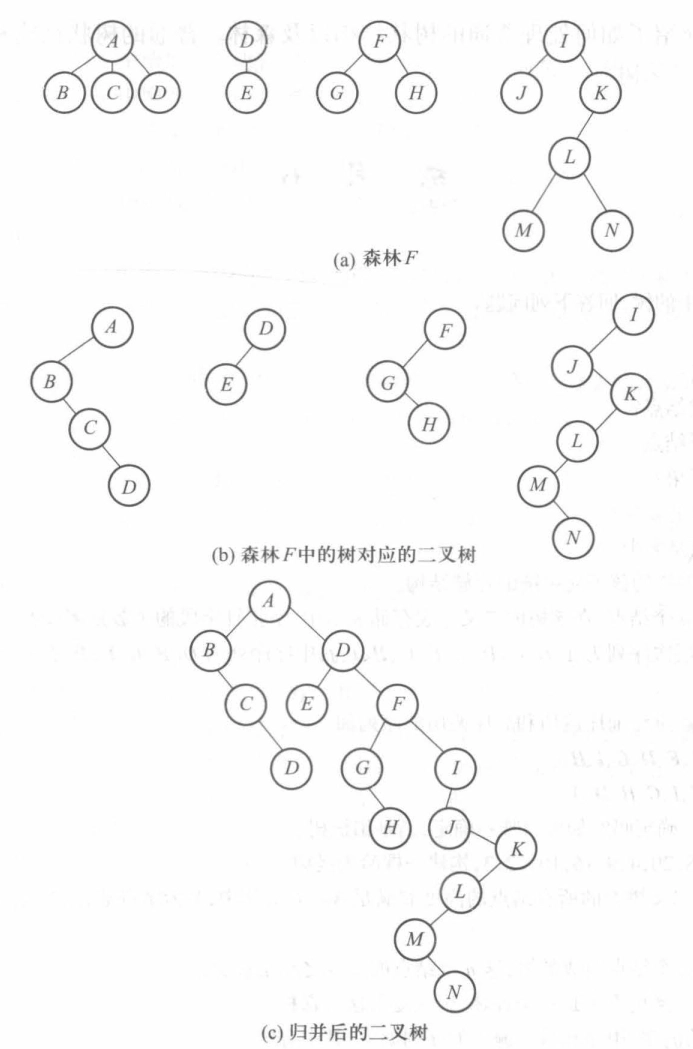
- 存储方式:把森林存储为一棵二叉树
-
把森林转换为二叉树的步骤:
-
把森林 \(F={T_1, T_2, \ldots, T_k}\) 中的树 \(T_i\) 用孩子兄弟链法表示为一棵二叉树 \(B_i\)
-
把二叉树 \(B_i\) 作为二叉树 \(B_{i-1}\) 的根结点的右子树
-