动态查找表
动态查找表的定义
-
支持增、删、查、改等操作
-
存储结构:
-
查找树
-
散列表
-
-
动态查找表的抽象类
#ifndef DYNAMICSEARCHTABLE_H
#define DYNAMICSEARCHTABLE_H
#include <bits/stdc++.h>
#include "8-1-set.h"
using namespace std;

template <class KEY, class OTHER>
class dynamicSearchTable {
public:
    virtual SET<KEY, OTHER>* find(const KEY& x) const = 0;
    virtual void insert(const SET<KEY, OTHER>& x) = 0;
    virtual void remove(const KEY& x) = 0;
    virtual ~dynamicSearchTable() {};
};

#endif
二叉查找树
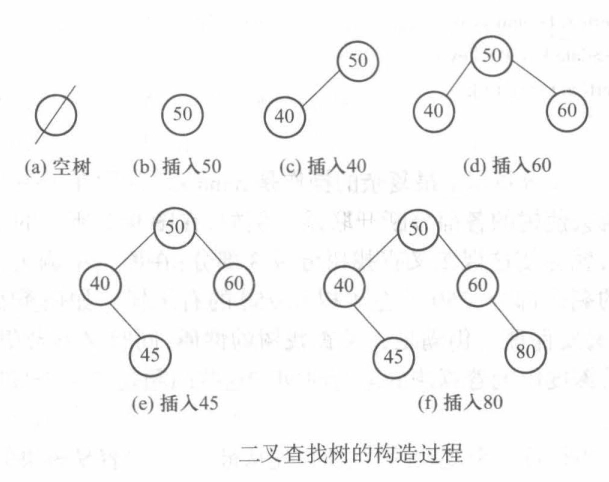
二叉查找树的定义
-
定义:二叉查找树又称二叉排序树,非空情况下满足下列条件
-
若左子树非空,则左子树上的所有非空结点的关键字值均小于根结点的关键字值
-
若右子树非空,则右子树上的所有非空结点的关键字值均大于根结点的关键字值
-
左右子树也是二叉查找树
-
-
性质:
- 中序遍历一棵二叉查找树的道德访问序列 按键值递增
二叉查找树的实现
-
通常采用二叉树的标准存储法
-
每个结点包含以下字段
-
数据:键值-数据对
-
左、右子结点指针
-
-
-
运算实现:
-
查找:
-
若根结点不存在,则不存在
-
若根结点关键字值等于查找值,则找到
-
若根结点关键字值大于查找值,则递归查找左子树
-
若根结点关键字值小于查找值,则递归查找右子树
-
-
插入:
-
若根结点不存在,则插入为根结点
-
若根结点关键字值大于插入值,则在左子树上递归插入
-
若根结点关键字值小于插入值,则在右子树上递归插入
-
-
删除:
-
若根结点关键字值大于待删值,则在左子树上递归删除
-
若根结点关键字值小于待删值,则在右子树上递归删除
-
若根结点关键字值等于待删值,则:
-
根结点无子结点:直接删
-
根结点有一个子结点:作为新的根结点
-
根结点有两个子结点:找到左子树的最大结点或右子树最小结点替代
-
-
-
-
时间复杂度:\(O(\log N)\)
#include "9-1-dynamicSearchTable.h"
using namespace std;

template <class KEY, class OTHER>
class binarySearchTree : public dynamicSearchTable<KEY, OTHER>
{
public:
    binarySearchTree();
    ~binarySearchTree();
    SET<KEY, OTHER>* find(const KEY& x) const;
    void insert(const SET<KEY, OTHER>& x);
    void remove(const KEY& x);
private:
    struct BinaryNode {
        SET<KEY, OTHER> data;
        BinaryNode* left;
        BinaryNode* right;
        BinaryNode(const SET<KEY, OTHER>& thedata, BinaryNode* l=NULL, BinaryNode* r=NULL)
            : data(thedata), left(l), right(r) {}
    };
    BinaryNode* root;
    void insert(const SET<KEY, OTHER>& x, BinaryNode*& t);
    void remove(const KEY& x, BinaryNode*& t);
    SET<KEY, OTHER>* find(const KEY& x, BinaryNode* t) const;
    void makeEmpty(BinaryNode*& t);
};

template <class KEY, class OTHER>
binarySearchTree<KEY, OTHER>::binarySearchTree()
{
    root = NULL;
}

template <class KEY, class OTHER>
binarySearchTree<KEY, OTHER>::~binarySearchTree()
{
    makeEmpty(root);
}

template <class KEY, class OTHER>
SET<KEY, OTHER>* binarySearchTree<KEY, OTHER>::find(const KEY& x) const
{
    return find(x, root);
}

template <class KEY, class OTHER>
SET<KEY, OTHER>* binarySearchTree<KEY, OTHER>::find(const KEY& x, BinaryNode* t) const
{
    if (t == NULL || t->data.key == x) {
        return t;
    }
    if (x < t->data.key) {
        return find(x, t->left);
    } else {
        return find(x, t->right);
    }
}

template <class KEY, class OTHER>
void binarySearchTree<KEY, OTHER>::insert(const SET<KEY, OTHER>& x)
{
    insert(x, root);
}

template <class KEY, class OTHER>
void binarySearchTree<KEY, OTHER>::insert(const SET<KEY, OTHER>& x, BinaryNode*& t)
{
    if (t == NULL) {
        t = new BinaryNode(x);
    } else if (x.key < t->data.key) {
        insert(x, t->left);
    } else if (x.key > t->data.key) {
        insert(x, t->right);
    }
}

template <class KEY, class OTHER>
void binarySearchTree<KEY, OTHER>::remove(const KEY& x)
{
    remove(x, root);
}

template <class KEY, class OTHER>
void binarySearchTree<KEY, OTHER>::remove(const KEY& x, BinaryNode*& t)
{
    if (t == NULL) {
        return;
    }
    if (x < t->data.key) {
        remove(x, t->left);
    }
    else if (x > t->data.key) {
        remove(x, t->right);
    }
    else if (t->left != NULL && t->right != NULL) {// Two children
        BinaryNode* tmp = t->right;
        while (tmp->left != NULL) {
            tmp = tmp->left;
        }// Find the smallest node in the right subtree
        t->data = tmp->data;
        remove(t->data.key, t->right);// Remove the smallest node in the right subtree
    }
    else {// One or zero children
        BinaryNode* oldNode = t;
        t = (t->left != NULL) ? t->left : t->right;
        delete oldNode;
    }
}

template <class KEY, class OTHER>
void binarySearchTree<KEY, OTHER>::makeEmpty(BinaryNode*& t)
{
    if (t != NULL) {
        makeEmpty(t->left);
        makeEmpty(t->right);
        delete t;
    }
    t = NULL;
}

int main()
{
    SET<int, char*> a[] = { {10,"aaa"},{8,"bbb"},{21,"ccc"},{87,"ddd"},{56,"eee"},{4,"fff"},{11,"ggg"},{3,"hhh"},{22,"iii"},{7,"jjj"} };
    binarySearchTree<int, char*> tree;
    SET<int, char*>* p;
    SET<int, char*> x;
    for (int i = 0; i < 10; i++) {
        tree.insert(a[i]);
    }

    p = tree.find(21);
    if (p) {
        cout << "Find 21: " << p->other << endl;
    } else {
        cout << "21 not found" << endl;
    }
    tree.remove(21);
    p = tree.find(21);
    if (p) {
        cout << "Find 21: " << p->other << endl;
    } else {
        cout << "21 not found" << endl;
    }
    return 0;
}
AVL 树
AVL 树(二叉平衡树)的定义
-
二叉平衡树是满足某个平衡条件的二叉查找树,其保证树的高度是 \(O(\log N)\),从而操作都是 \(O(\log N)\)
-
最理想是每个节点的左右子树都有同样的高度,不过条件可以放宽一些,因此有了二叉平衡查找树
-
平衡因子(平衡度):结点的平衡度是结点的左子树的高度减去右子树的高度
-
要求每个结点的平衡因子都为 \(+1, -1, 0\),即每个结点的左右子树的高度最多差 \(1\)
-
一棵由 \(N\) 个结点组成的 AVL 树的高度 \(H \leq 1.44\log (N+1) - 0.328\)
-
AVL 树的实现
-
采用二叉链表存储
-
每个结点包含以下字段
-
数据
-
键值-数据对
-
节点高度
-
-
左、右子结点指针
-
-
-
运算实现
-
查找:与二叉查找树相同
-
插入:插入结点后检查到根结点路径上的平衡性,如果没破坏平衡性,可以直接插入,然后自下而上修改结点平衡度(若有结点平衡度没变,上面的就都不用修改);如果破坏了平衡性,则需要调整树的结构(单旋转 or 双旋转),再修改平衡度
-
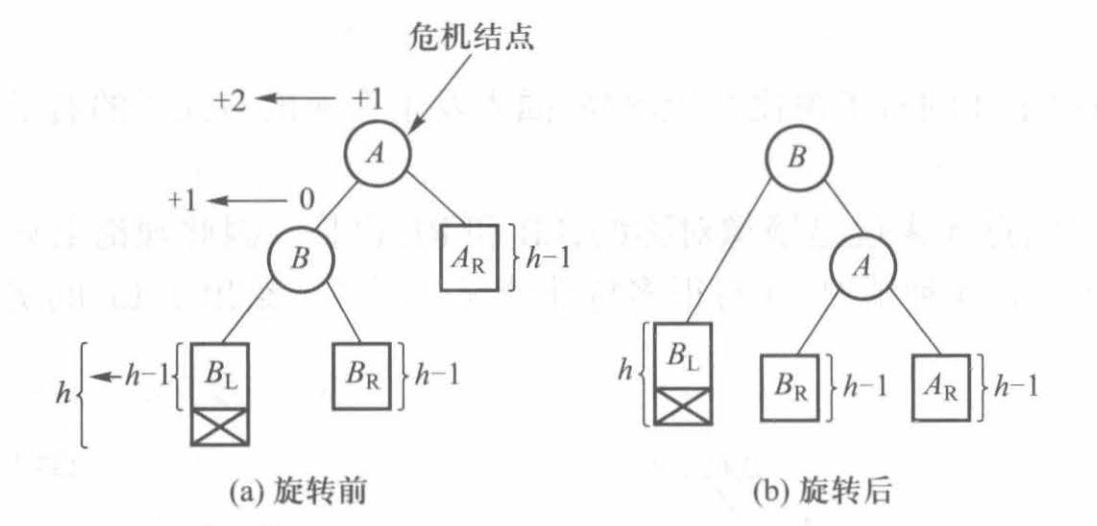
插入方法:LL 和 RR、LR 和 RL 是对称的
-
LL/RR:插入在危机结点的左子结点的左子树/右子结点的右子树,进行单旋转
-
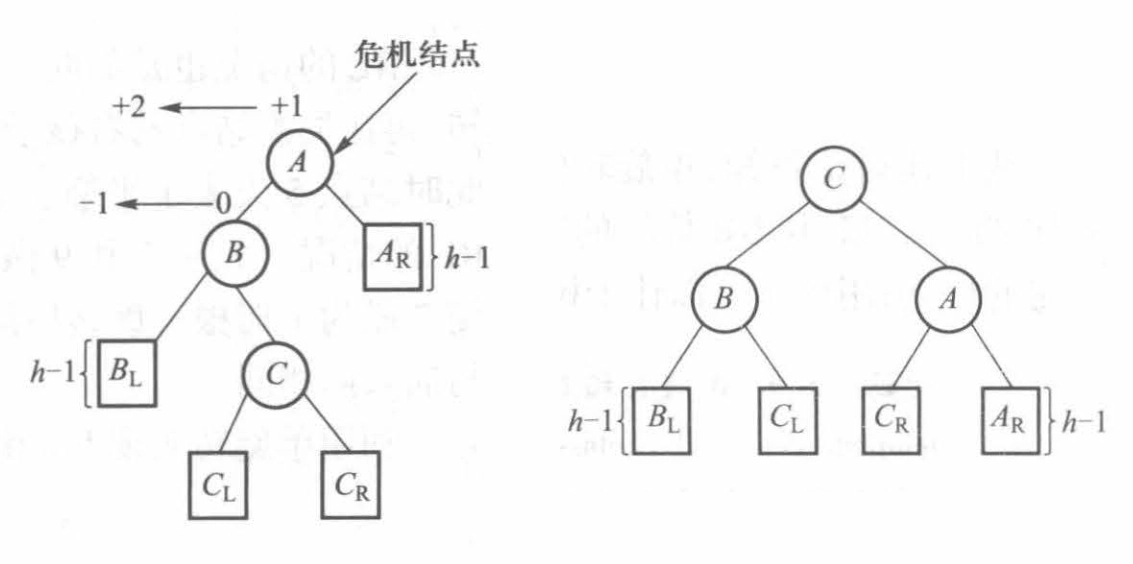
LR/RL:插入在危机结点的左子结点的右子树/右子结点的左子树,进行双旋转
-
LR:先对危机结点的左子树执行 RR,再对危机结点自身执行 LL
-
RL:先对危机结点的右子树执行 LL,再对危机结点自身执行 RR
-
-
-
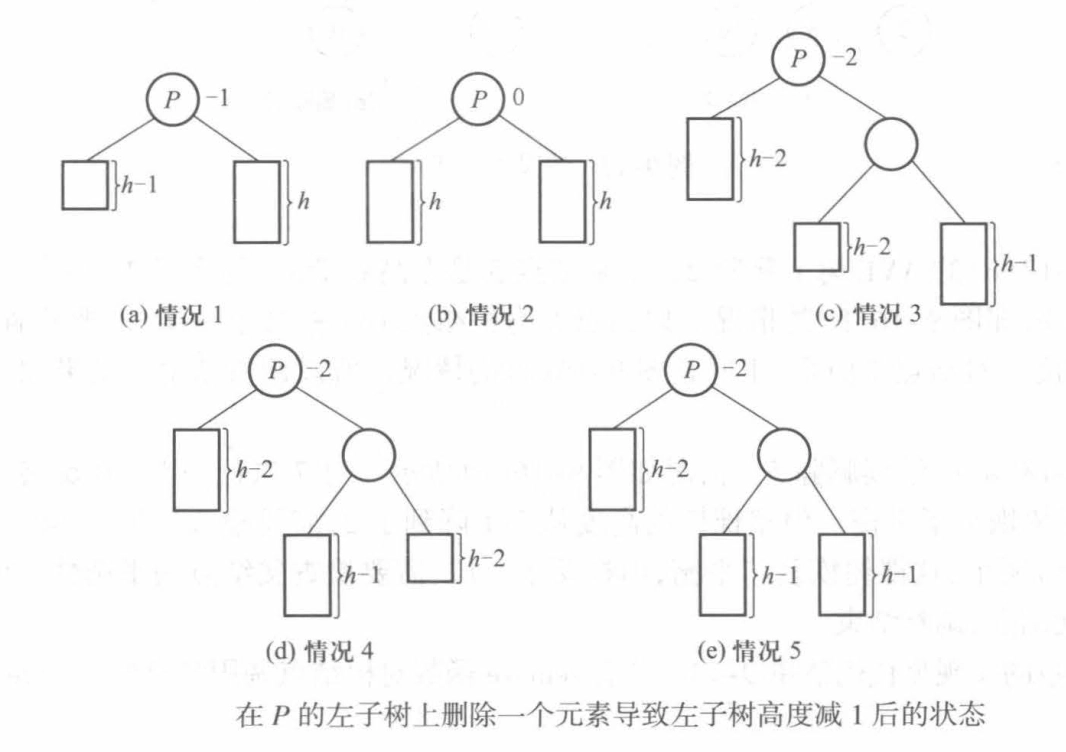
删除:删除结点后检查到根结点路径上的平衡性,共分五种情况:
-
#include "9-1-dynamicSearchTable.h"
#include <bits/stdc++.h>
using namespace std;

template <class KEY, class OTHER>
class AvlTree : public dynamicSearchTable<KEY, OTHER>
{
public:
    AvlTree();
    ~AvlTree();
    SET<KEY, OTHER>* find(const KEY& x) const;
    void insert(const SET<KEY, OTHER>& x);
    void remove(const KEY& x);

private:
    struct AvlNode {
        SET<KEY, OTHER> data;
        AvlNode* left;
        AvlNode* right;
        int height;
        AvlNode(const SET<KEY, OTHER>& thedata, AvlNode* l=NULL, AvlNode* r=NULL, int h=0)
            : data(thedata), left(l), right(r), height(h) {}
    };
    AvlNode* root;

    void insert(const SET<KEY, OTHER>& x, AvlNode*& t);
    bool remove(const KEY& x, AvlNode*& t);
    void makeEmpty(AvlNode*& t);
    void LL(AvlNode*& t);
    void LR(AvlNode*& t);
    void RL(AvlNode*& t);
    void RR(AvlNode*& t);
    int height(AvlNode* t) const { return t == NULL ? -1 : t->height; }
    int max(int a, int b) { return a > b ? a : b; }
    bool adjust(AvlNode*& t, int subTree);
};

template <class KEY, class OTHER>
AvlTree<KEY, OTHER>::AvlTree()
{
    root = NULL;
}

template <class KEY, class OTHER>
AvlTree<KEY, OTHER>::~AvlTree()
{
    makeEmpty(root);
}

template <class KEY, class OTHER>
SET<KEY, OTHER>* AvlTree<KEY, OTHER>::find(const KEY& x) const
{
    AvlNode* t = root;
    while (t != NULL && t->data.key != x) {
        if (x < t->data.key) {
            t = t->left;
        } else {
            t = t->right;
        }
    }
    return t == NULL ? NULL : (SET<KEY, OTHER>*)t;
}

template <class KEY, class OTHER>
void AvlTree<KEY, OTHER>::insert(const SET<KEY, OTHER>& x)
{
    insert(x, root);
}

template <class KEY, class OTHER>
void AvlTree<KEY, OTHER>::insert(const SET<KEY, OTHER>& x, AvlNode*& t)
{
    if (t == NULL) {
        t = new AvlNode(x, NULL, NULL);
    } else if (x.key < t->data.key) {
        insert(x, t->left);
        if (!adjust(t, 1)) {
            if (height(t->left) - height(t->right) == 2) {
                if (x.key < t->left->data.key) {
                    LL(t);
                } else {
                    LR(t);
                }
            }
        }
    } else if (x.key > t->data.key) {
        insert(x, t->right);
        if (!adjust(t, 0)) {
            if (height(t->right) - height(t->left) == 2) {
                if (x.key > t->right->data.key) {
                    RR(t);
                } else {
                    RL(t);
                }
            }
        }
    }
    t->height = max(height(t->left), height(t->right)) + 1;
}

template <class KEY, class OTHER>
void AvlTree<KEY, OTHER>::remove(const KEY& x)
{
    remove(x, root);
}

template <class KEY, class OTHER>
bool AvlTree<KEY, OTHER>::remove(const KEY& x, AvlNode*& t)
{
    if (t == NULL)
    {
        return true;
    }
    if (x == t->data.key)
    {
        if (t->left == NULL || t->right == NULL)
        {
            AvlNode* oldNode = t;
            t = (t->left != NULL) ? t->left : t->right;
            delete oldNode;
            return false;
        }
        else
        {
            AvlNode* tmp = t->right;
            while (tmp->left != NULL)
            {
                tmp = tmp->left;
            }
            t->data = tmp->data;
            if (remove(tmp->data.key, t->right))
            {
                return true;
            }
            else return adjust(t, 1);
        }
    }
    if (x < t->data.key)
    {
        if (remove(x, t->left))
        {
            return true;
        }
        else return adjust(t, 0);
    }
    else
    {
        if (remove(x, t->right))
        {
            return true;
        }
        else return adjust(t, 1);
    }
}

template <class KEY, class OTHER>
bool AvlTree<KEY, OTHER>::adjust(AvlNode*& t, int subTree)
{
    if (subTree)
    {
        if (height(t->left) - height(t->right) == 1)
        {
           return true;
        }
        if (height(t->right) == height(t->left))
        {
            --t->height;
            return false;
        }
        if (height(t->left->right) > height(t->left->left))
        {
            LR(t);
            return false;
        }
        LL(t);
        if (height(t->right) == height(t->left))
        {
            return false;
        }
        else return true;
    }
    else
    {
        if (height(t->right) - height(t->left) == 1)
        {
            return true;
        }
        if (height(t->right) == height(t->left))
        {
            --t->height;
            return false;
        }
        if (height(t->right->left) > height(t->right->right))
        {
            RL(t);
            return false;
        }
        RR(t);
        if (height(t->right) == height(t->left))
        {
            return false;
        }
        else return true;
    }
}

template <class KEY, class OTHER>
void AvlTree<KEY, OTHER>::makeEmpty(AvlNode*& t)
{
    if (t == NULL) {
        return;
    }
    makeEmpty(t->left);
    makeEmpty(t->right);
    delete t;
    t = NULL;
}

template <class KEY, class OTHER>
void AvlTree<KEY, OTHER>::LL(AvlNode*& t)
{
    AvlNode* l = t->left;
    t->left = l->right;
    l->right = t;
    t->height = max(height(t->left), height(t->right)) + 1;
    l->height = max(height(l->left), t->height) + 1;
    t = l;
}

template <class KEY, class OTHER>
void AvlTree<KEY, OTHER>::LR(AvlNode*& t)
{
    RR(t->left);
    LL(t);
}

template <class KEY, class OTHER>
void AvlTree<KEY, OTHER>::RL(AvlNode*& t)
{
    LL(t->right);
    RR(t);
}

template <class KEY, class OTHER>
void AvlTree<KEY, OTHER>::RR(AvlNode*& t)
{
    AvlNode* r = t->right;
    t->right = r->left;
    r->left = t;
    t->height = max(height(t->left), height(t->right)) + 1;
    r->height = max(height(r->right), t->height) + 1;
    t = r;
}
散列表
散列表的定义
-
散列表的思想是用一个比集合规模略大的数组来存储这个集合,将数据元素关键字映射到这个数组的下标
-
这个映射成为 散列函数
-
散列函数的定义域范围大于值域,可能发生冲突/碰撞
-
散列函数
-
直接定址法:去关键字值或其线性函数值作为散列地址
-
除留余数法:如果 \(M\) 是散列表的大小,关键字为 \(x\),则散列地址为 \(H(x) = x \mod M\),常选 \(M\) 为素数,使其分布更均匀
-
数字分析法:对关键字集合中的所有关键字,分析每一位上数字分布,取关键字的某一部分(数字分布均匀的位)进行映射
-
平方取中法:如果关键字中各位的分布都比较均匀,但关键字的值域比数组规模大,则可以将关键字平方后,取其结果的中间各位作为散列函数值
-
折叠法:关键字相当长,以至于和散列表的单元总数相比大得多时,可选取一个长度后,将关键字按此长度分组相加
闭散列表
将溢出数据元素存放到没有使用过的单元中
-
线性探测法:
-
插入:当散列发生冲突时,探测下一个单元,直到发现一个空单元,即 \(H, H+1, H+2, H+3, \cdots\)
-
查找:算出来位置之后,找不到的话就向后查找,直到找到或者遇到空单元
-
删除:采用迟删除,标记该单元活动/被删除
-
缺点:可能产生 初始聚集
-
#include "9-1-dynamicSearchTable.h"
#include <bits/stdc++.h>
using namespace std;

template <class KEY, class OTHER>
class closeHashTable : public dynamicSearchTable<KEY, OTHER>
{
    private:
        struct node {
            SET<KEY, OTHER> data;
            int state; // 0: empty, 1: active, 2: deleted
            node() { state = 0; }
        };
        node* array;
        int size;
        int (*key)(const KEY& x);
        static int defaultKey(const int& k) { return k; }
    public:
        closeHashTable(int length = 101, int (*f)(const KEY& x) = defaultKey);
        ~closeHashTable() { delete [] array; }
        SET<KEY, OTHER>* find(const KEY& x) const;
        void insert(const SET<KEY, OTHER>& x);
        void remove(const KEY& x);
};

template <class KEY, class OTHER>
closeHashTable<KEY, OTHER>::closeHashTable(int length, int (*f)(const KEY& x))
{
    size = length;
    array = new node[size];
    key = f;
}

template <class KEY, class OTHER>
void closeHashTable<KEY, OTHER>::insert(const SET<KEY, OTHER>& x)
{
    int initPos = key(x.key) % size;
    int pos = initPos;
    do {
        if (array[pos].state != 1)
        {
            array[pos].state = 1;
            array[pos].data = x;
            return;
        }
        pos = (pos + 1) % size;
    } while (pos != initPos);
}

template <class KEY, class OTHER>
void closeHashTable<KEY, OTHER>::remove(const KEY& x)
{
    int initPos = key(x) % size;
    int pos = initPos;
    do {
        if (array[pos].state == 0) return;
        if (array[pos].state == 1 && array[pos].data.key == x)
        {
            array[pos].state = 2;
            return;
        }
        pos = (pos + 1) % size;
    } while (pos != initPos);
}

template <class KEY, class OTHER>
SET<KEY, OTHER>* closeHashTable<KEY, OTHER>::find(const KEY& x) const
{
    int initPos = key(x) % size;
    int pos = initPos;
    do {
        if (array[pos].state == 0) return NULL;
        if (array[pos].state == 1 && array[pos].data.key == x) return (SET<KEY, OTHER>*)&array[pos];
        pos = (pos + 1) % size;
    } while (pos != initPos);
    return NULL;
}
-
二次探测法:
-
当散列发生冲突时,检查远离初始探测点的某一单元,即 \(H, H+1^2, H+2^2, H+3^2, \cdots\)
-
定理:使用二次探测法且表的大小是一个素数,则如果表至少有一半空单元,新的元素总能被插入,且插入过程中没有一个单元被探测两次
-
动态扩展:当负载因子超过 \(0.5\) 时,需要把数组扩大一倍,并且进行 重新散列(新的数组隐含新的散列函数)
-
-
再散列法:
- 两个散列函数 \(H_1, H_2\),分别用于计算探测序列的起始地址和下一个探测的步长,即 \(H_1(x), H_1(x)+H_2(x), H_1(x)+2H_2(x), H_1(x)+3H_2(x), \cdots\)
开散列表/拉链表
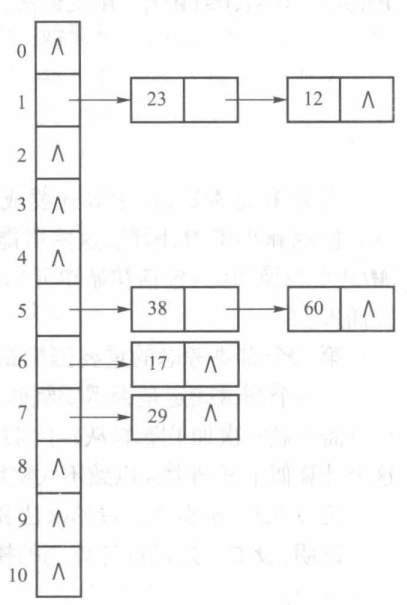
将具有相同散列地址的碰撞结点存储在一个单链表中,散列表中的 \(k\) 号单元保存的是指向散列地址同为 \(k\) 的链表的第一个结点的地址。
#include "9-1-dynamicSearchTable.h"
#include <bits/stdc++.h>
using namespace std;

template <class KEY, class OTHER>
class openHashTable : public dynamicSearchTable<KEY, OTHER>
{
    private:
        struct node
        {
            SET<KEY, OTHER> data;
            node *next;

            node(const SET<KEY, OTHER> &d, node *n = NULL)
            {
                data = d;
                next = n;
            }
            node()
            {
                next = NULL;
            }
        };

        node **array;//指针数组
        int size;
        int (*key)(const KEY &x);//函数指针
        static int defaultKey(const int &x)
        {
            return x;
        }
    public:
        openHashTable(int length = 101, int (*f)(const KEY &x) = defaultKey);
        ~openHashTable();
        SET<KEY, OTHER> *find(const KEY &x) const;
        void insert(const SET<KEY, OTHER> &x);
        void remove(const KEY &x);
};

template <class KEY, class OTHER>
openHashTable<KEY, OTHER>::openHashTable(int length, int (*f)(const KEY &x))
{
    size = length;
    array = new node*[size];
    key = f;
    for (int i = 0; i < size; i++) array[i] = NULL;
}

template <class KEY, class OTHER>
openHashTable<KEY, OTHER>::~openHashTable()
{
    node *p, *q;
    for (int i = 0; i < size; i++)
    {
        p = array[i];
        while (p != NULL)
        {
            q = p->next;
            delete p;
            p = q;
        }
    }
    delete []array;
}

template <class KEY, class OTHER>
SET<KEY, OTHER> *openHashTable<KEY, OTHER>::find(const KEY &x) const
{
    int pos;
    node *p;
    pos = key(x) % size;
    p = array[pos];
    while (p != NULL && p->data.key != x) p = p->next;
    if (p == NULL) return NULL;
    else return (SET<KEY, OTHER> *)p;
}

template <class KEY, class OTHER>
void openHashTable<KEY, OTHER>::insert(const SET<KEY, OTHER> &x)
{
    int pos;
    node *p;
    pos = key(x.key) % size;
    p = array[pos];
    array[pos] = new node(x, array[pos]);
}

template <class KEY, class OTHER>
void openHashTable<KEY, OTHER>::remove(const KEY &x)
{
    int pos;
    node *p, *q;
    pos = key(x) % size;
    if (array[pos] == NULL) return;
    p = array[pos];
    if (array[pos]->data.key == x)
    {
        array[pos] = p->next;
        delete p;
        return;
    }
    while (p->next != NULL && p->next->data.key != x) p = p->next;
    if (p->next != NULL)
    {
        q = p->next;
        p->next = q->next;
        delete q;
    }
}